Zsolt Varga, student Master of Development and Rural Innovation, made a video blog about his MSc-thesis research to what extend people in rural Hungary still grow their own food.

Zsolt Varga, student Master of Development and Rural Innovation, made a video blog about his MSc-thesis research to what extend people in rural Hungary still grow their own food.
As part of the perfect storm seminar series at the University of Edinburgh, Dr Jessica Duncan gave a seminar about civil society participation in the global governance of food security on the 26th of January. ‘The Perfect Storm Scholars‘ interviewed her afterwards and posted a podcast that resulted of this interview on their blog.
As part of the perfect storm seminar series (see poster), Dr Jessica Duncan, Assistant Professor in Rural Sociology at Wageningen University, The Netherlands, gave a seminar about civil society participation in the global governance of food security on the 26th of January at the University of Edinburgh.
She kindly made the time to talk to me about her seminar and research when she was in Edinburgh. You can find the result of this conversation in a podcast. Click HERE to listen to it.
Podcast structure
We talk about her seminar and research until around 24:40 min. From that point onwards we discuss the practical dynamics of undertaking empirical research in general, and specifically on global governance. At 30:00 min Dr. Duncan shares her views on interdisciplinary research.
Podcast notes:
You can find out more about Jessica’s research in her latest book: Global Food Security Governance: Civil society engagement in the reformed Committee…
View original post 229 more words
By Tian Yu, a PhD candidate at Wageningen University, who’s research focusses on organic farming and rural development.
Since the ecological movement came into being in the sixties, organic farming has kept on developing and now has a history of half century in the Netherlands. Today’s organic farm is different from what it was in the beginning. Some ‘modern elements’ have been added, but the underlying social and environmental principles are still the same.
After doing some readings and interviews about organic farm in the Netherlands, I finally got the chance to experience a real, tangible Dutch organic farm. The farm I visited is located in the famous Dutch ‘polders’ in the Flevoland province, and produces mainly vegetables. It has 75 hectares of land, which is bigger than the average organic farm in Holland. Even though it has no plants or work in the field during wintertime, still I have experienced and seen a lot, especially regarding energy- and labour use on the farm. It’s easy to notice at first that some fuel-based and electricity-based machines were used for planting, harvesting and washing vegetables, which is kind of out of my imagination. But also the so-called new energy – solar energy and methane – are used here.


 February 12 and 13 the 2nd Food Otherwise conference takes place in the Orion building of Wageningen University. The first Food Otherwise Conference took place in 2014 and has been an overwhelming success with 800 participants and full of spirit to make a difference. The Food Otherwise conference is supported by many organisations that published the Foods Otherwise manifesto: Towards fair and sustainable food and agriculture systems.
Next to the plenary programme there will be 60 workshops in four parallel sessions on four themes: 1. Agroecology, soil & permaculture; 2. Short chains and urban farming; 3. Fair agriculture and trade policies; 4. Access to land and land rights. You can download the full programme and guidelines on how to register yourself. There is a special programme for kids, so you can take them along.
The plenary programme offers inspiring key note speakers from home and abroad: e.g. Irene Cardoso (Chair of the Brazilian Agroecology Association, Professor of Soil Science), Jyoti Fernandes (farmer and member of La Via Campesina Europe), Sieta Keimpema (Dutch Dairymen Board), Jonathan Karpathios (Greek- Dutch chef, food blogger and gardener), Olivier De Schutter (IPES-Food), Jocelyn Parot (Urgenci), Maryam Rahmanian (FAO) and Jan Douwe van der Ploeg (Wageningen University).
Reclaim the Seeds is a special co-event on Saturday, from 10.00-17.00 in the Forum building.
The Rural Sociology Group supports the Food Otherwise Conference. Jan Douwe van der Ploeg (professor Transition Studies) contributes on Saturday with an overall reflection and convenes a workshop on ‘Gebiedscooperaties: zelfsturing en autonomie’ with speakers from the Northern Frisian Woodlands and Province of Friesland.
Call for papers for the Yearbook of Women’s History (2016)
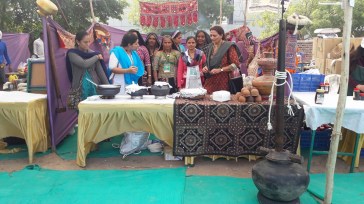
Pastoralist women at traditional food fair in Gujarat, India (photo credit: MARAG)
Gendered food practices from seed to waste
Guest editors: Bettina Bock and Jessica Duncan
About the Yearbook
The Yearbook of Women’s History is a peer-reviewed academic annual covering all aspects of gender connected with historical research throughout the world. It has a respectable history in itself, reporting on issues concerning women and gender for 35 years. The Yearbook has addressed topics such as women and crime, women and war, and gender, ethnicity and (post)colonialism. Overtime the Yearbook has shifted focus from purely historical analysis to a broader historical and gender analysis, focused on women’s and men’s roles in society. By focusing on specific themes, the Yearbook aspires that each issue crosses cultures and historical time periods, while offering readers the opportunity to compare perspectives within each volume. There has been one previous issue related to food: Gender and Nurture (1999). The present volume is a follow-up and aims to testify to differences in scholarly approaches in this field since the 1990s.
About the Annual Issue
In nearly all societies gender has been and continues to be central in defining roles and responsibilities around food production, manufacturing, provisioning, eating, and disposal. Food–related work and practices along with context and cultures serve to construct and reinforce identities and social structures. At the same time, the gendered practices around food are complex and often contradictory. Much of the literature on gender and food explores these complexities and contradictions but continues to make use of dichotomies (i.e., rural/urban; local/global; producer/consumer; large-scale/small-scale; man/woman; past/future) that are increasingly less suited to critical analyses of the fluidity of experiences and science and thus limit our ability to better understand relationships between food and gender.

 Rural Sociology Wageningen University