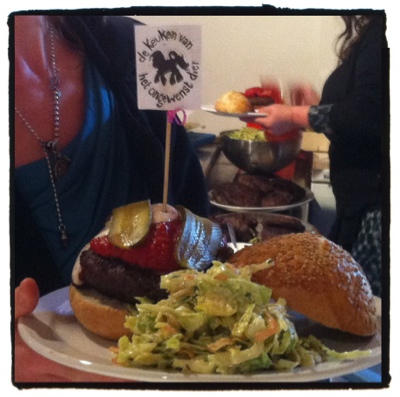
(Un)accepted Foods – Lectures, discussion and tasting on April 8

Join RUW at the ‘(Un)accepted Foods’ evening and learn more about the potential of insects as food and about eating unconventional food products like horse and goose meat. Find out why responses to such food items can be so strong and how attitudes towards them differ across cultures. And how about challenging your own food habits at the tasting?

Contributions by:

  • Jessica Duncan: Lecturer in Food Cultures and Food Policy at Rural Sociology Group of Wageningen University
  • Arnold van Huis: Author of ‘The insect cookbook’, researcher at the Entomology department (WUR)
  • Rob Hagenouw: Keuken van het Ongewenst Dier (Kitchen of the Unwanted Animal)

Venue: April 8, 19.00-21.00 in the public libary of Wageningen (BBLTHK), free entrance.

For more information see: www.stichtingruw.nl or the Facebook page (Un)accepted food.

Theoretical approaches to the ecologisation of agrifood systems – European Society of Rural Sociology 2014 Summerschool

Transitions towards more sustainable agrifood systems and rural landscapes are at the core of societal demands, technological but also social innovations and renewed public policies at various scales. In rural sociology they are addressed through different theoretical frameworks and the main objective of the ESRS PhD Summer School this year, is to discuss these competing and sometimes articulated frameworks and thereby to help the PhD students to clarify their own theoretical choices and to position them in relation to other theoretical frameworks that are used in rural sociology. For students who are rather at the beginning of their PhD, the aim will be to help them organize their state of the art and clarify their problematisation, while for students who are more advanced, it would rather be a discussion of their results in the light of existing literature and/or possibly the preparation of a future article. All the participants should have an interest in the theoretical frameworks that will be structuring the discussion, i.e. mainly Socio-Ecological Systems/Resilience theories, Food Regime Theory, Transition Theories, Actor Network Theory, and Social Studies of Science and Knowledge. Continue reading

Food security in an urbanizing society

Professor Han Wiskerke will be participating in a very interesting and innovative course about food security in an urbanizing society. The course is being offered by Wageningen University’s  Centre for Development Innovation and will take place 2 June 2014 until Fri 13 June 2014.

Course objectives

  • understand the basic premises of the metropolitan food cluster, sub-sector and spatial planning approaches , and how these can be integrated to ensure nutritious food to all strata of rural and urban communities;
  • be able to understand and intervene in complex rural-urban planning processes from an integrated, holistic and multi-stakeholder perspective;
  • have strengthened skills to develop and facilitate multi-stakeholder processes.

Target audience

Participants need to have several years of professional work experience in one of the following fields: rural and/or urban planning, local sub-sector, agribusiness cluster development and/or spatial planning, rural/urban livelihoods governance, sustainable development or other relevant areas. Proficiency in English is a must.

For more information, see: https://www.wageningenur.nl/en/show/CDIcourse_Food_security_in_an_urbanizing_society_2014.htm 

Continue reading

“Sugar in Dutch foods throughout the years” – MSc-thesis possibility with Rural Sociology and Food Technology

Sugar in Dutch foods throughout the years: proposal for a Rural Sociology Master’s Thesis supervised by dr Jessica Duncan of the Rural Sociology Group and dr ir Ralf Hartemink of the Food Technology Group of Wageningen University.

Note: the research question is proposed by Knowledge Centre for Sugar & Nutrition (Kenniscentrum suiker & voeding). They will review the thesis and potentially use findings to develop a fact sheet on the history of sugar use in the Netherlands.

Research context and problem:

Today, it is not uncommon to read warning of the impacts of increasing amounts of sugars being added foods and drinks and thus increasing sugar intake by consumers. But is this the case in the Netherlands? Are Dutch people using more sugar in their cooking? Are they consuming more sugar in ready-made products? Has the sugar content in these products increased over the years? If so, by how much and why? In order to establish an overview of trends in sugar use in some typical Dutch products the researcher will:

  1. Research and map sugar trends in foods and drinks throughout the years (both domestic cooking and industrially prepared foods);
  2. Research the functionalities of sugar in a variety of products in the context of the trends.
  3. Analyse the  social and technological drivers and implications of the trends

Continue reading

Food Tank: Five Ways to Change the Food System

About the Food Tank:

Our food system is broken. Some people don’t have enough food, while others are eating too much. There’s only one way to fix this problem—and it starts with you and me.

Food Tank: The Food Think Tank is for the 7 billion people who have to eat every day. We will offer solutions and environmentally sustainable ways of alleviating hunger, obesity, and poverty by creating a network of connections and information for all of us to consume and share. Food Tank is for farmers and producers, policy makers and government leaders, researchers and scientists, academics and journalists, and the funding and donor communities to collaborate on providing sustainable solutions for our most pressing environmental and social problems.

As much as we need new thinking on global food system issues, we also need new doing. Around the world, people and organizations have developed innovative, on-the-ground solutions to the most pressing issues in food and agriculture. Through years of field visits (and years of trying to eat better in her own community) our President Danielle Nierenberg has helped to highlight and promote these best practices. Today, we hope to bridge the domestic and global food issues by highlighting how hunger, obesity, climate change, unemployment, and other problems can be solved by more research and investment in sustainable agriculture.

Food Tank will highlight hope and success in agriculture. We will feature innovative ideas that are already working on the ground, in cities, in kitchens, in fields and in laboratories. These innovations need more attention, more research, and ultimately more funding to be replicated and scaled-up. And that is where we need you. We all need to work together to find solutions that nourish ourselves and protect the planet.

See the clip how the food systems can be changed in the five ways: