Traditional Foods at IP Romania (6) Student reflection

Four previous blogs reported on the Intensive Program on Traditional Foods in Romania which took place during the first weeks of February. Students who participated reflect on their experiences.

Written by Hylke Sibtsen

While watching the airplanes departing from Schiphol airport take-off from a runway with perfectly white lanes of snow on either side I wondered what the IP in Cluj-Napoca Romania would bring. Besides a little bit of information concerning the topic, “Microbes and traditional foods: competitors or allies?”, and that each participating country would present several traditional products of their country or region, I didn’t know what to expect from the IP.

Continue reading

Traditional Foods at IP Romania (5) Student reflection

Four previous blogs reported on the Intensive Program on Traditional Foods in Romania which took place during the first weeks of February. Students who participated reflect on their experiences.

Written by Cho-Ye Yuen

picture: Stefanos Nastis - Valea Draganului

Not knowing what to expect, we arrived in Cluj-Napoca, where it was minus 15 degrees during the day and minus 20 during the night and everywhere was covered with snow. The first day started off well, students from different countries brought their own traditional food and held a presentations about it. Afterwards there was this big tasting where we enjoyed parmigiano reggiano aged 12 and 48 months, French saucisson, different kinds of cheeses and cakes, smoked bacon and off course accompanied by some drinks: strong liquors from Poland and Romania such as plum brandy. The next day was more serious and started with lectures from professors all over Europe. Assignments were given and working in groups with different nationalities was not unfamiliar when you come from Wageningen.

Continue reading

Factoren die beleving van maaltijd bereid uit lokale producten beïnvloeden – MSc-thesis onderzoek

Door Marina van Maanen,  MSc-studente Gezondheid en Maatschappij

Lokaal betrokken en streekproducten staan steeds vaker op het menu van zorginstellingen. Waar eerder een trend was van steeds meer geïndustrialiseerde maaltijden als gevolg van kostenbesparingen, lijkt nu de ambachtelijke maaltijd terrein te winnen. Er zijn veronderstellingen dat een maaltijd op basis van lokaal betrokken en streekproducten een toegevoegde waarde kan hebben op de maaltijdbeleving en gezondheid van ouderen in zorginstellingen. Hier is echter (nog) geen wetenschappelijk bewijs voor.

Doel van mijn thesis onderzoek was daarom een verkenning van de mogelijke relatie tussen een maaltijd op basis van lokaal betrokken producten, maaltijdbeleving en kwaliteit van leven in een zorginstelling. Hier doe ik verslag van in mijn MSc-thesis getiteld:  Beleving van de maaltijd bereid uit lokaal betrokken producten in zorginstelling Joris Zorg.

Om deze vragen te onderzoeken heb ik een casestudy gedaan in zorginstelling Joris Zorg in Oirschot. Binnen Joris zorg worden op dit moment al maaltijden geserveerd op basis van lokaal betrokken en streekproducten. Binnen de casestudy heb ik interviews gedaan met bewoners, gastvrouwen in het restaurant, de koks en met vrijwilligers. Ook heb ik op verschillende dagen meegegeten en geholpen met het afruimen van de tafels. Opvallend was dat bewoners niet of nauwelijks op de hoogte waren van de herkomst van hun maaltijden. Ook waren bewoners niet bekend met termen als lokaal of streek. Dit maakte het doen van ‘gewone interviews’ lastig. Als een ‘verbeterde’ interview methode heb ik een vragenlijst ontwikkeld op basis van een menukaart, waarmee meer waardevolle informatie werd verzameld. Reden hiervoor is waarschijnlijk dat deze vragenlijst beter aansloot bij de belevingswereld van ouderen in zorginstelling Joris Zorg.
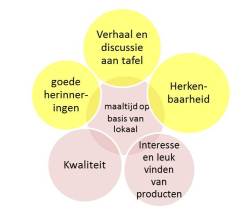
Maaltijdbeleving in Joris Zorg: uitkomst na proef met menukaart

Het verband tussen de maaltijd en kwaliteit van leven zoals verondersteld door literatuur, heb ik niet kunnen bevestigen op basis van mijn onderzoek. Kwaliteit van leven binnen Joris Zorg wordt voornamelijk geassocieerd met verzorging, rust en georganiseerde activiteiten. Wat de maaltijd aangenaam maakt en wat factoren zijn die bijdragen aan de maaltijdbeleving zijn: de juiste bereiding van de maaltijd, sociale factoren van de maaltijd, maaltijdsamenstelling en de versheid van producten. De toegevoegde waarde van het gebruiken van lokaal betrokken producten voor de maaltijd zit nu voornamelijk in de kwaliteit van deze producten en de interesse en het leuk vinden van deze producten in de Week van de Smaak. Wat zeer opvallend is, is dat bewoners buiten de Week van de Smaak niet of nauwelijks op de hoogte zijn van de lokaal betrokken achtergrond van de maaltijd. Uit de menukaartjesproef komt naar voren dat wanneer bewoners wel op de hoogte zijn, dit kan leiden tot goede herinneringen, verhaal en discussie aan tafel en herkenbaarheid. Dit kan een zeker een toegevoegde waarde zijn voor de maaltijdbeleving.

Aanbeveling voor Joris Zorg is dan ook om meer/beter te communiceren naar bewoners over de achtergrond van de maaltijd. Dat kan bijvoorbeeld in de vorm van een nieuwe menukaart (deze heb ik ondertussen samen met het keukenteam ontworpen). Aanbeveling voor vervolgonderzoek is het gebruiken van onderzoeksmethoden welke aansluiten bij de belevingswereld van ouderen. Met als voorbeeld in dit onderzoek de menukaartjesproef.

New book – Sustainable Food Planning: Evolving Theory and Practice

Half the world’s population is now urbanised and cities are assuming a larger role in debates about the security and sustainability of the global food system. Hence, planning for sustainable food production and consumption is becoming an increasingly important issue for planners, policymakers, designers, farmers, suppliers, activists, business and scientists alike. The rapid growth of the food planning movement owes much to the unique multi-functional character of food systems. In the wider contexts of global climate change, resource depletion, a burgeoning world population, competing food production systems and diet-related public health concerns, new paradigms for urban and regional planning capable of supporting sustainable and equitable food systems are urgently needed. This book addresses this urgent need. By working at a range of scales and with a variety of practical and theoretical models, this book reviews and elaborates definitions of sustainable food systems, and begins to define ways of achieving them. Four different themes have been defined as entry-points into the discussion of ‘sustainable food planning’. These are (1) urban food governance, (2) integrating health, environment and society, (3) urban agriculture (4) planning and design. Continue reading

How to feed our cities in the future?

Thursday 5 April, 19-21
Reception (from 5 pm) with dinner at Stroom Den Haag (Hogewal 1-9, The Hague)

Location Tribunal: ISS, Kortenaerkade 12, The Hague
Information and tickets: www.stroom.nl

Today’s food system is in the line of fire. The advocates of an industrial food production coupled with a global economy are diametrically opposed to the supporters of local and ecological farming. Both parties defend their views with an almost religious belief. But the future of food is also the future of mankind.

Stroom Den Haag brings the two opposing parties together and into court. Experts from various fields and from different generations (from farmers to philosophers, from retailers to architects, from scientists to activists, from policymakers to politicians) will present their views on how to feed our cities in the future. Starting point is a threesome of visionary scenarios developed by artists/architects in connection with Stroom Den Haag’s ‘Foodprint’ program: Park Supermarket, City Pig and Foodscape Schilderswijk.

The tribunal concludes with a closing manifesto by a jury, stating how we can develop a sustainable food system for the city of the future. This manifesto will be published on the Stroom website and will be sent to all stakeholders. The setup of the food tribunal is in keeping with The Hague’s international profile as the City of Peace and Justice.