Eating insects; moral pressure and fashion

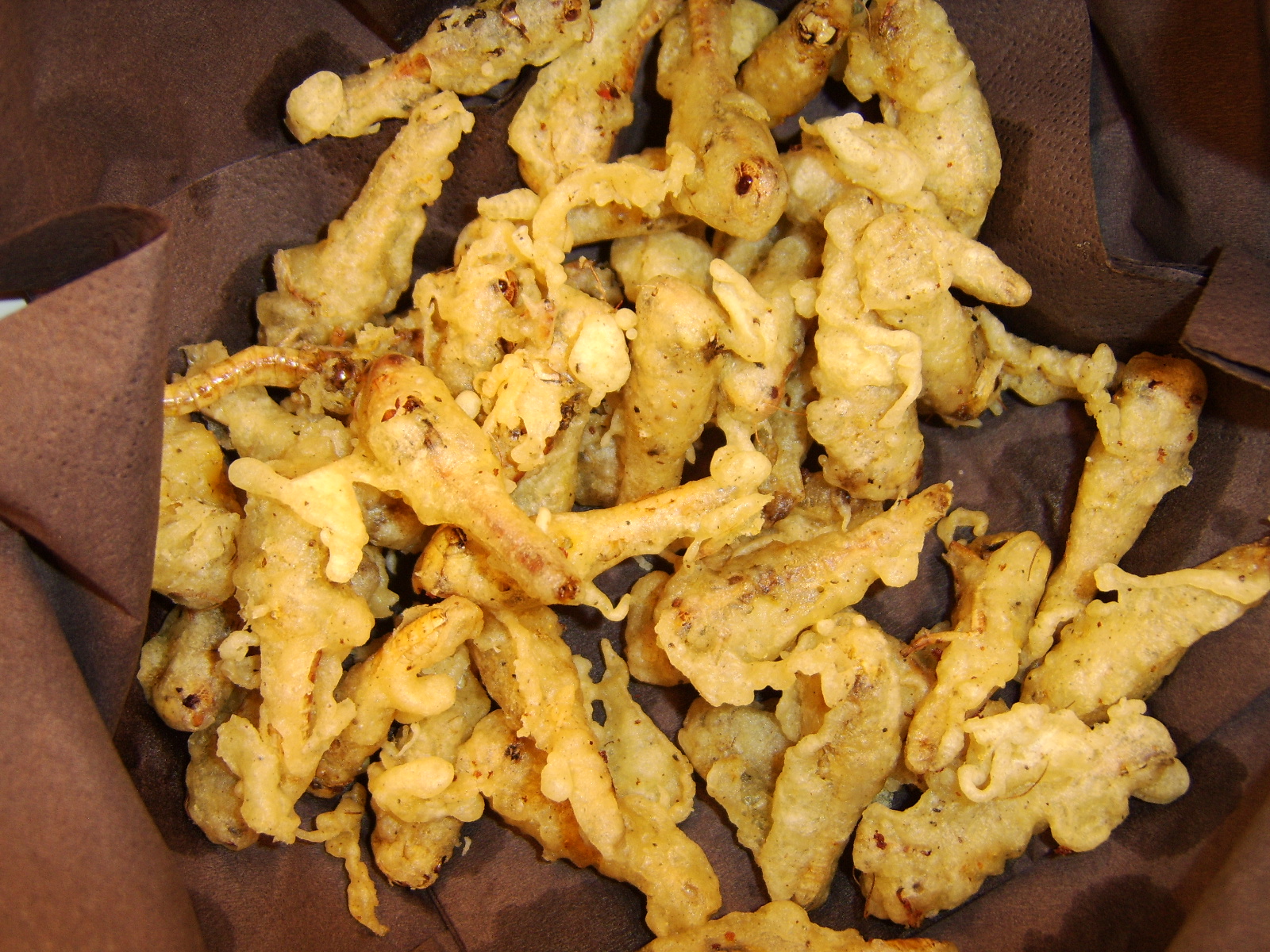
Trying to change ‘Ick’ into ‘Yum’” is the heading of an article in the NY Times on how the Dutch are preparing their homeland market for insect food. The article is referring to the research done at Wageningen University on insects as food and Dutch government efforts to facilitate the insect breeding sector. Wholesaler Sligro sells insects, such as mealworms or locusts, mostly to restaurants. Will insects soon be in the supermarket? ‘Market penetration’ is certainly an ambition of the insect-as-food protagonists in the Netherlands. It seems, after decades in the margins, that momentum is building up for large scale introduction (see also this coming debate).

jasonfking.com

Not too many respondents had an ‘Ick’ reaction much to the surprise of the students of the Food Culture course. They found a remarkably high rate of respondents who were willing to try (60%). The respondents, mainly fellow students, often referred to the expected protein scarcity in the future and the environmental devastation associated with current livestock production. How to feed the world? Moral pressure by environmental consciousness may be an important factor in the willingness to accept insects as food. Another factor, which, at least in theory, should help consumer acceptance is to construct trendiness around eating insects. If Angelina Jolie is eating insects, we of course, cannot stay behind…where is the Dutch role model?

Working group at 24th ESRS congress in Chania, Greece 22-25 August 2011: Call for papers

Imre Kovách ( Institute for Political Science of the Hungarian Academy of Sciences, Budapest), Petra Derkzen and I are organising a working group on “the governance of semi-subsistent food and farming strategies in the countryside and city- a compartive perspective” at the 24th ESRS congress in Chania (Greece) from 22-25 of August 2011. We would like to invite all interested researchers to submit their papers dealing with empirical or theoretical reflections on the driving forces, structure and mechanisms of semisubsistence food and farming strategies in the countryside and-or cities, both within developed and developing countries. Abstracts may be submitted  to Imre Kovach (ikovach@mtapti.hu) AND chania2011@agr.unipi.it until the 30th of April 2011.  For a more detailed description of the workshop please read further…

Courtesy of European Forum on Nature Conservation and Pastoralism

Continue reading

The kids menu and the industrialised palate

`It is entirely possible to have a thriving restaurant trade and a bankrupt food culture at one and the same time´

writes Carolyn Steel in her book Hungry City p239. It seems to me that this observation holds true for Dutch food culture too, from the fieldwork that students did during the course food culture at the foreign cuisine restaurants in Wageningen (see earlier blog).

Carolyn Steel gave two guest lectures during the course where she focused on the Chapters Kitchen and Table. American fast food companies and the wider fast food rationalities easily rolled over Britain as they rolled over the Netherlands in stark contrast to the resistance it met in France or Italy. With little gastronomic heritage to defend we developed an industrial palate, characterised by processed rather than fresh, by heavy reliance on meat and by spicing down to salt and sugar while adding thick sauces to cover up.

We discussed the existence of special kids menu´s which most of the restaurants had, sometimes with Disney names. There were other signs of adaptations. Schnitzel with french fries at the Greek, bread with melted cheese at the Turkish and salmon with sauce at the Spanish restaurant are among the examples of non-ethnic choices available. All restaurant owners felt compelled to offer these choices in order to keep their customer base happy, thus the kids menu ends up with a frikandel and french fries.

Equally, the plethora of cooking programs and celebrity chefs is sure sign that the food culture at large became alienated from the value and intimacy of food and cooking. Carolyn but also others, such as Revel in The Taste Culture Reader, argue that professional and domestic cooking should be related.

 `Where food cultures remain strong professional and domestic cookery can co-exist in a mutually beneficial relationship’.  This allows for maintaining ´´vertical´ cuisines, in which different levels of cookery (rustic, regional, amateur and professional) continue to inform one another` (p238/239).

In weak food cultures, however, restaurants become a substitute for cooking. We want to be entertained based on a vague idea of ´otherness´. And the food? Oo yeah, it was okay.

Carolyn’s book Hungry City has been translated to Dutch as De Hongerige Stad published by NAi publications  and will be presented on various locations between 15th and 17th of March

Foreign cuisines and authentic Dutch experiences

Toledo Wageningen

Going to a regular foreign cuisine restaurant in the Netherlands can be called an authentic Dutch experience since these restaurants often represent a Dutch interpretation of a foreign cuisine. That at least, is my conclusion from the fieldwork the students did among the many foreign cuisine restaurants in Wageningen.

Authenticity can be created in various ways, by the language on the menu or as welcomed by the host, by the music, the interior and of course by the dishes themselves. However, it is mainly here where most adaptation takes place to the Dutch palate. We learned that authenticity is a social construction in which the initiator meets the expectations of a customer base. If they both agree a certain idea of authenticity can be maintained. In the judgement about authenticity knowledge is needed, different ‘capitals’ according to Bourdieu. ‘Capitals’ to be able to distinguish oneself or to judge a good distinction. Of course, the Dutch often lack a deep knowledge and experience with the culture of the foreign cuisine; they miss the cultural capital to judge between ‘authentic’ and ‘authentic’. It is the tourist gaze, which works similar to foreigners visiting the ‘Zaanse Schans’ or the like.

A good illustration of this mechanism is that some restaurants make special dishes which are not part of the menu but can be asked for – only if you know. Hence the Chinese restaurants serve Babi Pangang or Foe Young Hai to their Dutch customers, which are not Chinese but Indonesian dishes and cook on demand for the Chinese guests.

Even the car-booth sales on the campus of the university makes a distinction between Chinese and other students. A Chinese student in class found out, when she accidentally ordered in the English language, that she got something different from normal.

Indeed, for an analysis of foreign cuisine restaurants in the Netherlands it may be more important to look at the history of how the particular restaurant-type came into existence in the Dutch context than to make a comparison with the national cuisines they are supposed to stem from. This is brilliantly explained by Jennifer Lee in this Ted Talk.

Insect food acceptance; a Wageningen bias?

Last week, students of the Food Culture Course conducted fieldwork on how people relate to the eating of insects or insect protein. To our surprise, many more respondents were open to the idea of eating insects or food with insect protein than expected. As I wrote earlier, insects are generally not seen as part of the category ‘food’ in Western societies. Hence, putting forward the option of eating insects to people who never considered this as a food item can instigate a disgust reaction which in turn can be seen to illustrate an unconscious taboo.

Disgust, as we learned from Rozin and Fallon has its roots in our mind, in wider ideas connected to the item which lead to the assumption that therefore the item will taste bad/is dangerous/should be avoided. Disgust can be observed by the facial expression of people as well as by choking or vomiting reactions. It is often impossible for a disgusted person to tell the precise reason for the disgust reaction, other than that the ‘idea’ is not right.

Students did find disgusted reactions in people’s facial expressions and in the difficulty people had to reason about what made it disgusting. However, 60% of the 111 (mainly student-)respondents were found to be open to the eating of insects, or insect protein in processed food. In their reports, students concluded that this high willingness to try may be related to that we are in Wageningen (not a ‘normal’ place), in 2006 briefly ‘City of Insects’ with also currently lots of research on insect protein and a student population who is exposed to the ‘life science’ issues in current debates.

Awareness of environmental degradation related to meat production and future scarcity of animal protein were among the often mentioned reasons why many student-respondents were open to the idea of eating insects. Those who expressed disgust had some typical reactions close to what was described in the literature for this week. For example, the problem of categorisation which Mary Douglas writes about. Is an insect indeed an animal and hence meat? Or where does it belong in the food categories we routinely employ? Confusion over categorisation – insects as anomaly not fitting a particular category – was mentioned alongside disgusted reactions of those respondents.

Also the ‘law of sympathetic magic’ may have played a role in people’s disgust reactions, which means that an item is contaminated by negative associations. For example (some) insects sit on manure, therefore insects are dirty and cannot be eaten. No real conclusions can be drawn on such a small and specific interview-population, however, given the surprising openness, we may once belong to the 3000 ethnic groups in 113 countries all over the world who regard insects as delicacies.