75th Anniversary: 37) Pre-announcement: PhD Course Agrarian and Food Citizenship, May 6–13, 2022

Introduction

We are delighted to announce our PhD course on agrarian and food citizenship. The course gives participants an opportunity to intensively engage with some of the major debates and approaches on the democratization of our agricultural and food systems so that they can continue to explore and expand these in their own research. The course is organized as a one-week intensive discussion seminar in the week of our 75th anniversary celebration

Agrarian and Food Citizenship

Rooted in a shared belief that our agricultural and food system has produced unsustainable social and environmental cleavages, social movements like Via Campesina have called for the right of people to define their agricultural and food practices. At the same time, various initiatives have emerged that bring this principle into practice. Instead of assuming our relationship to agriculture and food to be that of a consumer making individual decisions in the marketplace, these movements and initiatives have focused on how we organize our agriculture and food practices, and how this can be done different. The aim of this course is to investigate the shift away from a consumerist perspective in which we shop our way to a better agricultural and food system (”vote with our fork”) and towards a citizenship perspective based on the right to have a say in, as well as actively shape, our agriculture and food system. Applying a citizenship lens to an understanding of how our agriculture and food system are organized implies a consideration of the power-relations and identities concealed. In addition, is raises the question how to understand “citizenship”? Various scholars (Isin and Nielsen 2008, Wittman 2009, Carolan 2017) have argued that citizenship is not a formal status, and that people establish themselves as citizens by enacting rights. In this course we will consider agrarian an food citizenship from this perspective of “citizenship acts”.

Target Group and Min/Max Number of Participants

This course is intended for students doing a research master, PhDs, postdocs, and staff members who want to expand their engagement with the democratization of our agricultural and food practices and the citizenship approach to this. In order to ensure opportunities for full discussions during the sessions, the minimum number of participants is 10 and the maximum 20.

More information about the instructors in this course and registration will follow soon.

References

Carolan, M. (2017). No One Eats Alone: Food as a social enterprise. Washington, Island Press.

Isin, E. and G. Nielsen (2008). Acts of Citizenship. London, Zed Books.

Wittman, H. (2009). “Reframing agrarian citizenship: Land, life and power in Brazil.” Journal of Rural Studies(25): 120-130.
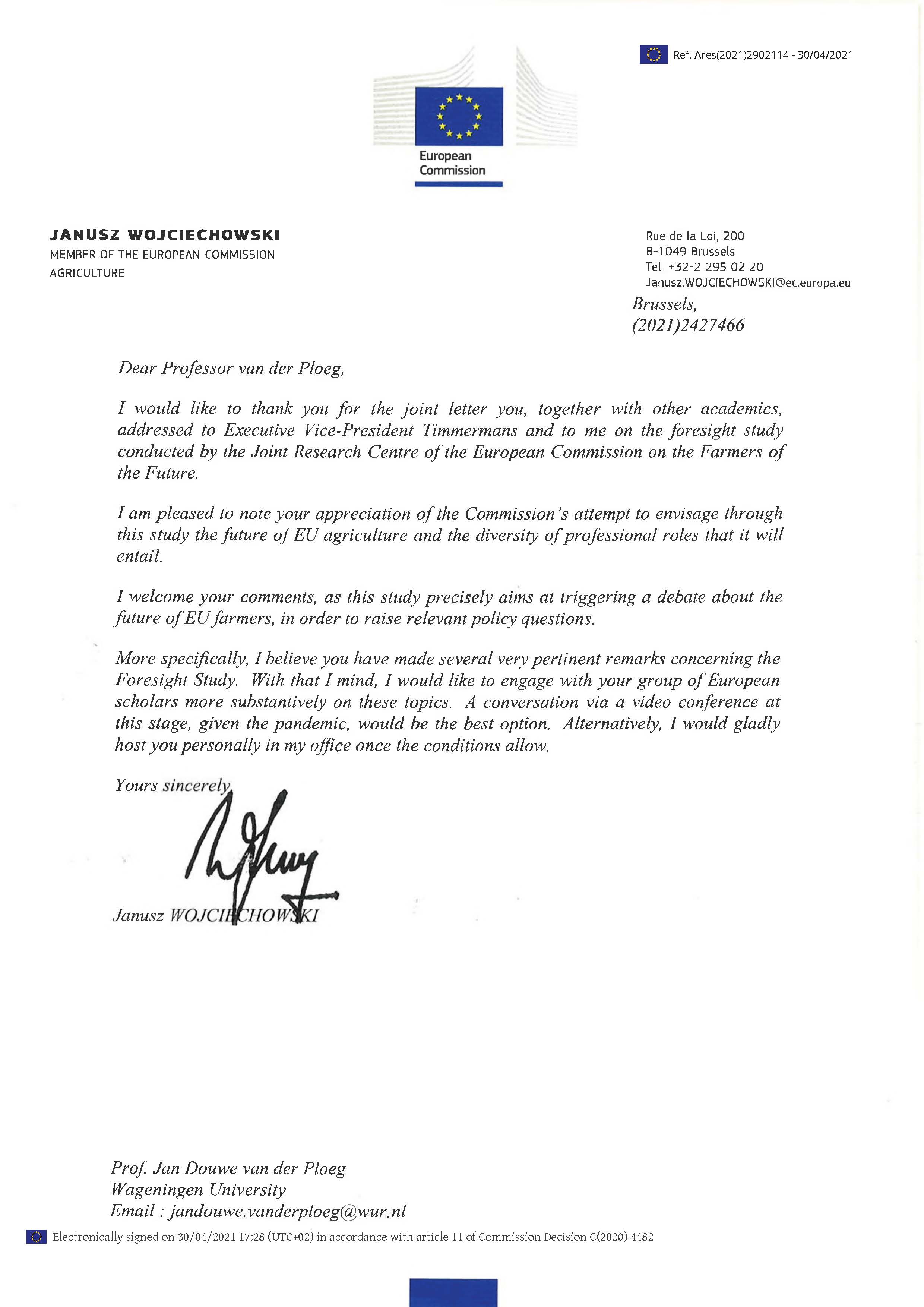
Reply of the European Commission to the Open letter on the EU’s ‘Farmers for the Future’ Report and the Farm to Fork Strategy

On March 11, we published an open letter to Frans Timmermans, Executive Vice-President of the European Commission, Janusz Wojciechowski, European Commissioner for Agriculture, and Norbert Lins, President of COMAGRI of the European Parliament  about the ‘Farmers for the Future’ (EUR 30464 EN) policy report. Signed by many academics from different countries in Europe, the letter wrote: “[W]e observe that ‘Farmers for the Future’ critically fails to make use of, or build upon, Europe’s rich academic tradition of exploring and extrapolating the wide and richly-chequered heterogeneity of its agriculture. We also observe that the report does not offer evidence-based, scientific, support that can contribute to the process of European policy making. Instead, ‘Farmers for the Future’  contains and introduces dangerous biases into the discussions and debates.” See the post: Open letter on the EU’s ‘Farmers for the Future’ Report and the Farm to Fork Strategy | Rural Sociology Wageningen University

In his response to the letter, European Commissioner for Agriculture Janusz Wojciechowski writes “I welcome your comments, as this study precisely aims at triggering a debate about the future of EU farmers, in order to raise relevant policy questions”.

Read the letter here.

75th Anniversary: 27) From farmers in the countryside to urban citizens keeping an apple tree

The blog series celebrating 75 years of Rural Sociology often discusses farming, professional food production or the countryside. Rural Sociology’s research interest is broader than that, however. Over the years attention for urban areas and their eaters – either or not involved in food production – has grown. Hence, staff members of our group have studied urban allotment gardening, urbanites sharing food and making yoghurt, and urban composting. In sum, the city has taken its place next to the countryside as an important research area, and our research is no longer limited to the professional food producer. 

My own research in Almere, conducted in 2019, serves as an illustration. With WUR-colleagues Jan Eelco Jansma, Hans Dagevos and Jan Willem van der Schans, I studied food prosumption in Almere. We defined a prosumer as someone who grows or collects (part of) his/her own food, for instance in a community garden, by growing it in the backyard or by wild foraging. Our goal was to understand the concept in theory and practice and to clarify who is involved in prosumption and what these activities entail. In order to do so we conducted a literature review, interviewed people involved in prosumption as well as experts, and sent out a questionnaire (n=835).

The concept of prosumption fits certain processes we witness in today’s society, including the motivation to take responsibility and to ‘do it yourself’, in order to be less dependent on larger companies. Although the word prosumption is hardly used in the literature, the phenomenon of citizens engaging in food production is studied and described, for instance with regards to the shifting and partly overlapping roles of producers and consumers in Alternative Food Networks.

We were surprised by the number of respondents who are involved in prosumption one way or the other. Two thirds of our questionnaire respondents grow basil in the window sill, harvest their own apples or pick blackberries in the woods. However, the scale in which they do so is only small: the acreage respondents use for prosumption activities is limited, and just a small part of people’s diets results from these activities. Hence, people are much less involved in time-consuming activities as community or allotment gardening than in small-scale activities like having a few plants in the backyard.

We found that motivations to be engaged in food production mainly relate to the fun of gardening. People enjoy being outside and to produce something that they can eat. A few people were motivated by a distrust in the supermarket, health, and sustainability, but these motivations were for most respondents subordinate to the pleasure of engaging in a hobby. We did find that people who are involved in prosumption more often take ethical considerations into account when shopping for groceries, but we couldn’t make any statements regarding causality. 

Despite the limited scale of food prosumption activities as found in our research, the conclusion that a large number of respondents participates at least to some degree in food production, shows that prosumption is something ‘normal’, suggesting that people may not be as far removed from food production as often thought. The next step is to better understand what needs to be done to interest people more for food and the food system, and to connect to their main motivations in order to change the food system to become more sustainable.

See our published paper here and the research report (in Dutch) here.

Open letter on the EU’s ‘Farmers for the Future’ Report and the Farm to Fork Strategy

Open letter of European scholars to (in English, French and Spanish):

  • Frans Timmermans, Executive Vice-President of the European Commission
  • Janusz Wojciechowski, European Commissioner for Agriculture,
  • Norbert Lins, President of COMAGRI of the European Parliament.

Re: ‘Farmers for the Future’

Wageningen, 10th of March 2021

Dear Sirs,

In 2020 the European Commission released ‘Farmers for the Future’ (EUR 30464 EN), a Science for Policy Report, prepared by the Joint Research Centre (JRC) of the European Commission. This policy report is intended to contribute to the further elucidation of the EU’s Farm to Fork Strategy which is a key element of the European Green Deal. It has, at its core, a description of 12 profiles that are attempt to categorize the likely diversity and range of professional farming styles in European agriculture in 2040. The report asks, and tries to respond to, the following question: “ Who will be the key players of the EU next generation agriculture, the farmers of the future?” Continue reading

75th Anniversary: 11) Notes from the field: Agricultural Development in Rojava and Resistance of the Third Kind

Women’s cooperative farm in Rojava (2015)

Introduction

In one of our previous blogs we discussed Van der Ploeg’s concept resistance of the Third Kind (see Anniversary Blog 7). This was defined as a resistance which resides in working practices and farmers’ fields and is expressed in the way that cows are bred, how manure is made, products are delivered. In short, it is a resistance which intervenes in and reorganizes production, reproduction and markets (Van der Ploeg 2007). In this blog, the reconstruction of Kobanî is discussed a resistance of the third kind. Continue reading