Sustainable Food Systems Education and Engagement in Detroit

Recently, in the process of writing an international research proposal, I had an email exchange with Dr. Kami Pothukuchi, Associate Professor in Urban Planning at the College of Liberal Arts and Sciences of Wayne State University. Dr. Pothukuchi is, together with Prof. Jerry Kaufman, one of the founders of food planning in the USA. She was the first to write about food as a stranger to the planning field in 2000 and is one of the authors of “Community and Regional Food Planning: A Policy Guide of the American Planning Association“. This policy guide was a major source of inspiration for organizing the first European Sustainable Food Conference under auspices of the AESOP.

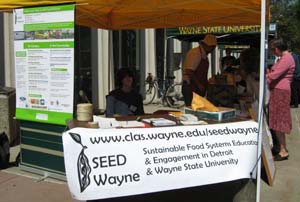
In our email exchange Dr. Pothukuchi informed me that she has recently become director of SEED Wayne. SEED is the acronym for Sustainable food systems Education and Engagement in Detroit. 

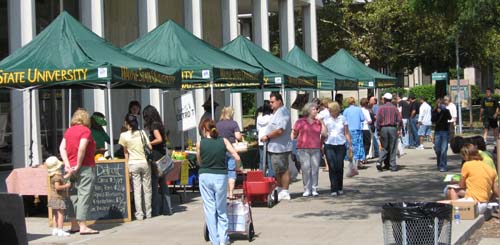
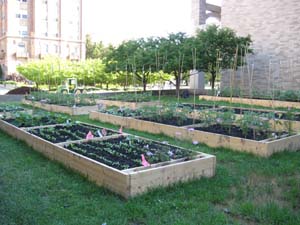
SEED Wayne is dedicated to building sustainable food systems on the campus of Wayne State University and in Detroit communities. SEED Wayne works in partnership with community-based organizations promoting food security, urban agriculture, farm-to-institution, and food and fitness planning and policy development. SEED Wayne embraces core university functions in teaching, research, engagement and operations. 

I think SEED Wayne is a perfect example of the role a university can and should play in enhancing sustainable food systems as well as in creating a learning-by-doing environment for students in which close collaboration with local communities is an intrinsic part of university teaching and research. For those interested in SEED Wayne download the brochure or simply browse SEED Wayne’s website.

Brochure over stadslandbouw van Wageningen UR

Binnen Wageningen UR krijgt stadslandbouw steeds meer aandacht en profiel. In een recente brochure  wordt vanuit Wageningen UR een visie gegeven op het concept stadslandbouw, de betekenis voor de stad, de bijdrage van stadslandbouw aan duurzaamheid en de belangrijkste uitdagingen. Ook beschrijft de brochure een flink aantal lopende en al afgesloten projecten op het gebied van stadslandbouw. Zie voor meer informatie een bericht op de WUR-website (www.syscope.wur.nl)  over onderzoek naar systeeminnovatie die moeten bijdragen aan transtie naar duurzame landbouw en vitaal platteland.

Zoals uit eerdere blogs al is gebleken profileert Rurale Sociologie zich ook op het terrein van stadslandbouw. Zo komt Jan Willem van der Schans (Jan-Willem.vanderschans@wur.nl), werkzaam bij het LEI en mede-initiatiefnemer van Eetbaar Rotterdam, met ingang van 1 december onze groep versterken.

1 Billion Hungry

One billion people live in chronic hunger. In the time it takes to watch this video, two children will die of hunger. If this situation is unacceptable to you, sign on http://www.1billionhungry.org

The Food and Farming Transition: Toward a Post Carbon Food System

More and more scientists are pointing to the fact that the end of the cheap oil era will require us to fundamentally change the prevailing current food and agricultural system; a system that has become addicted to and dependent on fossil fuels. This week I came across a report entitled “The Food and Farming Transition: Toward a Post Carbon Food System” published by the Post Carbon Institute earlier this year.  Although the report focuses on the United States, its contents applies to many other parts of the world as well. In this well accessible and readable report the authors not only point to the key vulnerabilities of a food system resting on an unstable foundation of massive fossil fuel inputs but also to the seeds of transition toward a post carbon food system:

The seeds of the new food system have already been planted. America’s farmers have been reducing their energy use for decades. They are using less fertilizer and pesticide. The number of organic farms, farmers’ markets, and CSA operations is growing rapidly. More people are thinking about where their food comes from.

These are important building blocks, but much remains to be done. Our new food system will require more farmers, smaller and more diversified farms, less processed and packaged food, and less long-distance hauling of food. Governments, communities, businesses, and families each have important parts to play in reinventing a food system that functions with limited renewable energy resources to feed our population for the long term.

Stage opdrachten bij LandMarkt

LandMarkt is een moderne open marktplaats met horeca die de stad en het platteland met elkaar wil verbinden door middel van lekker, lokaal en natuurlijk geproduceerd eten. Consumenten worden in contact gebracht met producenten, producten leveren rechtstreeks aan consumenten – local for local.

Een groep van onderzoekers, kennisinstellingen, financiers en ondernemers zijn actief in het project LandMarkt. Er wordt onder meer onderzoek gedaan naar consumentenwensen, samenwerking in de keten, het duurzaamheidsprofiel van diverse versketens en de planning van het voedselsysteem.

Tevens wordt aan beleidsmakers gevraagd hoe zij rekening houden met de stedelijke voedselvoorziening binnen de ruimtelijke planning. Medio 2010 staat de opening van de eerste LandMarkt gepland.

LandMarkt is op zoek naar studenten die een stage willen lopen bij dit zeer jonge bedrijf. Vragen van LandMarkt die in aanmerking komen zijn onder andere:

1. Het vaststellen van de door LandMarkt te gebruiken products assessment methode : hoe wegen we onze inkoopcriteria en communiceren we deze aan de consument.

 2. Het bepalen van de warenwettelijke- en kwaliteitseisen waarmee we rekening dienen te houden, zowel op product- als winkelvloerniveau

Meer informatie:  Jan Willem van der Schans. 

Email: Jan-Willem.vanderschans@wur.nl