Burgerkracht in krimpend Limburg: master thesis student(en) gezocht

DorpsraadEen Masterthesis in een real life setting, dat is de mogelijkheid die je hier wordt geboden. In het wetenschapswinkelonderzoek ‘Inzicht in burgerkracht in Limburg’ wordt in opdracht van de Vereniging Kleine Kernen Limburg (VKKL) onderzoek gedaan naar de veranderende burgerwensen in Limburg in het licht van de participatieve samenleving. Door haar activiteiten in de haarvaten van de maatschappij signaleert de VKKL een trend naar een samenleving die voorzieningen zelf organiseert en soms ook zelf bekostigt. Burgers wachten niet langer af, maar nemen zelf initiatieven om hun leefomgeving te verbeteren. Binnen alle veranderingen in de Limburgse samenleving heeft vooral ook de demografische ontwikkeling (ontgroening, vergrijzing en krimp) ingrijpende gevolgen voor de leefbaarheid.

De veranderende verhouding tussen burgers en de overheid lijkt steeds meer te draaien om co-creatie. Dit vraagt om een nieuwe attitude bij de overheid én de burger. De vraag die hier centraal staat is hoe die burger hier nu op voorsorteert. Welke ontwikkelingen zien burgers op zich af komen, hoe anticiperen ze hierop en wat hebben ze nodig om die nieuwe rolontwikkeling in te vullen?
De VKKL, nu 10 jaar actief op Dorpsniveau in Limburg, ziet dat er in de praktijk heel verschillend op maatschappelijke transities wordt ingespeeld. Sommige bewoners en gemeenschappen treden daarin heel pro-actief op. Initiatieven als dorpsoverleggen kenmerken zich vaak door een sterke interne drive, samenhang en gemeenschappelijke focus. Andere, meer traditioneel georganiseerde samenwerkingsverbanden als dorpsraden zijn soms nog meer reactief en gericht op ondersteuning van buiten. Soms wordt daardoor vertraagd of onvoldoende ingespeeld op de maatschappelijke ontwikkelingen.
Als jij het leuk vindt om je te verdiepen in de aard van verschillende typen ‘burgerkracht’ in Limburg (stad en/of platteland), in de wijze waarop dergelijke lokale initiatieven in staat- en bereid zijn in te spelen op de maatschappelijke transities en uitdagingen in Limburg als het je interessant lijkt om de ondersteuningsbehoefte die daarbij bestaan vanuit deze initiatieven inzichtelijk te maken neem dan contact met ons op.
Contactpersonen: Bas Braman (bas.breman@wur.nl ) en Jeroen Kruit (jeroen.kruit@wur.nl).
Food security in an urbanizing society

Professor Han Wiskerke will be participating in a very interesting and innovative course about food security in an urbanizing society. The course is being offered by Wageningen University’s  Centre for Development Innovation and will take place 2 June 2014 until Fri 13 June 2014.

Course objectives

  • understand the basic premises of the metropolitan food cluster, sub-sector and spatial planning approaches , and how these can be integrated to ensure nutritious food to all strata of rural and urban communities;
  • be able to understand and intervene in complex rural-urban planning processes from an integrated, holistic and multi-stakeholder perspective;
  • have strengthened skills to develop and facilitate multi-stakeholder processes.

Target audience

Participants need to have several years of professional work experience in one of the following fields: rural and/or urban planning, local sub-sector, agribusiness cluster development and/or spatial planning, rural/urban livelihoods governance, sustainable development or other relevant areas. Proficiency in English is a must.

For more information, see: https://www.wageningenur.nl/en/show/CDIcourse_Food_security_in_an_urbanizing_society_2014.htm 

Continue reading

Life in the Alpujarra (Spain)

YEGEN-53Since the beginning of February my family and I have been in the Alpujarra; south side of the Sierra Nevada in Spain. We are here to experience the rough side of life: being a farmer in a tough arid land. We are trying to get a glimpse of the other side of the food story and feel what it is like to work the land (mainly by hand labour); and give our brain a bit of a rest. But despite the huge amount of physical work we do each day, the mind doesn’t rest. There is just too much going on here: the shrinking and greying villages, the contrast between coastal and hill-side farmers, the young versus the old, the ‘extranjeros’  vs the locals, fighting bush fires vs keeping a varied landscape, organic farmers selling mainstream to the world market, etc etc… I will start by telling you a bit about the village structure here, in Yegen.

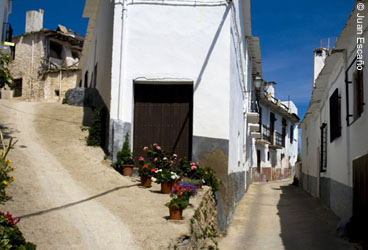
Yegen is a small, typical white Moorish village in the centre of the Alpujarra. It seems just another village, but it is bit more special than all the other white towns. A certain Gerald Brenan (a British self-appointed anthropologist) was already fascinated by the life and customs in this village more than 90 years ago. He experienced Yegen as rather backwards (a way of life that he couldn’t imagine still existed) while at the same time the villagers as being extremely open to new comers. He ended up living in Yegen for about 30 years and produced a very popular book. Unfortunately, I haven’t had the chance to get a hold of a copy but I did discover a 45 minute documentary about Gerald Brenan’s return to the village in 1974 (http://www.youtube.com/watch?v=2JAAYPVsQQ4). Interestingly enough, he talks about the huge progress of the village and the change in customs and traditions, whereas to me – born in the late 1970s – it seems to be a pre-War setting. I couldn’t believe it was actually 1974; the streets were huge irregular stones mixed with sand on which only mules were to be seen, the women washed their clothes in a river, no motorised traffic at all. At the same time, Continue reading

Interested in Food and Place?

Are you interested in the sociological aspects of food provisioning and place-based development and want to know more about topics like place-based food systems, food citizenship, civic food networks, sustainable place-shaping, diverse economies, place branding and social movements? Then it may be a relevant for you to attend the MSc course ‘Sociology of Food Provisioning and Place-based Development’ that starts on Monday 17 March 2014. Lectures and workshops are held on Monday, Wednesday and Friday mornings for a period of 6 weeks. Included in the program is also a gastronomic excursion to rural estate Rhederoord, to experience the practice of place-making and enjoy the taste of place-based food products. Although registration for the course has formally closed you can still register for the course by sending an email to the course coordinator  (han.wiskerke@wur.nl). For more information about the content of the course, the program and the literature, have a look at the Course Guide.

LEADERSHIP MATTERS! Seminar on ‘Leadership in Urban and Regional Development: Debates and New Directions’, 5-6 February 2014, University of Birmingham

This seminar was organised by the ‘Research network on Leadership in Urban and Regional Development, of the Regional Studies Organisation. I have included a summary of the most interesting presentations here, written by Alistair Bowden, Teesside University Business School. For more information, the full report and power-point presentations, please send a mail to lummina.horlings@wur.nl. If you are interested in doing a master thesis on leadership, please contact me as well.

Thirty five enthusiastic academics converged on Park House on the wooded outskirts of the Birmingham University campus on a rainy British morning, but the weather could not dampen spirits. The speakers and discussants were from diverse academic backgrounds (from politics to palaeontology, and from planning to psychology), had varied careers (from a physicist to a field geologist, and from a curator to councillor) and had travelled from disparate locations round the globe (from Auckland to Bishop Auckland, and from Babeş-Bolyai to Birmingham). But we all shared a passion for leadership of place: cities, conurbations, rural areas and regions. Discussing the seminar with a more experienced conference goer on the way back to the station, this mix of disciplines, careers and nationalities, held together by a shared interest in this emerging subfield, was highlighted as the reason for its success: diverse actors and a strange attractor!

John Gibney kicked us off with a brief, considered introduction. This wasn’t going to be an easy conference. We weren’t given the answer at the start. We were going to have to work out ‘what it was all about’ for ourselves.

Our first speaker was Lummina Horlings, who gave a paper on an entrepreneurial rural area just west of Groningen, Netherlands. She was interested in how to enhance collaboration, institutional reform and joint learning to help make a place more resilient. From informal foundations with a small group of visionaries engaging in a pilot project, collective agency emerged through ‘spiral development’ of bottom up initiatives, supporting policy schemes and joint learning by doing. The conclusion was that collaborative leadership played a critical role in enabling success. The discussion explored the motivation(s) to collaborate, the catalytic role of a key actor, the supporting role played by local politicians, the role of the research team and their relationship to the local people.

This was followed Andrew Beer, President of the RSA. Andrew has taken upon himself to try to make sense of leadership of place; to answer the question ‘how do we get beyond case studies?’ But he wasn’t being driven my some esoteric desire for theoretical purity, rather he came across as having a great streak of pragmatism, wanting to do something practical with the growing research on leadership of place.

Continue reading