
Stichting SintJan is een bijzonder particulier initiatief uit Kloosterburen, gemeente De Marne, in de provincie Groningen. Het initiatief SintJan Kloosterburen is voortgekomen uit het traject ‘Korensantoverleg’ (1997-2000) en het ontwikkelen van de dorpsvisie Kloosterburen 2003.
In dit traject zijn burgers met kennis, inzicht en een grote maatschappelijke betrokkenheid bezig hun eigen leefomgeving vorm te geven. Wat SintJan vernieuwend maakt, is de integrale benadering die aan het plan ten grondslag ligt: de initiatiefnemers willen wonen, werken, zorg en cultuur zodanig in Kloosterburen borgen dat de leefbaarheid en vitaliteit van het dorp versterkt wordt.
Dergelijke vitale gemeenschappen en burgerinitiatieven krijgen steeds meer een cruciale rol te vervullen, juist ook in regio’s die te maken hebben met bevolkingsdaling (Breman, 2011). Waar de gemeente De Marne op dit moment nog ongeveer 11.000 inwoners kent, wijzen de prognoses uit dat dit aantal tussen nu en 2040 zal dalen naar ongeveer 8.000 (Gemeente De Marne, 2011a). Daarmee behoort de gemeente tot één van de sterkst krimpende gebieden in Noord Nederland. Behalve een krimpend aantal inwoners leidt dit ook tot een veranderende samenstelling van de bevolking (ontgroening en vergrijzing).
Hoewel het bewustzijn en de erkenning van de meerwaarde van dit soort burgerinitiatieven groeiende is, ook in de gemeente De Marne en de provincie Groningen (zie o.a. de visie op burgerparticipatie, Gemeente De Marne, 2011b) blijken er in de praktijk nog veel valkuilen en obstakels die de doorontwikkeling van burgerinitiatieven in de weg staan.
Wij zijn op zoek naar een student of een groep studenten die aan de slag gaat met ‘het verhaal van Kloosterburen’ in termen van ‘storytelling’ als aanpak. Vragen die daarbij aan de orde komen zijn:
‘Wat is de achtergrond / ontstaansgeschiedenis van dit initiatief?’, Hoe is het de afgelopen jaren verlopen? Wie heeft de kar getrokken op welk moment? (gedeeld leiderschap? , vitale coalities? Etc.), Wat zijn belangrijke mijlpalen of keerpunten. Wat is de spin-off van het initiatief (Wat is tot stand gekomen / bereikt? ) en hoe kijken diverse direct of indirect betrokken hier gedurende de tijd (op wellicht andere wijze) tegen aan?
Category Archives: Thesis and internship possibilities
Interessante afstudeeropdracht in Tilburg
 Tussen Udenhout, Berkel-Enschot en Tilburg Noord ligt de Nieuwe Warande. Het is een open landbouwgebied gelegen te midden van de geplande stedelijke uitbreidingen van de stad Tilburg. De gemeente Tilburg wil de randen van dit gebied gaan bebouwen. Onder leiding van de BMF hebben omwonenden, boeren en andere betrokken partijen in 2009 een visie opgesteld voor de Nieuwe Warande. Stadslandbouw en regionaal voedsel hebben daarbij als inspirerend uitgangspunt gediend. Het gevolg is dat nu ook gemeente Tilburg stadslandbouw hier actief op de kaart wil zetten. Daarmee blijven er economische dragers in het gebied aanwezig. Zij zorgen ervoor dat het gebied open en leefbaar blijft en kan fungeren als uitloopgebied voor omwonenden.
Wij zijn op zoek naar een student of (bij voorkeur) een groep studenten die in beeld brengt welke bedrijven of instanties (denk aan overheden, zorginstellingen, e.d.) interesse hebben in het aanbod van producten uit de regio, bijvoorbeeld ten behoeve van hun catering of als secundaire arbeidsvoorwaarde voor hun personeel. Hiervoor zul je actief contacten moeten leggen en gesprekken voeren met bedrijven in Tilburg. Continue reading
A Sociology of Farm-Level Animal Disease Awareness, Knowledge and Practices – Fully-funded PhD Studentship
We seek to recruit a PhD student who will adopt a qualitative research approach to sociologically explore the nature of land managers’ knowledge, experiences and practices in relation to farm animal diseases in Scotland. The studentship is part of the Centre of Excellence in Epidemiology, Population Health and Disease Control (EPIC) and is funded by the Scottish Government. The studentship will begin 1st October 2012. Continue reading
Request for a master student interested in place, landscape and population
The PeerGrouP is a location-art group that specializes in site-specific theatre and visual arts in the northern provinces of the Netherlands. The PeerGrouP consists of a lively mix of theatre makers and artists who are inspired by the landscape, the location and the local inhabitants. The quality of food, ecology, practical knowledge of the landscape, community spirit and the supply of energy are recurring themes within the PeerGroup’s projects.
The PeerGroup is looking for artists and researchers willing to participate in their P.A.I.R. (Portable Artist in Residence) project. The P.A.I.R.-project promotes artistic social commitment while focusing attention on man and his surroundings. The P.A.I.R. will be visiting three different locations (Veenkoloniën, Donderen, de Wolden) in the north of the Netherlands (Drenthe) to meet local inhabitants and to investigate their surroundings. In the past three years, the PeerGrouP realized three P.A.I.R.-projects every year. In 2012, the P.A.I.R.’s fourth year, the theme is Landscape Population. The landscape and its meanings in relation to the inhabitants and other users will be looked at on different levels.
The Rural Sociology Group and the Peer Group are looking for a (preferably Dutch speaking) master student interested in landscape, place, population and art, who is enthusiastic to do his/her internship or thesis in this site-specific project, starting preferably around August. The student-researcher will actually stay in the P.A.I.R. (see photo) for a while in September, in the area of the Wolden (near Meppel) in the north of the Netherlands, while doing participative research. 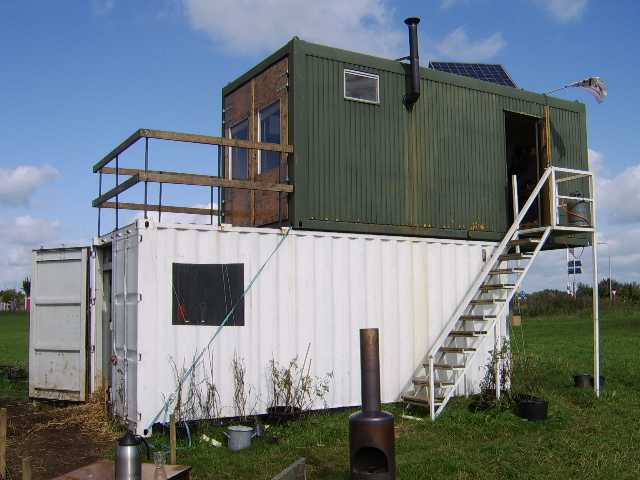
Possible research questions are for example:
– What is ‘sense of place’ for the local population in the Wolden?
– Which meanings to they give to the landscape?
– Do inhabitants experience local identities? Do they have story-lines related the landscape?
– How are meanings, identities and sense of place linked to underlying values of people?
– How can meanings identities and sense of place be translated to recommendations for practice and policy? (people’s participation, community cohesion, networks)
Places are constituted by sedimented social structures and cultural practices, endowed with meaning and the constitution of identities, subjectivities and difference. In other words: culture sits in places. ‘Sense of place’ refers to an individual’s connection with a place (location, building, landscape) and to their experience of place, including different senses (sight, hearing, smell, movement, touch, imagination, purpose and anticipation). It is both individual and inter-subjective, closely connected to community as well as to personal memory and self. Sense of place has many components such as place attachment, place identity, place commitment and dependency, belongingness or rootedness or community connectedness and community cohesion. We will focus here on ‘Sense of landscape’. Sense of place is rooted in underlying values, about what people perceive as important for their quality of life. People value places and express agency and take leadership in shaping their own place. On the local level people reflect on and negotiate the conditions of engagement/participation, rooted in underlying values. If people become more aware of their source of passion, values, feelings and sense making, this can enlarge our ‘cultural repertoire’ and lead to a more inspired use of our environment.
The student researcher will carry out ‘on-site’ participatory research from a development and/or historic perspective on the sense of place and values of the local population in the Wolden in Drenthe, in the early autumn of 2012. The student will potentially cooperate with students from other educational institutes (AOC’s).The research will be supervised by the RSO group (Ina Horlings) and the Peer Group (Henry Alles). If you are interested, please send a mail before March to Ina Horlings (lummina.horlings@wur.nl).
Request for a master student interested in product development and marketing for an organic farm and macro-distillery in Wales



Glynhynod is an organic farm where artisan cheeses are produced, situated in west-Wales and managed by a Dutch family. The firm is highly innovative, applying sustainability guidelines to all their activities and producing food of high quality; several cheeses have received prices on national and international level. The family is now developing the first organic Welsh whisky and an orange liqueur at their newly established organic micro-distillery. They are looking for a master student- preferably one in food technology- who will be able to do an internship and/or thesis inWales. The student should be interested in organic, artisan food production. The student will be during his/her intership:.
- actively involved in developing, testing and trying out new liqueur and spirit recipes using organic ingredients and trial batches of different orange liqueurs using different ingredients and different amounts of ingredients. The student will be required to accurately measure the amounts of ingredients e.g. total weight, of oranges, orange peel amounts of sugar etc; ‘age’ the different liqueurs for 3 different periods e.g. 40, day, 50 day and 60 day infusions. The same method will be used to develop various recipes for spirits e.g. sloe gin and seaweed gin.
- Doing research on marketing aspects to try out the new recipes such as implementing a sensory evaluation in a real life situation where the public will be asked to judge the product. The student will be expected to develop a statistical sensory evaluation method that will determine which liqueur the public prefers and this liqueur will then proceed to bulk production.
His/her master thesis can be focused on of the following themes:
- Marketing and/or gastronomy: how to enhance the supply of local artisan products in this rural area;
- Consumer demands towards locally produced speciality products in west-Wales;
- Develop guidelines for food quality and taste of new alcoholic local products
- Research on food safety of organic artisan products
The student will start around the beginning of April 2012 and stay on the farm for 3-4 months in the beautiful setting of the Teifi Valley in Llandysul near Carmarthen, not far from the sea in west-Wales. The research will be supervised by a staff member of the relevant chair group and co-supervised by Ina Horlings (Rural Sociology Group). If you are interested please apply or ask for more information by sending a mail to (lummina.horlings@wur.nl) before the end of February, 2012.
