Urban Ag – Stadslandbouw

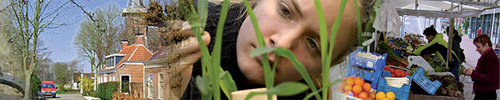
Grow your own is emerging as a trendy urban activity. Although allotment gardens often exists for over 50 years, their image is drastically changing. Until recently, these spaces were ignored by any city with promotional aspirations. Rather, they were tolerated at fringes or near railroad tracks. Quite different from the central place ‘community gardens’ are conquering now, increasingly heralded as ‘healthy’ spaces in and for neighborhoods. For a closer connection to nature, for the educational value of food growing, for the connection to better diets, for improvement of the social fabric of the ‘hood’.

What is policy aspiration and what is real in this? An interesting question for sociologists trying to understand contemporary society. Colleague Esther Veen is studying various forms of allotment/community gardens throughout the Netherlands. She is making her research accessible through the blog; www.onderzoekerstadslandbouw.wordpress.com. In Dutch.

Moreover, there are opportunities for students to study specific gardens in The Netherlands, recently a Master Thesis on an allotment garden in Ede was completed. A new research question comes from a garden in Sliedrecht (see blog in Dutch) and also the city of Rotterdam is interested in a city-wide study on the functioning of their community gardens.

For more information on Master Thesis possibilities in this field, please contact Els Hegger; Els.Hegger@wur.nl

Een uitdagend afstudeervak!

Sociale Moestuin Sliedrecht – Een tuin voor en door Sliedrechters

Achtergrond informatie

Het bestuur van Stichting Sociale Moestuin Sliedrecht wil een sociale moestuin realiseren. Een moestuin voor en door Sliedrechters zelf. Het initiatief, dat nu een jaar loopt, krijgt al veel positieve belangstelling. Het bestuur wil verkennen of de ambities realistisch en uitvoerbaar zijn. Bestaat er voldoende draagvlak in de ‘omgeving’? Hoe zijn de ambities te vertalen naar een haalbaar plan? Welke partijen zijn daarbij onontbeerlijk? Welke stappen zijn te identificeren? Hoe ga je om met onverwachte zaken? Oftewel hoe ga je gedurende het project bijsturen? Allemaal vragen die voorgelegd zijn aan de Wetenschapswinkel van Wageningen UR[1]. De Stichting Sociale Moestuin Sliedrecht streeft ernaar om middels een toegankelijke, inspirerende en gezonde moestuin de inwoners van de gemeente Sliedrecht nader tot elkaar te brengen, in educatie te voorzien en sociale doelgroepen te ondersteunen in de integratie in de maatschappij.

Continue reading

Thesis possibility with Dutch Sustainable Development Organisations


The thesis assignment is commissioned by Dutch Sustainable Development Organisations, COS Gelderland & OIKOS. There is an additional option to include your internship.

 The assignment is a feasibility study of a private network of (young) migrants, (inter)national students and others active in local sustainable development organisations. In order to encourage regional cooperation and to improve the quality of the activities by exchanging knowledge.

 Wageningen UR Science Shop accepted the assignment of COS Gelderland & OIKOS to do this feasibility study of the project ‘Participand’. The research will make you familiar with ‘Action Research’ and is a chance to achieve work experience in the field of the Science Shop and Dutch Sustainable Development Organisations. The research will start mid September.

Are you interested? Please contact project leader Margriet Goris (cocreation@live.nl or 06-28109539). The research is guided by Ina Horlings of the Rural Sociology Group (lummina.horlings@wur.nl or 06-51126725).

Internship possibility with Stroom Den Haag

 In 2009 Stroom Den Haag (www.stroom.nl) kicked off the program Foodprint. Food for the city. The program takes place over the course of several years and focuses on the influence food can have on the culture, shape and functioning of the city, using The Hague as a case study. The program invites artists and designers to develop appealing proposals on the subject, while at the same time establishing a clear connection with entrepreneurs, farmers, food experts and the general public. 

Foodprint as a project ends in 2012. To mark the end of the three year project, a book will be published and a symposium organised around the same theme: How do we feed our cities of the future (2050) in a sustainable way? Stroom is looking for a student to assist them with the organisational work but also to do additional research. For instance, there is an idea to create a visual essay with a timeline starting around 2050 B.C. (Sumerian clay tablets being the oldest judicial document, communicating about barley) with on it the most important laws and inventions in the field of production and trade of food in urban areas.

If you are curious about the possibilities, please contact Els Hegger (els.hegger@wur.nl).

Afstudeermogelijkheid bij OIKOS

De Wetenschapswinkel Wageningen heeft een opdracht van COS Gelderland & OIKOS aangenomen om een haalbaarheidsonderzoek te doen voor het project ‘Participand’. Projectleider is Margriet Goris; het onderzoek wordt begeleid door Ina Horlings van Rurale Sociologie.

Met het project ‘Participand’ wil COS/OIKOS diverse doelgroepen -migranten, (inter)nationale studenten en anderen actief op het gebied van duurzame internationale ontwikkeling- bijeenbrengen om ondersteuning te bieden, samenwerking te stimuleren en om de kwaliteit van de activiteiten door kruisbestuiving te verbeteren.

Het onderzoek bestaat uit twee delen; inzichtelijk maken van wat er op dit gebied gebeurt in Wageningen en omgeving en hoe dit functioneert. Om vervolgens aanbevelingen te genereren voor een faciliteit die de verschillende initiatiefnemers in staat stelt hun werk te verbeteren door interactie met zusterorganisaties van verschillende oorsprong en culturele afkomst.

Het project omvat literatuuronderzoek, inventarisatie van initiatieven, interviews maar ook het organiseren van groepsbijeenkomsten met de verschillende initiatieven in samenwerking met de projectleider.

We zoeken een (Nederlands sprekende) masterstudent die zijn of haar afstudeeronderzoek op dit terrein wil doen. Het onderzoek start bij voorkeur rond half september.

Meer informatie tot 12 augustus bij Ina Horlings: lummina.horlings@wur.nl of 06-51126725; of na 8 augustus bij Margriet Goris: 06-28109539 (cocreation@live.nl).