(De)coding a technopolity: Tethering the civic blockchain to political transformation – PhD-thesis by Syed Omer Husain

May 14 2020, at 11.00 am (CET) Syed Omer Husain will defend his PhD-thesis ‘(De)coding a technopolity: Tethering the civic blockchain to political transformation‘. See the Abstract below. The full thesis can be downloaded (click title) from WUR Library after the defence ceremony.

The ceremony will be live-streamed by Weblectures.wur.nl but is recorded and can be viewed later as well. Syed Omer Husain is affiliated as PhD-candidate at the Rural Sociology Group of Wageningen University. He was employed at the EU-funded MSCA ITN project SUSPLACE.


Abstract

This study rests at the intersection of technopolitics, translocal networks and political change. The overall aim of the thesis is to understand, and in turn, influence, the way technology interacts with political transformation. It responds to the fact that social science has thus far neglected to adequately account for and analyze how emerging technologies like blockchain and civic tech influence the way politics is practiced. The main research question guiding the study is how does the design, implementation and use of technopolitical innovations influence the practice of politics. The thesis foregrounds the idea that technopolitical experiments personify a ‘prefigurative politics by design’ i.e. they embody the politics and power structures they want to enable in society.

Conducted as part of the EU-funded SUSPLACE project that explores the transformative capacity of sustainable place-shaping practices, the research was predominantly inspired by a hybrid digital ethnography methodology. The thesis confines its focus to three empirical clusters: technopolitical blockchain projects, government-led blockchain projects and place-based civic engagement technologies. The study delineates how differing politico-social imaginaries play a role in the design and implementation of technopolitical projects; addresses contemporary post-political phenomena such as the depoliticization of agency; and identifies the activation of a place-based geography of political action through digitally-mediated municipal networks. It articulates the language and frameworks necessary to analyze these present-day challenges, while simultaneously developing approaches that can be exported to different domains of political activism.

Technology is not neutral; but neither are its designers and users. The thesis finds that it is through considerable, deliberate efforts, in conjunction with individual and collective choices, that technopolitical innovations can reframe our socio-economic and political realities. The study demonstrates the emphatic and urgent need for researchers, practitioners, politicians and citizens to collaboratively work on redrawing boundaries of access, empowering the citizenry, creating new forms of organization and re-politicizing the economy. It outlines a transdisciplinary research and practice agenda that aims at not only (de)coding the existing technopolitical innovations, but also (re)coding them to create a more equitable system of politics. The thesis concludes that since coding affordances and constraints in a technopolitical system is shown to regulate political agency and even influence the behavior of citizens, we must devise value-driven technology that incentivizes creating a more equitable political system.

Values and relationships in the diverse economy of De Ommuurde Tuin: an illustrated ethnography

inez thesis coverLast year Inez responded to a RSO thesis advert to join a research team exploring the social economy of food and nature in Gelderland in connection with several science shop projects coordinated by Jan Hassink. Inez completed her research at de Ommuurde Tuin in Renkum, and took the opportunity to further explore visual and creative methods, documenting her results in an illustrated ethnography that was shared with stakeholders at our most recent network gathering Nijmegen. Thanks for being part of our research team Inez ! 

Inez Dekker, MSc student Sociology of Development (MID) Wageningen University

Below please find the abstract of the MSc  minor thesis Values and relationships in the diverse economy of De Ommuurde Tuin: an illustrated ethnography

The full thesis can be downloaded from the WUR-Library by clicking on the hyperlink

Summary : In the last decades a growing number of alternative food and care initiatives emerged in North-America and Europe. Due to uncertain situations within current neoliberal economic systems such as the recent recession, ongoing outsourcing and environmental depletion, and alienation from production (Morgan and Kuch, 2015), these initiatives offer an alternative to an existing neoliberal model. Moreover, they inspire to create a more diverse pallet of economies alongside dominant economic and social systems. Important to mark here is that their decisions and actions are not merely led by dominant economic models, but intentionally done to create worlds that are environmentally and socially just (Gibson-Graham et al., 2013). Often these initiatives fit in an alternative economic framework where a diverse, interdependent, rich and prolific disarray of ‘good life’ are central for their economies. One of such frameworks is the diverse economic research framework based on the work of Gibson-Graham (2008) where the economy is one based on a myriad of human and non-human social relationships that go beyond capitalist economic models. While there seems to be an emerging interest for practices within alternative economic frameworks, such as in community supported agriculture (CSA) or care farms, there is an absence of how human and non-human relationships create values that form an (diverse) economy. Moreover, in conventional economic thinking, practices occurring outside current economic system remain often unrecognized and unseen, though, these are essential for an economy to exist. Therefore, I aim to strengthen a network of diverse economic initiatives focus on initiatives located in the Dutch province Gelderland. To do this, I created a visual illustration that highlights the diverse practices and human and non-human relationships in the organic horticulture business located in Gelderland called ‘De Ommuurde Tuin’. I add to the scholarship of diverse economies by describing and showing the processes that produce a diversity of values in De Ommuurde Tuin’s daily economic practices. These processes are not only led by relationships among humans but include human and non-human relationships as well. To do this, I not only use a written form, but foremost I used visual and sensory research methods that highlights relationships between humans-humans and humansnonhumans. By putting forward the senses, the visual and emotional, this research concerns the processes in daily economic practices through a study of an economy that is lived and experienced. Moreover, I make alternative and diverse frameworks of economy/is more visible for a wider public through presenting my outcomes in a visual manner in booklet form. This approach tries to display and recognize economic alternatives, which helps to connect and build a coherent and powerful social movement for another economy (Miller, 2008; Gibson-Graham, 2008; Gibson-Graham and Miller, 2015)

Thesis opportunity: developing a framework for business models that enhance soil quality

The Rural Sociology Group and Business Economics Group jointly offer thesis opportunities on developing business models that enhance soil quality.

Developing a theoretical framework for business models that enhance soil quality in crop and dairy production.

Soil quality is (rapidly) decreasing in The Netherlands, and thereby endangering future income perspectives of farmers. Moreover, reduced soil quality provokes all kind of negative externalities, such as reduced biodiversity, increased climate-change related risks, etc.. Hence, increasing and maintaining soil quality is a prerequisite for sustainable soil use.

This issue affects a multitude of stakeholders, each with different positions and preferences.

Business models, including various stakeholders and aimed at increasing and maintaining soil quality, are essential to enable farmers taking appropriate measures focused on these aims.

Currently, various initiatives have been taken to develop business models, mostly at a smaller scale. However, for mainstream agriculture to getting involved in improved soil management, a thorough theoretical framework, based on scientific analysis and rooted in (at least) economic and sociological theory, is essential. Only then, essentials of balanced business models can be developed which have the pursuit for larger-scale adoption in practice.

Being a pilot study, the aims of this MSc Thesis research are:

  • Qualitative analysis of real costs of soil management (i.e. monetary and non-monetary costs, such as costs for society) through the application of basic economic (cost) concepts;
  • Qualitative analysis of the stakeholder structure;
  • Definition of business cases and performance of a qualitative SWOT-analysis;
  • Evaluation of several existing business cases against the developed framework.

We are looking for a MSc-thesis student with an interest in the topic and a background in (business-)economics and/or rural/agrarian sociology.

Energy and labour use on farms: case studies from the Netherlands and China – PhD-thesis Tian Yu

November 20, 2019 at 4.00 pm Tian Yu will defend his PhD-thesis ‘Energy and Labour use on farms: case studies from the Netherlands and China‘. See the Abstract below.
The full thesis will be available after the defence ceremony. The ceremony will be live-streamed by Weblectures.wur.nl but can be viewed later as well. Tian Yu is affiliated as PhD-candidate at the Rural Sociology Group of Wageningen University.

Abstract

As one of the major contributors to greenhouse gas emission, agricultural production is responsible for climate change. In the most industrial countries, agricultural production has built a great dependency on fossil energy consumption by replacing most human labour with agro-technologies on the farm. This is unsustainable in the context of climate change and resource depletion. Therefore, in order to mitigate climate change, the transition to sustainable food production is necessary and urgent. Rising in the 1970s, organic agriculture is believed to be a sustainable approach for agricultural production. It has been proved to use less fossil energy due to a commitment not to use any synthetic substances, but at the same time it uses more labour. When labour and fossil energy are regarded as two basic resource inputs on a farm, it seems that organic farms use more labour to compensate for the reduced fossil energy consumption. However, it is still unknown how the input balance of fossil energy and labour on organic farms is different from that on conventional farms, and how the different input balance would influence the sustainability of agricultural production. It is valuable to explore these questions against the backdrop of climate change. As the issue of fossil energy and labour input balance on farms has not been studied thoroughly, this thesis is written based on an exploratory research. The main objective is to explore the balance of fossil energy and labour input at farm level by comparing conventional and organic farming systems, and to explore the possibility to optimise sustainability of resource use in agricultural production.

By conducting comparative case studies in both the Netherlands and China, this thesis first calculated the energy and labour input balance separately in the two countries, and it concluded organic farming uses less energy and more labour compared with conventional farming in both countries, but there is great variation among all the farms in the size and farming activity of this gap. When comparing the results from the two countries, the thesis concluded that Dutch farms use more energy while Chinese farms use more labour due to their different resource endowments. However, the situation is changing in both countries, and the changes show that the so-called industrial agriculture – which consumes much more energy – is not the only nor the best trajectory for agricultural development. Requiring more labour use on-farm, how organic farming can deal with the labour constrains is then answered: organic farmers should be encouraged to explore their diverse local solutions to increase the resilience of their farm when dealing with the constraints. In further, using the theory of farming mode and farming style, this thesis discussed farmers’ input strategies by clarifying the heterogeneity within organic farms, and highlighting the trend of conventionalisation in the development of organic agriculture, and it supports the hypothesis that organic agriculture with peasant qualities shows better potential in applying organic principles to optimise the sustainability of an organic farm. At last, the thesis discussed the theoretical concept of organic peasant agriculture and tries to distinguish it from conventional agriculture and conventionalised organic agriculture. It concludes that organic peasant agriculture is valuable in the transition to sustainable food production.

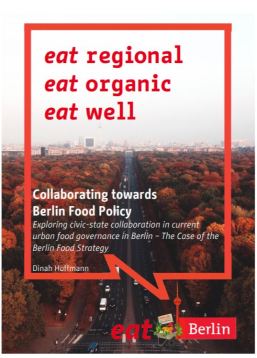
Collaborating towards Berlin Food Policy: Exploring civic-state collaboration in current urban food governance in Berlin – The Case of the Berlin Food Strategy

dinah thesis coverDinah Hoffman, MSc student Communication, Health and Life Sciences
Specialization: Health and Society, Wageningen University

Below please find the abstract of the MSc thesis Collaborating towards Berlin Food Policy: Exploring civic-state collaboration in current urban food governance in Berlin – The Case of the Berlin Food Strategy

The full thesis can be downloaded from the WUR-Library by clicking on the hyperlink


Urban food policy is an area that joins actors from civil society, academia, the local state and the market. To accomplish sustainable changes of local food systems these actors work together in governance arrangements. Two prominent instruments that are used in urban food governance where these actors collaborate are the food policy council and the urban food strategy. Both can be initiated through top-down or bottom-up processes or a combination of both with the relationship of local government and civil society having an impact on the success of the initiatives. One of the cities where civil society and local government engage in collaborative food governance is the city-state of Berlin, the biggest city in Germany, surrounded by the agricultural region of Brandenburg. Drawing on data from 11 interviews and 40 documents, this thesis describes and examines the nature of the relationship and governance arrangement of the two main actors in current Berlin food governance. The collaborative governance framework, a categorization of civic-state relationships found in urban food governance and the concepts of integrated food policy and institutionalization were used to guide the analysis. The objective of this thesis is to understand how civic-state collaboration in urban food governance looks like in Berlin, what impact the local context has on the development of the governance arrangement and what strengths and challenges involved stakeholders perceive. The two main stakeholders were found to be the civic food policy council Ernährungsrat Berlin and the Berlin Senate Administration for Consumer Protection. It was found that the Ernährungsrat Berlin’s food policy activity brought forward a relationship where they are striving for independence but are linked to the government through a secondary agency, being the aforementioned administrative department. Although not embedded in municipal institutions, which has been identified as crucial for a food policy councils’ success, the Ernährungsrat Berlin proved to be an agile and resilient structure able to successfully be an independent advocate for civil society and a valued advisor to the government. Their collaboration resulted in the development of a Berlin Food Strategy. In this thesis I investigate the process of developing this strategy as a form of collaborative governance. Regarding their governance arrangement around the Berlin Food Strategy, the involvement of the Green Party in the current coalition was found to have had a big impact on the position the Ernährungsrat Berlin but also food policy was able to occupy on the urban agenda. This research identified a number of strengths and challenges of the governance arrangement including a strong interdependence, a strong and long history of civic action, the presence of political food champions in the coalition and the administration, the limiting structure and functioning of the Senate administrations and the limited inclusiveness and representatives of the Ernährungsrat Berlin.

Key words: urban food governance, urban food policy, food policy council, urban food strategy, collaborative governance, Berlin food strategy, Ernährungsrat Berlin, Senate of Berlin