This conference was organised by the Regional Studies international research network on leadershp, at the University of Birmingham. This is an overview of the highlights. For more information, please contact lummina.horlings@wur.nl.
Prof. Joyce Liddle of the University of Nottingam described the recent policy shift in the UK. The New Coalition advocates ‘The Big Society and social enterprise’. The Regional Architecture has completely changed, which resulted in the demise of Regional Development Agencies. The Coalition’s vision is expressed in three values: freedom (frameworks with support social responsibility and civil liberties), fairness (those we cannot we always help) and responsibility (those we can, do). The means are e.g. Public Service Reform and A Smaller State. This is expressed in the slogan ‘A Big Society matched by Big Citizens’. New Local Enterpreneurs Partnerships (LEP’s) have now been launched. Prof. Liddle analyses the role of leadership in these LEP’s, based on the concept of auxiliary leadership. Liddle argues that only by having a clearer understanding of the role of auxiliary leadership in the dynamics of local and regional governance, we can better understand how collaborating state and non-state articulate and foster the necessary change processes.
Andrew Johnston of the University of Sheffield talked about Public Sector Entrepreneurship and leadership of the urban and regional development process in the UK. He distinguishes two notions of public entrepreneurship 1) Occupational role of leadership 2) Behavioural role of entrepreneurship.
Conditions for public sector entrepreneurship are according to Boyett: a devaluation of power to a lower level; a re-allocation of resources to a lower level and an uncertain environment. Characteristics of Public sector entrepreneurship are: a) innovation b) Promoting change c) making decisions d) taking responsibility e) identify opportunities f) influencing stakeholders g) shifting resources h) influencing localities, form and use of goods, resources and institutes. Several conflicts between public entrepreneurship & democracy can be identified: 1) Autonomy versus accountability 2) Vision versus participation 3) Secrecy versus openness 4) Risk taking versus public stewardship.
Prof. Andrew Beer, University of Adelaide in Australia described the case of Waikerie District. The scale of policy arrangements in Australia is much smaller than those evident in the UK and Europe. Compared to Europe leadership is small scale, community based (community building); has a private sector orientation (short term success possible, but long term?), independent of government processes, a characteristic of individuals instead of an achievement of groups, and has a weak relationship with politics and governance. The case of Waikerie showed that: 1) formal government/governance processes can impede leadership in Australia’s regions 2) leadership carries costs that may not be paid easily by communities that have neither large scale institutions (eg universities) or large businesses 3) leadership roles can have adverse impacts on the lives of leaders 5) lack of knowledge on regional development processes and governance processes make it difficult to establish a ‘leadership relay’. 6) sustaining leadership is the most significant hurdle, not the identification or formation of leadership 7) failure in leadership may have compounding impacts.
Dr. Basilio Verduzco from Mexico uses game theory to analyse coalitions in urban development. He sees leadership as negotiating. Interesting is his description of tensions in leadership which leads to three roles: being a partner, promotional leader and mediator. He uses Sharpf’s strategies from altruism till hostillity. Traditional roles of leadership in Mexico are 1) corporatism 2) caudillism and corrupt clientism. Based on the case in Mexico he distinguishes three types of leadership: solid, hollow and contested/ustable.
Juha Kostainen from the University of Tampere in Finland described the Tampere knowledge society program which object was to make Tampere the spearhead city of information society development. Kostainen described Radical Development Initiatives, not included in the official strategies. In the design stage there are various challenges such as established organizations which tend to be less radical. He identifies a new ‘Leadership-Community (Mintzberg, 2009): 1) between leadership and citizenship 2) not a heroic type of leadership 3) engaged and distributed management 4) neither micromanaging nor ‘macroleading’ 5) “a community leader is personally engaged in order to engage others, so that anyone and everyone can exercise initiative”.
Prof. John Goddard from the New Castle University, presented about the role of the civic university and the leadership of place. He looked at this theme based on policy and academic discourses. The argument is that universities can create the divide between these discourses, this is a leadership challenge. He models universities and leadership of place as overlapping circles: political, managerial and community leadership, with in the middle intellectual leadership.
Prof. Markku Satorauta, University of Tampere in Finland, described why and how to study institutional entrepreneurship, see also his website. How to create change? An important role can be played by institutional entrepreneurship. Institutional entrepreneurship is a relay in time, multi-scalar and multi-actor. Institutions are more often than not seen as sources of stability and not as sources of change and innovation (Scott). But there is a need for change. Leadership is about creating a way for people to contribute to making something different happen. The champions of regional development are however constrained by the very same institutions they aim to change (embedded agency). The case study of stem cell research shows how breakthrough treatments developed and that leadership is about connecting interpretive power, network power and institutional & resource power in the different phases of the process. You need different types of knowledge as well: substance knowledge, policy knowledge, process knowledge. The case shows that institutional entrepreneurship is a multi-scalar and multi-actor process. It is a relay in time. Different actors surface in different phases of development. It is a constellation of different skills, competences, knowledge and power.

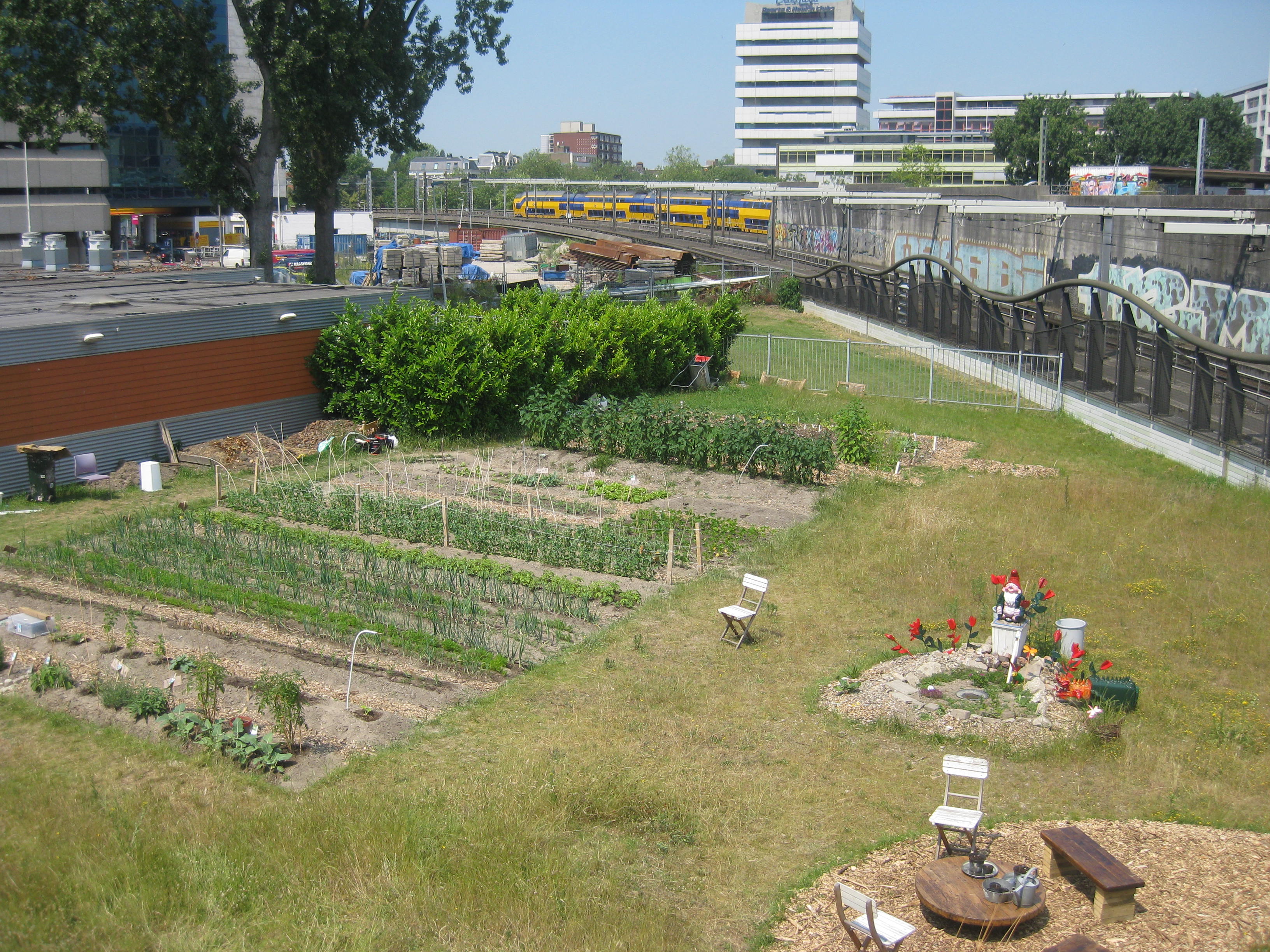
 In gangbare stadsplanning was ‘t moestuincomplex tot voor kort een rafelig en rommelig stuk groen, bij uitstek verbannen naar ‘overgebleven’ stukjes stad zoals vanuit de trein goed te zien is. Zonder overkoepelend ontwerp en beheersplan een doorn in ‘t oog van menig landschapsarchitect of planner. Binnen ‘t nieuwe perspectief representeert een volkstuinencomplex ‘diversiteit’ zowel bio als cultureel.
 Rural Sociology Wageningen University