Rural Sociology Wageningen University

Rural Sociology Wageningen University

Thesis option: exploring the gentrifying foodscape

The Amsterdamsestraatweg, a street in Utrecht, is known for its kebab take-away restaurants, hairdressers and massage salons. During the last years, however, businesses along the street are changing due to gentrification. ‘Hipster bars’ and vintage furniture shops are appearing. A similar process is happening at the Javastraat in Amsterdam.

The urban food landscape is in constant transition, but we do not clearly know how people engage with their everyday food planning – where do they go, what choices do they make, and what practical considerations do they take into account? Answering such questions will help us better understand people’s food provisioning practices, and how to make these practices more sustainable and healthy.

The Rural Sociology Group is looking for a student interested in exploring one or both of the changing foodscapes (Amsterdamsestraatweg / Javastraat). What kind of people are visiting these food places? Do the same people make use of the full variety, or do the kebab places and the hipster bars (as the two extremes) attract different groups of people? Where do the customers of both types of food places live? What do their food provisioning practices look like, and what is important to them when consuming food?

We are looking for one or two thesis students interested in these questions, and willing to do a thesis with the Rural Sociology Group, starting spring 2018. Interested? Send a short motivation to esther.veen@wur.nl and anke.devrieze@wur.nl.
Thesismogelijkheid: Tuinieren voor kankerpatienten

Due to the nature of this thesis, which involves speaking to Dutch former cancer patients, this thesis is only available for Dutch speaking students.

Voor het project Healing Gardens (zie www.healinggardenswur.nl) ben ik op zoek naar een student die een thesis wil schrijven bij de leerstoelgroep Rurale Sociologie.

Healing Gardens is een samenwerking van Rurale Sociologie en Humane Voeding. Doel van het project is onderzoeken in hoeverre tuinieren bijdraagt aan de kwaliteit van leven van ex-kankerpatiënten. Tussen april en september 2017 hebben we een pilot onderzoek uitgevoerd, waarbij 6 patiënten hebben getuinierd in Almere. De pilot was onderdeel van onderzoeksprogramma’s van AMS (Amsterdam Institute for Advanced Metropolitan Solutions) en de Flevocampus.

De deelnemers hebben tijdens de pilot aan drie meetronden meegedaan – aan het begin, in het midden en aan het einde. Vanuit Rurale Sociologie hebben we de deelnemers gevraagd naar hun verwachtingen, in hoeverre die uitkwamen, sociale relaties en lotgenotencontact. Ik ben nu op zoek naar een student om deze interviews te analyseren en daar een thesis over te schrijven. Daarnaast kun je zelf extra data verzamelen. Hiervoor zijn meerdere opties, afhankelijk van je eigen interesse. Voorbeelden zijn follow-up interviews met de deelnemers, of interviews met deelnemers van andere lotgenotencontact-groepen, om de verschillen tussen verscheidene vormen van lotgenotencontact te onderzoeken.

De thesis kan vanaf april beginnen. Geïnteresseerd? Stuur een korte motivatie naar esther.veen@wur.nl.

Healing gardens in a video

In an earlier post I talked about our pilot project Healing Gardens, which had just started: six (former) cancer patients were gardening under supervision of two enthusiastic volunteers, at Parkhuys (a cancer support center) in Almere. The aim of the pilot was to prepare for a larger study in which we hope to find out to what extent gardening is a useful way to increase physical activity, stimulate healthy eating patterns, and function as effective social peer support.

This pilot has now ended. It has been successful in the sense that the patients really enjoyed the activity. Almost all of them have taken up gardening at home – two of them have even rented an allotment together. Also, the pilot gave us valuable insights which we will use when starting the lager study: the gardening containers were considered too small by most participants, for instance, and it is extremely important to have access to knowledgeable garden supervisors. Currently we are analyzing our results – during the course of the pilot gardeners were interviewed three times, filled out different questionnaires and participated in various fitness tests. We expect the results early 2018.

One of our project partners, Jan Eelco Jansma, explains the aims of our study in more detail in a video. You can also visit our website for more information: www.healinggardenswur.nl. Sorry, both are in Dutch. Healing Gardens is a cooperation between Rural Sociology, Human Nutrition, and applied plant sciences, and supported by the Amsterdam Institute for Advanced Metropolitan Solutions and Flevocampus.

Planning for Equitable Urban and Regional Food Systems

There is a new Special Issue of the journal “Built Environment” on the topic of Planning for Equitable Urban and Regional Food Systems.

The Special Issues starts from the question: How does and can planning and design enhance the freedom and wellbeing of marginalized actors in the food system – low-income residents, people of colour, small-holder farmers, and refugees – the very people the alternative food movements purport to serve?

In the Special Issue authors from across the Global North and South explore the role of planning and design in communities’ food systems, while explicitly considering the imbalances in equity, justice, and power.

The collection includes a paper by former Rural Sociology MSc student Maria Vasile and Jessica Duncan.

We want to be part of the broader project’ Family Farmers and Local Food Governance in Porto Alegre, Brazil

Brazil has been praised for the development of its agricultural sector, its policies against hunger, and its support for family farming. Yet, the future of small-scale family farmers remains uncertain. In this paper, we question whether food system localization facilitates the integration of small-scale family farmers into food governance processes in Porto Alegre, Brazil. To answer this, we present the City Region Food System (CRFS) as a conceptual approach to explore the relationship between food systems localization and enhanced participation of small-scale family farmers in food governance. After introducing the case study of local food in Porto Alegre, we highlight key structural inequalities that limit family farmers’ participation in local food practices and influence their involvement in food governance. We then examine linkages between local food policy efforts and family farmers’ praxis, attempting to discern mismatches and related implications for the development of an inclusive CRFS. We argue that systematization of local food practices within the city region represents a double-edged sword as it may
translate into a decrease in farmers’ autonomy and ownership of local initiatives and burden them with regulations not fit for purpose. In conclusion, we suggest that a CRFS approach to planning can help to address structural inequalities and power asymmetries in local food governance only if informed by local dynamics and based on context-sensitive mechanisms for participatory governance incorporating a variety of small-scale family farmers (and other stakeholders).

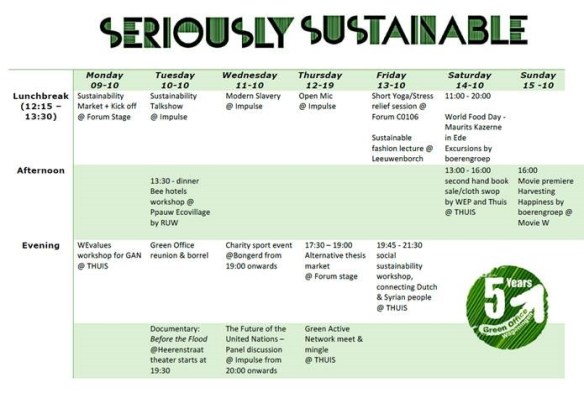
Seriously Sustainable Week 2017

Seriously Sustainable Week 2017 is coming up and Wageningen University’s Green Office has organised an entire week, packed with all kinds of activities, from fun to serious, from small to big.


Seriously Sustainable.jpg