 Susan Drion, MSc-student Organic Agriculture, Wageningen University.
Below the Executive Summary of the MSc-thesis “Financing Future Farming: an exploration of alternative financing constructions to enhance sustainability at farm level“.
The full thesis can be downloaded from the WUR-Library by clicking on the hyperlink.
De thesis bevat ook een Nederlandse samenvatting. Zie ook haar eigen website: waardenscheppers.com
The pressing ecological and economic state of Dutch agriculture begs eagerly for the acceleration of the sustainability transition in this sector. Access to sufficient capital is a major bottleneck in this transition. Established ways of financing agriculture, i.e. via a bank loan, becomes increasingly harder. This warrants an exploration of alternative financing constructions. This research aims to study to what extent alternative financing constructions enable farmers to achieve sustainability on farm level. It aims to find out how and why these constructions work well, how they are realised and what features of possible best practice can be extracted from them. This research is limited to the context of Dutch agriculture and to financing constructions that yield monetary returns. Alternative financing constructions are defined by the underlying investment logic to create social and natural returns and by the novelty in the mechanisms used.
In this research alternative financing constructions are considered new institutional arrangements, embedded in the framework of neo-institutionalism, practice theory, new practice creation and scaling dynamics. To study the alternative financing constructions, a qualitative case based best practice approach is employed. Eight cases of alternative financing are selected, ranging from citizen participation constructions, alternative loans, business participation constructions and collaborations with institutional investors. Over the course of two months, farmers and investors directly related to the selected case sites were interviewed. The technique of crowd-sourcing was used to find cases, reach the target group and get to know the field of social financing better. Twelve blogs were written about the research process and about the interviewed farmers. Also a collaboration with communication partners was set up to make this technique more effective.
By using the grounded theory approach the data was analysed and the following findings revealed itself:
- The key feature that is the foundation of the mechanisms of nearly all alternative financing constructions is the separation of capital and business. Also farmers offered diverse returns on investment;
- The added value of the alternative financing constructions to farmers were mostly the friendly collaboration with investors, which gave them a licence to produce, and the solutions they offer to take over of farms by the next generation;
- The alternative financing constructions were products of a long build up, earlier failing and the right momentum. Farmers experienced little resistance in the process;
- Each alternative financing construction requires certain personality traits of the farmer, the latter is therefore decisive in the choice of financing. Also, the current low interest rates for saving on the bank made it easier for the alternative financing constructions to succeed.
Five features of possible best practice were extracted from the findings.
- Make use of certificates, acting as perpetual bonds;
- Make use of long term lease contracts to access land and buildings;
- Stack capital flows;
- Work with shareholders;
- Loans remain an option.
Finally, one can say that alternative financing construction do enable farmers to achieve sustainability on their farms. However, the scope is limited because novel alternative financing constructions are yet only used by their designers. Further research is required to find out for whom and under which conditions features of possible best practice are scalable, while at the same time harnessing the personal approach to investors.
Keywords: social financing, Dutch agriculture, alternative financing constructions, elements of best practice, sustainability, separating capital and business, new practice creation, scaling

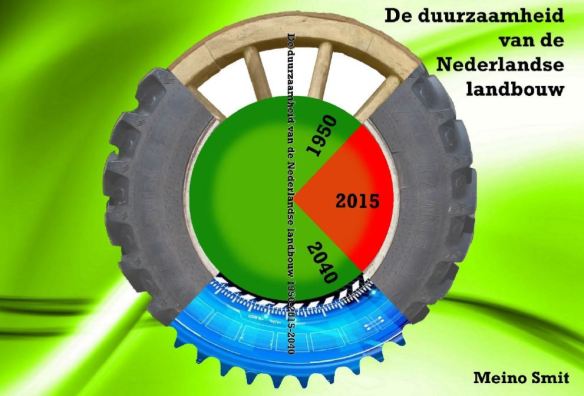 Op 11 september 2018 van 13.30-15.00 verdedigd Meino Smit zijn proefschrift getiteld: De duurzaamheid van de Nederlandse landbouw, 1950-2015-2040. De verdediging is live te volgen en ook terug te kijken via


