“Urban Development with Rural Consequences”

As part of the course Understanding Rural Development, a group of master students from France, Cameroon, Taiwan and the Netherlands plus staff from the Rural Sociology Group went on a study trip to Nijmegen-Lent to learn more on the developments in this area. The group was met by Karolien Andela, from the Municipality of Nijmegen. Gathered around a scale model of the area in the information centre De Waalsprong, she informed us on projects such as: ‘Space for the river Waal’, ‘the Waal Jump’ (new urbanisation in Lent), the ‘Waal front’ (reconstruction of an industrial area) and landscape development.
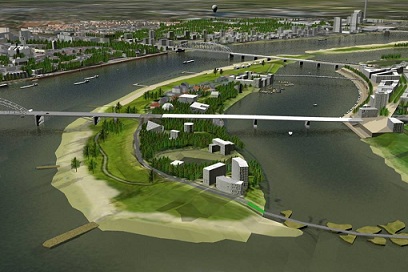
Her story revolved around the central meaning of the river Waal in the expansion of the city. The carrying capacity of the river is becoming too limited for the amount of water flowing through. In 1995 this already led to flooding in several parts of the city and as the water level tends to rise this is expected to have more negative consequences in the future. This is of course a concern to both local government as well as its citizens. In the past, the response to rising water levels in the Netherlands has been to strengthen dikes and increase its height, but this is not a long term solution. Therefore on a national level, the government decided to change its approach to this threat and introduced the idea to give more space to the river (“Geef de Rivier de Ruimte”) meaning to give the river more capacity. This is done for example by returning flood lands to the river, construct side dams, dig channels along the polder or streamline vegetation. The national government appointed 39 spots where this concept should be applied, concerning the rivers Maas, Waal and Lek. Most of these projects are located in predominantly rural areas but in this case it is right in the middle of a city.

In the case of Nijmegen, the suggested plan by the government entailed to relocate the existing dike more land inwards and in addition dig a channel in front of it to increase the capacity of the river and thus lower the water level. As a result, an island is created which will give opportunities for housing, recreation and cultural activities as well as nature development.

At first this plan was faced with a lot of public opposition as it implied the removal of houses and farming enterprises as well as other negative impacts such as a rise in the ground water level. The group of protesters even came up with an alternative plan which was accepted by the city council but eventually rejected by the national government who favoured the original plan. Initially the city was reluctant with this decision but managed to change it into an opportunity for urban development and even get the necessary public support. One of the factors enabling this public support was the creation of a platform that is involved  in different stages of the plan development and gives voice to various interest groups including a group of affected households.

The group from Wageningen was interested in aspects like: What is the effect of the plans on local farmers? Are the planned green spaces in the new part of the city going to be interconnected or just loose patches of green? How do the citizens of the village of Lent feel about the plans as they suddenly becoming part of a city? How are the urban planners going to create a shared feeling of identity between the inhabitants of the old and the new part of the city? What are the effects of the economic developments on the plan? And are sustainability concepts  taken into account in the design of the area and its houses?

After this informative talk by the Municipal spokesperson, the group took a short stroll over the bicycle bridge that connects the city of Nijmegen with the village of Lent. From here the group could see, with a bit of imagination, what the effects of the planned developments will be. Suddenly it became clear which households were going to be on the  “wrong” side of the new dike and will not be able to escape the new course of the river.

To voice your opinion about the plans you can interact with the project team on twitter (www.twitter.com/waalsprong) or follow the developments on YouTube (www.youtube.com/waalsprongnijmegen). The work is planned to start in 2013.
Rural regional learning in the Comarca de Verín, Galicia, Spain

Within the European research project DERREG, we are investigating how public policy can best be arranged to stimulate capacity building within development initiatives operating at grassroots level in rural areas across the European Union.

To find out how public policy interventions can best be arranged, we and our research partners have spoken to various stakeholders in different rural regions across the European Union to find out how they intend to support and facilitate learning and innovation and- most importantly- how the support and facilitation agreed upon is actually provided to the grassroots development initiatives. To find out what is working well and what isn’t working well yet, we have spoken to a number of grassroots development initiators in the participating DERREG case study areas and ask them to evaluate the current support and facilitation received.

To be able to compare the results obtained in the different case study areas, I have travelled to Alytus County, Lithuania in October and Oberlausitz, Germany in December of 2010. In January of this year, I was able to visit our colleague Lola Dominguez Garcia of  Universidade de Vigo in the Comarca de Verín in the South-West of Galicia, Spain. In this blog, we intend to share our experiences. Continue reading

Multifunctionele landbouw is een sector met toekomst

Ondernemen in de multifunctionele landbouw is niet voor stoppers, maar biedt juist toekomstperspectief. Het vervlechten van nieuwe activiteiten (zoals zorg, recreatie, educatie, huisverkoop etc.) met de agrarische productie zorgt voor een aanzienlijke bijdrage aan het gezinsinkomen en verdere ontwikkeling van de agrarische activiteiten. Dit blijkt uit het onderzoek ‘Dynamiek en Robuustheid van Multifunctionele Landbouw’ dat in opdracht van het ministerie van EL&I werd uitgevoerd door de leerstoelgroep Rurale Sociologie van Wageningen University. Het onderzoek is gebaseerd op diepte-interviews met 120 multifunctionele landbouwondernemers. De ondernemers komen uit het Brabantse Groene Woud, Flevoland, Laag-Holland (Noord-Holland), het Zeeuwse Walcheren/Zuid-Beveland, De Drentse Wolden en de Noordelijke Friese Wouden.

Robuustheid

Uit de interviews blijkt ten eerste dat bij de komst van nieuwe activiteiten vooral positieve drijfveren een rol spelen, meer dan een te laag inkomen. Betrokken boeren en boerinnen hebben vaak behoefte aan meer contact met burgers, consumenten en de maatschappij. Ten tweede blijkt dat op de onderzochte bedrijven gemiddeld bijna drie verschillende activiteiten voorkomen, in verschillende combinaties.

De verschillende combinaties van multifunctionele activiteiten op de onderzochte bedrijven zorgen voor een gemiddelde omzet van 195.000 euro (aanvullend op de agrarische omzet). De activiteiten leveren – met gemiddeld 40 procent – een aanzienlijke bijdrage aan het totale gezinsinkomen. Sinds de start van de nieuwe activiteiten is er bovendien op het overgrote deel van de bedrijven sprake van een positieve wisselwerking met verdere agrarische ontwikkeling. Agrarische omzet, grondgebruik en arbeidsinzet blijft behouden of groeit.

De robuustheid van multifunctionele bedrijvigheid blijkt verder ook uit de positieve beoordeling van het totale bedrijfsinkomen door boeren, groeiende omzetten en inkomensbetekenis en de geleidelijke uitbreiding van het aantal nieuwe bedrijfsactiviteiten in de tijd. Ook de totale arbeidsinzet op betrokken bedrijven neemt geleidelijk aan toe. “Multifunctionele landbouw is dus niet alleen van betekenis voor betrokken bedrijven, maar zeker ook voor de plattelandseconomie als geheel”, aldus projectleider Han Wiskerke.

Verschillen

Het onderzoek laat zien dat er grote verschillen bestaan in dynamiek en robuustheid van onderzochte bedrijven. Dit wordt enerzijds verklaard door regionale verschillen, zoals de aanwezigheid van sterke samenwerkingsverbanden als belangrijke succesfactor. Daarnaast maken ook meer bedrijfsgebonden factoren verschil. Te denken valt aan verschillen in bedrijfsstrategie zoals de mate van investeren, het wel of niet werken met personeel en in hoeverre er wisselwerking plaatsvindt tussen de verschillende bedrijfsactiviteiten.

Taskforce

De Taskforce Multifunctionele Landbouw zet zich namens het ministerie van EL&I in voor de verdere ontwikkeling van zorglandbouw, streekproducten, recreatie, agrarische kinderopvang en educatie en natuurbeheer. Kenniscoördinator Arjan Monteny: ,,Het onderzoek toont aan dat multifunctionele landbouw een stevig fundament heeft: ondernemers durven erin te investeren en behalen rendement uit de nieuwe bedrijfsactiviteiten. Het is mooi dat dit vaak gepaard gaat met verdere ontwikkeling van de agrarische activiteiten. Multifunctionele landbouw is daarmee onlosmakelijk verbonden met de agrarische productie. Het is duidelijk geen exit-strategie.”

Rapport

Het onderzoeksrapport is te downloaden via de website van het onderzoeksproject.

Bron: deze blog is een overname van een gezamenlijk persbericht van de leerstoelgroep Rurale Sociologie en de Taskforce Multifunctionele Landbouw

Wanted: Students for an international experience!

Every year, the Rural Sociology Group participates in a two week intensive programme on rural development in the EU. A diverse group of students from various European countries (a.o. Portugal, Poland, Germany, Hungary, Italy, Spain, Lithuania, Slovenia) work together on a case study. Through lectures and field trips scientific and practical knowledge will be aquired and then implemented in the case study analysis. See past experiences of Marlies, Petra and Wiebke
 
This year the IP is organised by the university of Padova and takes place in San Vito Di Cadore in the Italian Dolomites. The general topic is: “the role of agriculture in territorial identity and competitiveness of rural areas”. More specificly, the general question is related to how these (territorial identity and competitiveness) contribute to rural development in the Dolomites (Alps region). For more information on the content see below. 
 
Are you a student of Wageningen University and looking for an international learning experience? Then sign up for two intensive weeks from 3 to 16 April 2011! For subsciption or more information contact Els Hegger (els.hegger@wur.nl). 
 

Rural regional learning in Alytus County, Lithuania

Last week (October 21-22, 2010), I was given the opportunity to visit our DERREG project partner Emilija Kairyte (Institute NeVork) in her case study area of Alytus County in the South of Lithuania. In this blog, Emilija and I would like to share our experiences.

Like the Dutch DERREG case study region Westerkwartier in the province of Groningen, Alytus County comprises four rural municipalities. In terms of demography and economy, both areas are very different from each other. For example, the Westerkwartier has a population density of 173.4 inhabitants/ km², whereas the population density of Alytus County is estimated as 32.6 inhabitants/ km². While the Westerkwartier has witnessed an increase in citizens over the last years, amongst them a large number of young families, rural development in Alytus County is strongly affected by an increasing out-migration and an aging population. Living standards differ considerably. In the Westerkwartier, the GDP per capita was estimated as 55.400 Euro in 2006 while the GDP in Alytus County was estimated as 19.100 Litai in 2007 (equals 5.531,74 Euro, October 2010). Also in geographical terms the two regions are very different. The Westerkwartier is characterized by open grasslands in the North and small fields with framing hedgerows in the South. Alytus County is renowned for its vast forests and lakes.

During my visit to Alytus County, I accompanied Emilija to two workshops, one for the LAG and other public administration authorities on the 21st of October and one for rural initators and actors on the 22nd of October, which she organized in order to evaluate existing arrangements for support and facilitation of joint learning-by-doing activities within rural development initiatives. At these workshops, I presented supportive arrangements and benefiting rural development initiatives that we found during our investigations in the Westerkwartier and which we evaluated together with local stakeholders at a workshop organized by the Rural Sociology Group in the Westerkwartier on the 18th of October.

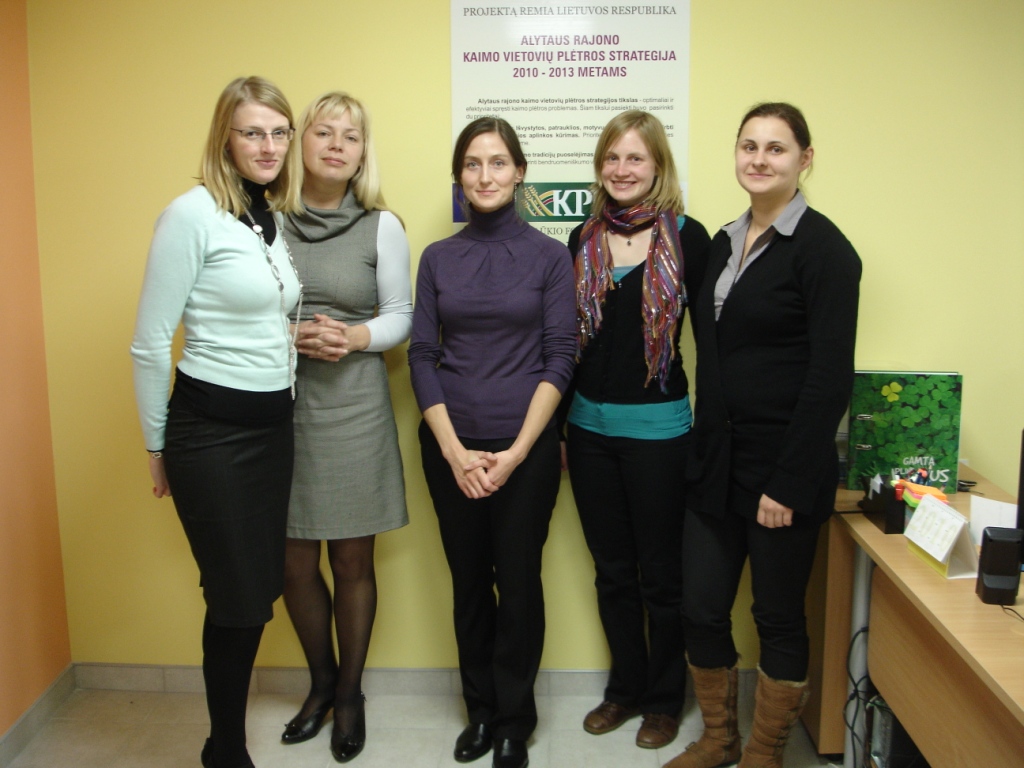
Meeting with rural development initiative supporters in Alytus District LAG office, Alytus

To my surprise, both regional learning supporters (including the LAG) and rural initiators did not see striking differences between the existing arrangements and support given to rural development initiatives in Alytus County and the Westerkwartier. Emilija and I however learned that there are some basic differences in the foundation and operation of the Countryside House (Plattelandshuis) in Westerkwartier and Seniūnija (NUTS5) in Alytus County. Continue reading