Presenting my Colombian case study area

During the last two weeks, I was in Bogotá to talk to experts from the IER at the Javeriana University as well as the Ministry of Environment and Sustainable Development to find out about public support for joint capacity building in rural Colombia. Now, I am back in the department of Santander to start my field work.

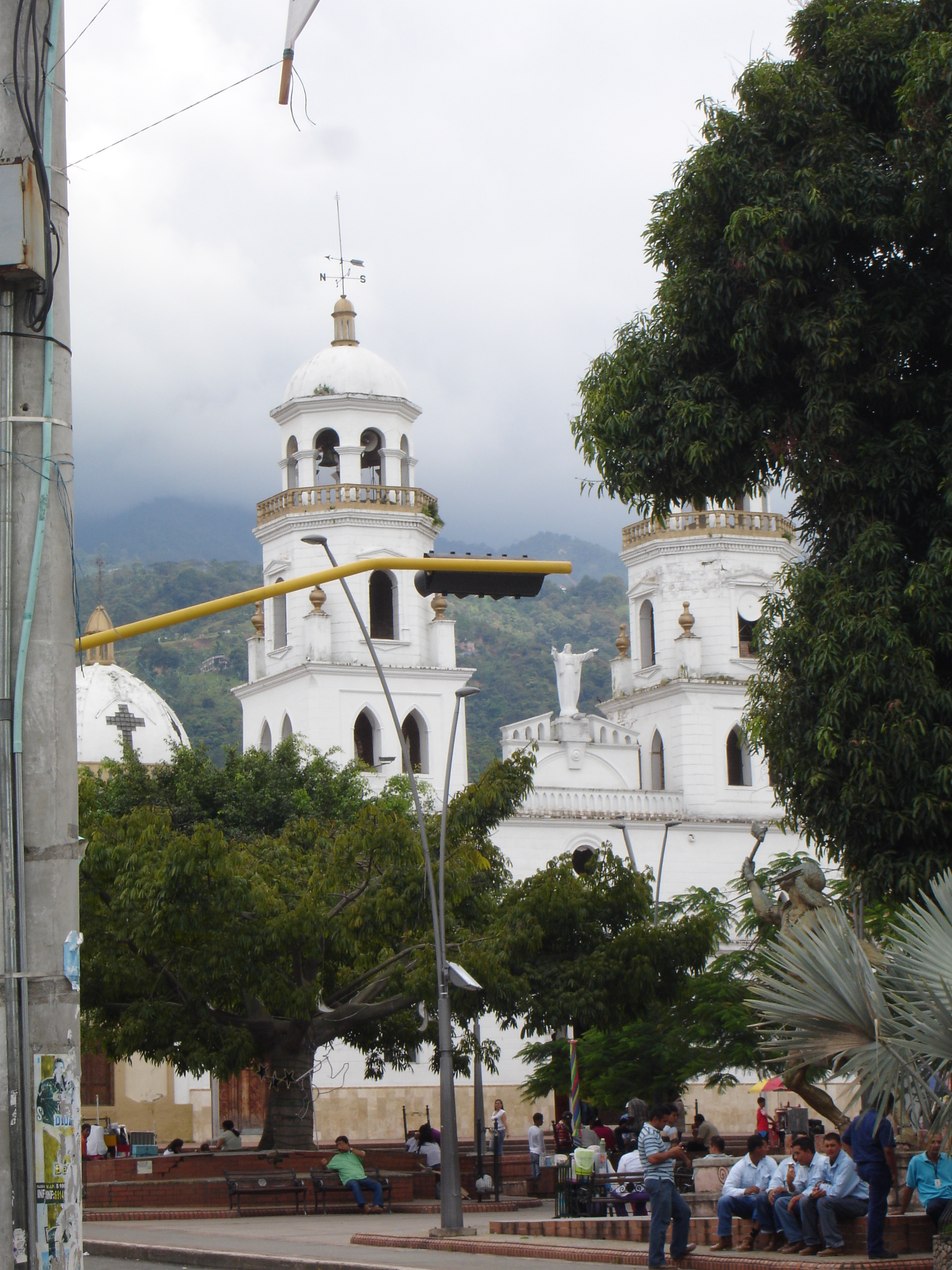
In order to be able to do an in-depth study of a) how support for joint capacity building in rural areas is organized and b) how this support is evaluated by its beneficiaries, I narrowed my case study area down to one municipality: Floridablanca.

Main square in Floridablanca

Continue reading

Excursion to Los Maklenkes nature reserve

Last Monday (21st of November), I participated in a field trip to Los Maklenkes nature reserve on top of the mountain La Judía in the municipality of Floridablanca, close to Bucaramanga. This nature reserve is managed by the peasants living around the reserve and, amongst others, sponsored by the Dutch state lottery. The field trip was part of the festival for urban-rural dialogue, in which I participated the previous weekend.

Los Maklenkes Nature Reserve, Floridablanca, Colombia

The day started with a gathering of all participants to make our way up the mountain to the nature reserve. It was an adventurous drive with 16 people in one Jeep, going up steeper and steeper mud-paths. I dared not to look to the right where the mountain was falling as steep to the ground as the road was crawling up.

Upon arrival at the entrance of the park, we were greeted by the local peasants and informed about the history of the nature reserve and its aim to protect biodiversity and water reservoirs. Following the introduction, we switched into our rubber boots and commenced with a three hour hiking tour through the reservoir.

Getting ready for our hike

Here, we saw the organic agro-forest farming activities which are being initiated under the facilitation of Fundaexpresión, a local NGO for promoting participatory research activities and education in peasant communities. I saw plantain and banana trees, coffee plants and avocado trees.

Banana tree

Following our hike, we settled in the communal house of the reserve to discuss nature protection activities in the high Andes and their impact on the livelihoods of peasants. At the end of the discussion, it was agreed that the provision of information and the creation of knowledge at local level was the most crucial point in enabling local peasants to deal with the resulting pressures on their livelihoods. The provision of information and the facilitation of capacity building were, however, regarded as poor. It was agreed that more attention must be given to the provision of information and the facilitation of capacity building at local level should peasants be enabled to deal with pressures on their livelihoods resulting from nature protection activities.

On the trail of regional learning in rural Colombia

Over the last two and a half years, we have been investigating arrangements to support regional learning in various rural areas across Europe (EU-project DERREG). This intense period of field work and data analysis has given me a first idea of just how complex this subject is, how diverse supportive arrangements can be, and how dependent their success is on the regional contexts in which they are implemented.

As if this complexity is not already enough to ponder about, my curiosity and interest in mutual learning for development has urged me to also investigate this topic outside the European Union. I was particularly interested in questioning how rural regional learning is supported in, what is commonly referred to as, “developing” countries. So, here I am in Colombia,

Downtown Bogotá, Colombia

Continue reading

Is facilitating citizen initiatives a food strategy?

One can be quite busy at the moment just going to interesting food strategy events. After all, it is harvesting time. Hence, we have the Week of Taste with activities all over the country and the Capital of Taste which is Groningen this year and the Food4You festival in Wageningen and.. probably many more events that I am not aware of. The Capital of Taste activities are situated inside the City of Groningen but in the meanwhile the city is also involved in the making of a Regional Food Strategy. Not so easy (see also Foodlog blog). What is the region? The province with its capital city? Or the administrative region Groningen-Assen which cuts across two provinces? (and who has money? Labeled for what?)

Moreover, what is the problem? Again, difficult. Maybe broadly covered under the heading of ‘urban-rural relationships’ but in fact more narrowly focused on how to get the urban citizen to buy regional products (with no specific focus on sustainable agriculture). Is this a problem? Not really, it is a chance it was agreed in the meeting. A chance which could be facilitated by the government without standing in the way. So there you have your strategy and it resonates with Hinrichs (2000) defensive localism.

It also resonates in another way with Proeftuin Amsterdam, where also the key focus was to facilitate initiatives already there. The task; bringing together, connecting, inspiring, communicating across the energy which crystallizes in a particular topic, food is the hottest at the moment. “We should ask ourselves, where is the energy is flowing towards” I heard in the meeting. Hence, the most important driving force of Proeftuin was according to a presentation, the attention for citizen initiatives. A conclusion too in the Schuttelaar debate in Wageningen, same day. Research done by students of Wageningen university confirms the trend; municipalities busy with food policy/strategy/projects were those activated by their own active citizens. 

After this, the next question often asked, becomes a bit weird. How to anchor the food strategy for the long-term? There is nothing to anchor where the ‘policy’ is to facilitate citizen initiatives, this goes as long as citizens are active. Proeftuin Amsterdam does not exist anymore. Amongst others because there was no political problem (“er lag geen bestuurlijke vraag”). Food security, policies for social exclusion and poverty and access to good food, problems the Food Banks now address, were deliberately not part of the Proeftuin focus.

So what’s wrong with stimulating enthusiastic citizens busy with creating sustainable food systems in various ways? Nothing of course. However, if that’s all, it seems that despite the many ‘nice’ activities, food keeps being seen as a private responsibility. There is a serious problem in the articulation of public interest addressing structural problems in our food system and in fact, no attention at all for social justice. Do-it-yourself for those who can.

Rural regional learning in the Comarca de Verín, Galicia, Spain

Within the European research project DERREG, we are investigating how public policy can best be arranged to stimulate capacity building within development initiatives operating at grassroots level in rural areas across the European Union.

To find out how public policy interventions can best be arranged, we and our research partners have spoken to various stakeholders in different rural regions across the European Union to find out how they intend to support and facilitate learning and innovation and- most importantly- how the support and facilitation agreed upon is actually provided to the grassroots development initiatives. To find out what is working well and what isn’t working well yet, we have spoken to a number of grassroots development initiators in the participating DERREG case study areas and ask them to evaluate the current support and facilitation received.

To be able to compare the results obtained in the different case study areas, I have travelled to Alytus County, Lithuania in October and Oberlausitz, Germany in December of 2010. In January of this year, I was able to visit our colleague Lola Dominguez Garcia of  Universidade de Vigo in the Comarca de Verín in the South-West of Galicia, Spain. In this blog, we intend to share our experiences. Continue reading