
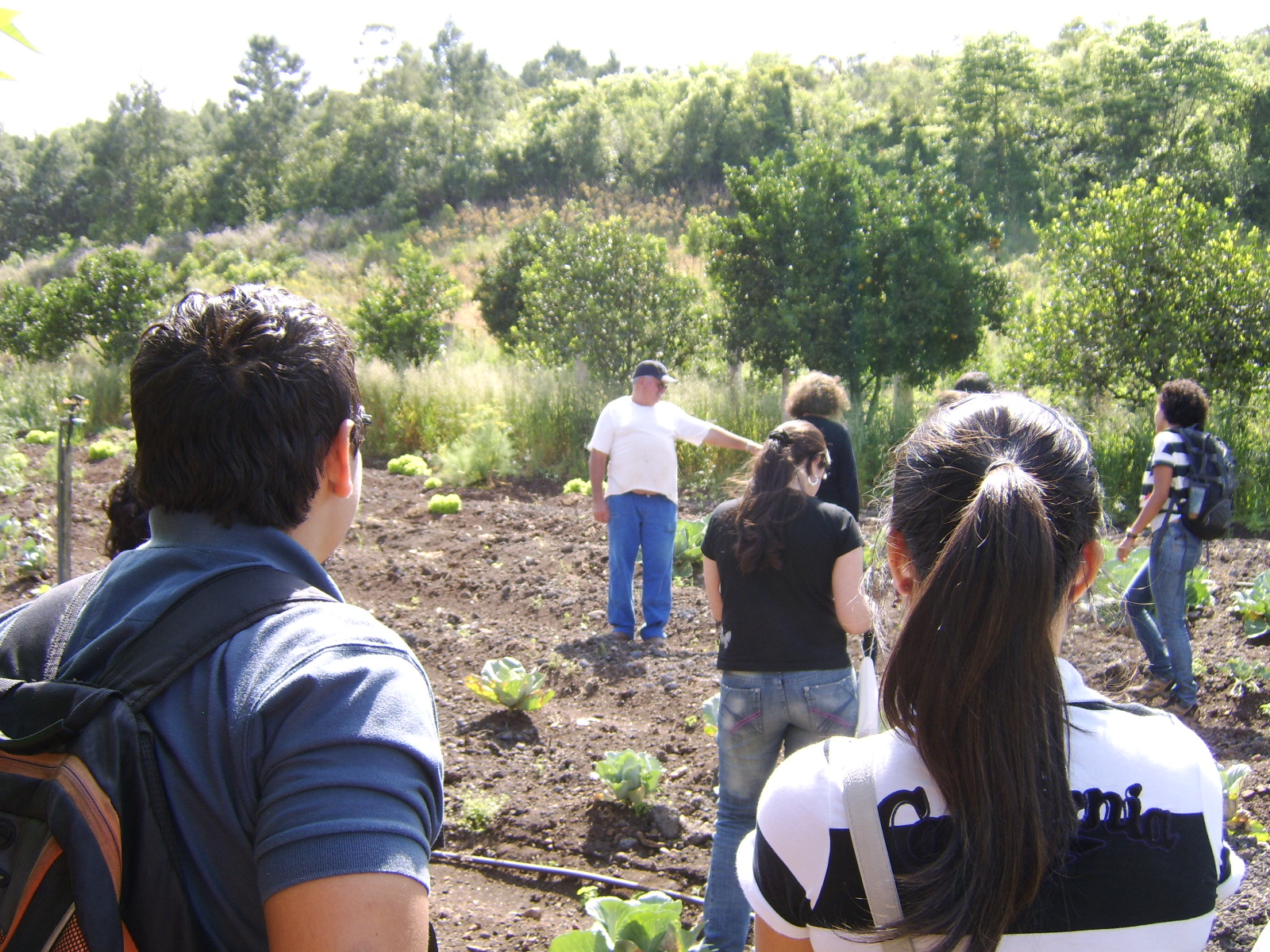
Municipal garden farmer explains
The Brazilian School Food Program underwent a lot of changes and, as posted earlier, the biggest change is related to localisation of the school meals. Previously, national menu’s with national tendering contract for enormous quantities to which only big companies were able to bid competitively were what the program was about. To give an idea, for 2010 the estimation was a total school food procurement market of 3 billion dollar providing food for 47 million students. Now cities and municipalities are responsible for contract tendering and supply selection. This has created opportunities to shorten the food chain although many municipalities still follow the logic of mass production and long supply chains (Triches and Schneider 2010). Therefore, additional Law 11947 created the rule that 30% of fresh produce has to come from the ‘family farm’.
Opportunities, but it has also created challenges. At municipal level, capacity is now assumed for things like the nutritional balance of menu’s based on local products, the legal process of tendering and supplier selection with many more suppliers and overseeing the many other issues such as logistics. Not all municipalities do have this capacity yet. Equally, not all ‘family farmers’ are equipped to supply particular quantities and collaborate with colleague farmers to meet demand.
However, in the State of Rio Grande do Sul many good examples can be found too. One of these is the school food program in the city of Dois Irmáos (see also Triches and Schneider 2010 in Portuguese). The municipality created a municipal ‘huerta’, a vegetable production garden which produces almost all greens for the school meals. Furthermore in collaboration with Rural Extension a pool of 160 family farmers is working with the program. Every 6 months, the municipality calls a tender to buy its supply for the coming half a year. Each time, 10 to 15 farmers of this pool are selected to supply foods like potatoes, onions, milk and meat. Although the bureaucracy involved in this tendering process is one of the biggest problems, the family farmers are not subject to the same legal scrutiny as is normal for other products. Buying from family farmers is done through a separate program PAA (Food acquisition program) where a certificate is needed which proves that the farmer can be classified as a ‘family farmer’ but where the language is different and the product descriptions simpler such as ‘salad’ or ‘potato’ rather than a legal description. The after-school which we visited invested in its own meat-cutting room in response to buying fresh meat from local farmers. Local nutritional studies show that the children like the meat and other food better. 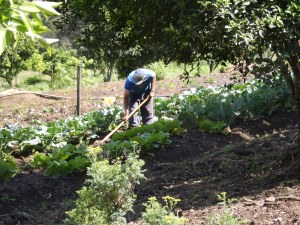

 It was very stimulating the hear the speech of Boaventura de Sousa Santos last Monday also because we use his theories in some courses. He pointed to the hegemonic epistemologies of the West which render other knowledges invisible and/or insignificant. However, the current economic/financial crisis in Europe creates turbulence in conceived concepts. Who knows the West can learn from other epistemologies such as from indigenous people in the South to overcome the theoretical exhaustion, he provoked. Also Patricia Allen challenged us to “illuminate our epistemological frameworks and interrogate our ideology constructions” (such as ideas on the free market).

 Rural Sociology Wageningen University