The Black Gold

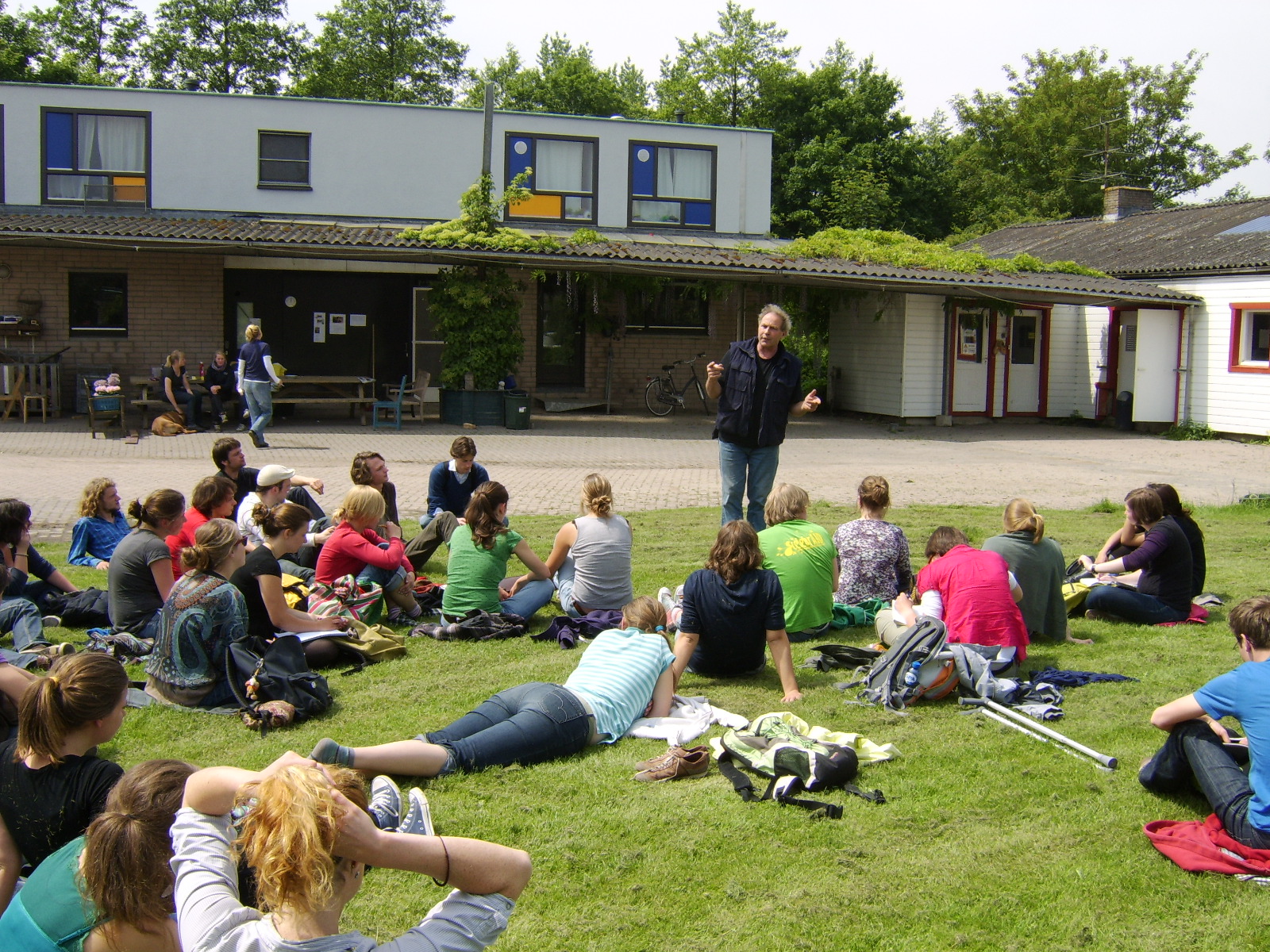
Last week, students of the course ‘Agrarische en rurale ontwikkeling, sociologische perspectieven’  had two days of excursions and could choose from 4 different excursions to see different models of multifunctionality and institutional arrangements in farming (see Birgit’s blog about a different excursion). With our group, we visited the Stadsboerderij Almere and the nearby Zonnehoeve in Zeewolde. Both farms have different other activities related to farming, such as school education, cattle in nature reserves, home sales of products, relations with care institutes.

Both are also organic farms, or better; bio-dynamic farms, which goes a step further in closing the nutrient cycle than organic farming. The nutrient cycle turned out to be the key to understanding the multifunctionality of these farms. At the very core of it all was what Tineke called ‘the black gold’; good quality manure, the essential ingredient for a healthy and productive farm without dependence on external input.

To illustrate her point, she took a handful of manure from last year and encouraged students to smell it. Hesitantly a few did. To their surprise it did not smell bad. The mixture of straw, urine and feces of the beef cattle was far into the composting process. It smelled more like soil than like shit….

At the Zonnehoeve they heard again about the importance of building soil. Piet told many unusual stories which illustrated that building soil is quite literally building a resilient farm. He showed his long list of activities in which he diversified which dazzled the students (amongst others, a bakery, permanent housing for caretakers, facilities for therapy with horses, internet shop). But starting with his dairy herd, he emphasised the importance of  Tineke’s ‘black gold’ too.

The centrality of the herd in the farming philosophy of both the Stadsboerderij and the Zonnehoeve, illustrates very well the theoretical framework which the students had learned in class (see Ploeg et al 2003). Grounding the farm in this vital resource  for a healthy nutrient cycle, both farmers deepened their farm strategy by shortening the supply chain whilst delivering high quality organic produce and from that solid base they broadened their farm with new additional functions. Tineke explained this by showing her ‘black gold’, which had brought good economic revenue of their core activity; producing food (e.g. onion, pies, carrots) which made it possible to invest in an entire new facility consisting of a farm-house and barn for a further expansion into care farming.

AspergeGilde Peel en Maas

Het AspergeGilde Peel en Maas is een samenwerking van 25 aspergetelers uit de gemeente Peel en Maas. De telersgroep werkt samen met een aantal lokale restaurants, kookstudio’s en recreatieondernemers, ook wel de vrienden van het AspergeGilde genoemd. Het AspergeGilde heeft de volgende doelstellingen:

  • promotie van de Peel en Maasregio als aspergeregio
  • bevordering van de aspergeconsumptie door nadere kennismaking met deze groente en de productiewijze ervan

Met doet dit onder andere door het organiseren van aspergearrangementen (bezoek aan een aspergeteler in combinatie met een aspergemaaltijd in een lokaal restaurant), fietstochten door het gebied, kookworkshops, etc… Elk jaar wordt het aspergeseizoen geopend door middel van een aspergemaaltijd voor een grote groep genodigden. Dit jaar vond de seizoensopening plaats op 28 maart.

Voor meer informatie over het AspergeGilde Peel en Maas verwijs ik naar het onderstaande promotiefilmpje.

Can farmers inform policy about multifunctional agriculture?

By Leonardo van den Berg (MSc. student International Development Studies, Wageningen University) & Klarien Klingen (graduate International Land and Water Management, Wageningen University).

On the 8th of October we participated in the mini-conference about multifunctional agriculture organized by the Rural Sociology Group. We would like to share some thoughts about the conference and relate them to our thesis research experiences in Brazil.

Gianluca Brunori spoke of the benefits of multifunctionality in Tuscany. Here, farms are not merely production spaces rather:

  • Educational sites where children learn about biodiversity and breeds of animals.
  • Sites where farmers are community leaders and negotiate with public institutions.
  • Sites where food quality is negotiated with consumers and subsequently created. This not only entails consumers’ feedback on wine but also farmers educating consumers on what other parts of a cow are edible.

These thoughts turn past and present public concerns of educating farmers upside down and coincide with our thesis experiences in Brazil, where we studied a movement of innovative peasants. Here, farmers refused to be assigned a role as a poor class and instead re-established their role as experts over production, consumption and the environment. Their knowledge, farming systems, and achievements surprised social and natural scientists.

Roberta Sonnino and Katrina Rønningen focused on state policies. Sonnino criticised the little support UK policy grants to multifunctional agriculture. She argues that the UK equates best value with low costs. The few developments in multifunctional agriculture have occurred despite rather than thanks of state action. An exception is the Scottish case where an increase in organic and locally produced school meals gained €150.000 of regional revenues. Rønningen showed us another picture: in Norway multifunctionality has been embedded in society for a long time. She says it started with market demand and that it is now supported by policy: the government aims at having 20% of the food locally produced by the year 2020. Farming as a profession is highly appreciated by the public: farmers are seen as managers of cultural heritage and as producers of healthy food.

Two things struck us about these two cases. First, the UK case shows how difficult it is to penetrate the neo-liberal armour that defines not only political but also much of our own rationality. Policies are often perceived as an obstacle rather than as enabling factors. It was this hostile context in which Brazilian peasants operated. Through diversification, agroecology, and community forms of exchange these peasants have increased their autonomy enabling them to pursue their own values. Second, the case of Norway gives us a taste of the role public policies could play in the valorisation of farmers as (re)producers of healthy food, nature, landscape, biodiversity, and public health. That most governments are lacking this is no secret, even according to a market oriented, middle size farmer in our research area:

I could fence a water source, buy some wire and provide some poles. If it were more, how do you say; all this imprisonment of all that is commerce, if it were more humane, looked more at the human side, I think there would be more left and all of society would gain from this (interview November 2009).

In short: we would argue that that the lessons from the third world should not be underestimated. Our experience learns that some of these cases may be running well ahead of theory and policy practice.

New ideas, but where are the new policies?

On behalf of Merel Heijke: second year student Master of International Development Studies at Wageningen University.

Thursday the eight of October I took part in the mini-conference: ‘Dynamics and Robustness of Multifunctional Agriculture: Lessons from abroad’ organized by Wageningen University’s Rural Sociology Group. I participated in the conference because since I came to Wageningen to study International Development Studies (I did my bachelor in interdisciplinary social science at the University of Utrecht), I really got interested in the way life is approached by people in the countryside. The topic multifunctional agriculture however, was quite new to me. Some considerations:

This conference opened my eyes about the difficulties people can face with certain top-down rural policies. The Norwegian guest Katrina Rønningen argued that too much attention and pressure is directed towards rural actors active in multifunctional agriculture. People that do not have sufficient knowhow and capacities to adjust their business to this way of life, fail and get into a lot of stress. This might be a consequence of a second point of view that struck me that afternoon, namely: policies implemented by the (national and/or local) government may not be relevant or can even hinder the development of new ideas. From a sustainable point of view: if we, as the global society, want to sustain the luxurious life we have, we need to adapt. Export versus quality, economical versus sustainable, short-term incomes against long-term investments – the choices are hard to make when governmental policies do not really support new initiatives (even the cheap ones) or the advertisement to the big public. An interesting topic to study…

I am very curious what the future will bring us… How will our food be produced in twenty years? What does our relationship with the countryside look like? How is our land going to be used? Let’s have an other conference about this subject in five years! This international exchange of information was really interesting and asking for new thoughts to develop. I am hungry for more!

Merel Heijke

Terugblik kenniskringbijeenkomst: buitenlandse ervaringen multifunctionele landbouw

Op donderdag 8 oktober jl. organiseerde de vakgroep Rurale Sociologie van Wageningen Universiteit een discussiebijeenkomst in het kader van het onderzoeksproject: “Dynamiek en Robuustheid van Multifunctionele Landbouw”. De bijeenkomst kende het uitwisselen van buitenlandse ontwikkelingen en ervaringen met multifunctionele landbouw als doel en was met 70 deelnemers goed bezocht.

Een korte terugblik op de bijeenkomst en de presentaties van de internationale sprekers zijn te vinden op het weblog Dynamiek en Robuustheid van Multifunctionele Landbouw.

Discussiebijeenkomst buitenlandse ervaringen van multifunctionele landbouw