Wanted: Students for an international experience!

Every year, the Rural Sociology Group participates in a two week intensive programme on rural development in the EU. A diverse group of students from various European countries (a.o. Portugal, Poland, Germany, Hungary, Italy, Spain, Lithuania, Slovenia) work together on a case study. Through lectures and field trips scientific and practical knowledge will be aquired and then implemented in the case study analysis. See past experiences of Marlies, Petra and Wiebke
 
This year the IP is organised by the university of Padova and takes place in San Vito Di Cadore in the Italian Dolomites. The general topic is: “the role of agriculture in territorial identity and competitiveness of rural areas”. More specificly, the general question is related to how these (territorial identity and competitiveness) contribute to rural development in the Dolomites (Alps region). For more information on the content see below. 
 
Are you a student of Wageningen University and looking for an international learning experience? Then sign up for two intensive weeks from 3 to 16 April 2011! For subsciption or more information contact Els Hegger (els.hegger@wur.nl). 
 

Rural regional learning in ‘Upper Lusatia’ (Oberlausitz), Germany

Following my visit to Alytus County, Lithuania in October, I travelled to Leipzig, Germany to visit our DERREG project partners Michael Kriszan, Robert Nadler and Joachim Burdack (Leibniz Institute for Regional Geography) in their case study area ’Upper Lusatia’. In this blog, Michael, Robert, Joachim and I would like to share some of our experiences.

We first discovered that the case study regions Westerkwartier and Upper Lusatia are very different in their geographical and demographical characteristics. The LEADER region Westerkwartier in Groningen province comprises four municipalities on an area of 374km² and has a population density of 173.4 inhabitants/km² (as of 2007). In 2006, its GDP per capita was estimated at 55,400 Euro and the area has recently witnessed a population increase due to its popularity amongst young families who work in the city of Groningen and value the countryside as their residential area. The Southern part of the Westerkwartier is thus characterized by a high population density and a number of conflicting interests regarding the use of the countryside while the North of the Westerkwartier is primarily used for agriculture.

Upper Lusatia consists of the two Saxon districts Landkreis Görlitz and Landkreis Bautzen that have only been established in 2008 in the process of a reform of the administration units in Saxony. The case study region has an area of about 4,500 km² and has a population density of 135 inhabitants/km². It comprises 122 municipalities- of which 30 are urban centers- and had a GDP per capita of 18,329 Euro (district Görlitz) respectively 19,396 (district Bautzen) in the year 2007 . The region is divided into ten rural development areas, six ILE regions and four LEADER regions. In contrast to the Westerkwartier, the population of Upper Lusatia is shrinking rapidly. Young inhabitants are leaving the area due to a lack of employment opportunities, leaving the elder people behind. Rural development in this region is therefore not only affected by an aging population but also by a shrinking human capital available for development purposes. Through the reform of administrative units altogether four previously distinct districts (Landkreise) and two cities (kreisfreie Städte) have been incorporated into the two “new” districts of Görlitz and Bautzen. The previous Landkreise, however, are very distinct in their physical appearance. The former district Niederschlesien-Oberlausitz for example is characterized by a low population density and shaped through past and present coal mining activities while the hilly district Löbau-Zittau is recognized as a touristic area and winter sport resort. Due to the lack of a common history and the physical distinctiveness, there is no regional identity of the population within both districts.

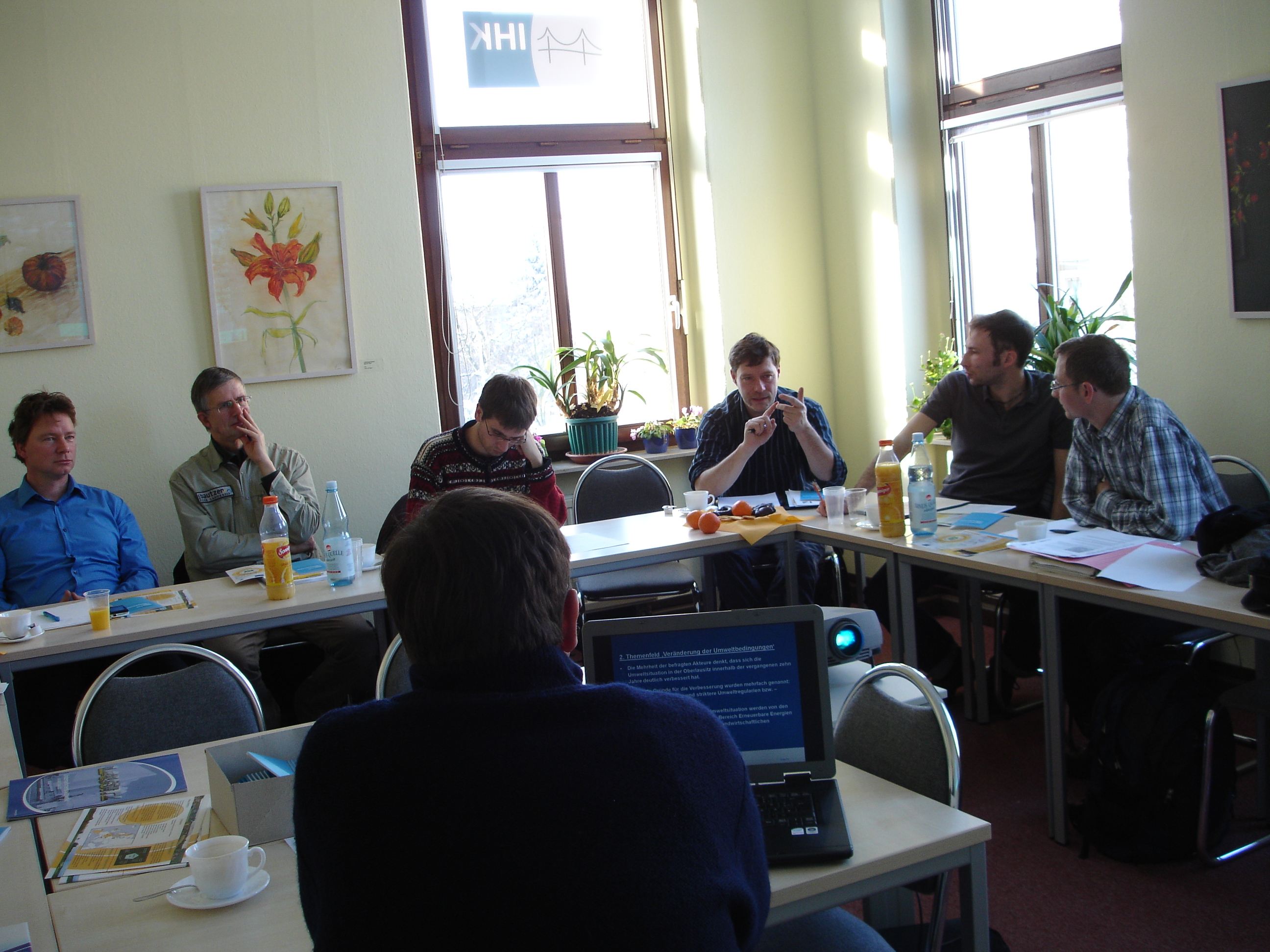
To evaluate the support and facilitation available for learning and innovation within local grassroots development initiatives in Upper Lusatia, Robert, Michael and Joachim organized a workshop for regional stakeholders.

Workshop in Upper Lusatia, Germany

Continue reading

Conference on leadership, 23-24th of November 2010, Birmingham.

This conference was organised by the Regional Studies international research network on leadershp, at the University of Birmingham. This is an overview of the highlights. For more information, please contact lummina.horlings@wur.nl.

Prof. Joyce Liddle of the University of Nottingam described the recent policy shift in the UK. The New Coalition advocates ‘The Big Society and social enterprise’. The Regional Architecture has completely changed, which resulted in the demise of Regional Development Agencies. The Coalition’s vision is expressed in three values: freedom (frameworks with support social responsibility and civil liberties), fairness (those we cannot we always help) and responsibility (those we can, do). The means are e.g. Public Service Reform and A Smaller State. This is expressed in the slogan ‘A Big Society matched by Big Citizens’. New Local Enterpreneurs Partnerships (LEP’s) have now been launched. Prof. Liddle analyses the role of leadership in these LEP’s, based on the concept of auxiliary leadership. Liddle argues that only by having a clearer understanding of the role of auxiliary leadership in the dynamics of local and regional governance, we can better understand how collaborating state and non-state articulate and foster the necessary change processes.

Andrew Johnston of the University of Sheffield talked about Public Sector Entrepreneurship and leadership of the urban and regional development process in the UK. He distinguishes two notions of public entrepreneurship 1) Occupational role of leadership 2) Behavioural role of entrepreneurship.

Conditions for public sector entrepreneurship are according to Boyett: a  devaluation of power to a lower level; a re-allocation of resources to a lower level and an uncertain environment. Characteristics of Public sector entrepreneurship are: a) innovation b) Promoting change c) making decisions d) taking responsibility e) identify opportunities f) influencing stakeholders g) shifting resources h) influencing localities, form and use of goods, resources and institutes. Several conflicts between public entrepreneurship & democracy can be identified: 1) Autonomy versus accountability 2) Vision versus participation 3) Secrecy versus openness 4) Risk taking versus public stewardship.

Prof. Andrew Beer, University of Adelaide in Australia described the case of Waikerie District. The scale of policy arrangements in Australia is much smaller than those evident in the UK and Europe. Compared to Europe leadership is small scale, community based (community building); has a private sector orientation (short term success possible, but long term?), independent of government processes, a characteristic of individuals instead of an achievement of groups, and has a weak relationship with politics and governance. The case of Waikerie showed that: 1) formal government/governance processes can impede leadership in Australia’s regions 2) leadership carries costs that may not be paid easily by communities that have neither large scale institutions (eg universities) or large businesses 3) leadership roles can have adverse impacts on the lives of leaders 5) lack of knowledge on regional development processes and governance processes make it difficult to establish a ‘leadership relay’. 6) sustaining leadership is the most significant hurdle, not the identification or formation of leadership 7) failure in leadership may have compounding impacts.

Dr. Basilio Verduzco from Mexico uses game theory to analyse coalitions in urban development. He sees leadership as negotiating.  Interesting is his description of tensions in leadership which leads to three roles: being a partner, promotional leader and mediator. He uses Sharpf’s strategies from altruism till hostillity. Traditional roles of leadership in Mexico are 1) corporatism 2) caudillism and corrupt clientism. Based on the case in Mexico he distinguishes three types of leadership: solid, hollow and contested/ustable.

Juha Kostainen from the University of Tampere in Finland described the Tampere knowledge society program which object was to make Tampere the spearhead city of information society development. Kostainen described Radical Development Initiatives, not included in the official strategies. In the design stage there are various challenges such as established organizations which tend to be less radical. He identifies a new ‘Leadership-Community (Mintzberg, 2009): 1)  between leadership and citizenship 2) not a heroic type of leadership 3) engaged and distributed management 4) neither micromanaging nor ‘macroleading’ 5) “a community leader is personally engaged in order to engage others, so that anyone and everyone can exercise initiative”.

Prof. John Goddard from the New Castle University, presented about the role of the civic university and the leadership of place. He looked at this theme based on policy and academic discourses. The argument is that universities can create the divide between these discourses, this is a leadership challenge. He models universities and leadership of place as overlapping circles: political, managerial and community leadership, with in the middle intellectual leadership.

Prof. Markku Satorauta, University of Tampere in Finland, described why and how to study institutional entrepreneurship, see also his website.  How to create change? An important role can be played by institutional entrepreneurship. Institutional entrepreneurship is a relay in time, multi-scalar and multi-actor. Institutions are more often than not seen as sources of stability and not as sources of change and innovation (Scott). But there is a need for change. Leadership is about creating a way for people to contribute to making something different happen. The champions of regional development are however constrained by the very same institutions they aim to change (embedded agency). The case study of stem cell research shows how breakthrough treatments developed and that leadership is about connecting interpretive power, network power and institutional & resource power in the different phases of the process. You need different types of knowledge as well: substance knowledge, policy knowledge, process knowledge. The case shows that institutional entrepreneurship is a multi-scalar and multi-actor process. It is a relay in time. Different actors surface in different phases of development. It is a constellation of different skills, competences, knowledge and power.

FAQs for PUREFOOD vacancies

We have received a high number of inquiries with regard to our 12 PUREFOOD vacancies. It is good to see there is so much interest in these topics!
Most reactions were inquiries about similar issues. Therefore, we have prepared a list of FAQs for the PUREFOOD vacancies. Please have a look at this list of FAQs before sending us an e-mail!

PUREFOOD – 12 vacancies for ESRs are open

As mentioned in an earlier post on this weblog, the Rural Sociology Group has been granted the the coordination of a Marie Curie Initial Training Network  entitled ‘Urban, peri-urban and regional food dynamics: toward an integrated and territorial approach to food (PUREFOOD)’ funded by the European Commission’s Seventh Framework PEOPLE program. The objective of PUREFOOD is to train a pool of 12 early-stage researchers (ESRs) in the socio-economic and socio-spatial dynamics of the (peri-)urban and regional foodscape. The PUREFOOD network is centred around food as an integrated and territorial mode of governance and studies the emergence of the (peri-)urban foodscape as an alternative (as opposed to a globalised) geography of food, including the ways in which, and the extent to which, sustainability aspects generally considered to be intrinsic to the alternative food geography are incorporated by the more conventional food companies.

As of now all 12 PUREFOOD research vacancies have been published (or soon will be) by the host universities. For information about the ESR vacancies and application guidelines, you can download the PUREFOOD vacancies leaflet. For more information about the objectives, training and research approach and training program of PUREFOOD you can download the PUREFOOD information pack for prospective ESRs. The deadline for application is 3 January 2011.

Eligibility criteria

The enhancement of transnational mobility to improve career perspectives of early stage researchers is the main goal of the Marie Curie Initial Training funding. To achieve this objective the following eligibility criteria for prospective ESRs have been formulated:

  • You are eligible as an ESR if you are, at the time of recruitment (i) in possession of a university degree, and (ii) have a maximum of four years of full-time research experience, including any period of research training. This is measured from the date when you obtained the degree which formally entitles you to embark on a doctorate, either in the country in which the degree was obtained or in the country in which the research training is provided. Please not that ESRs cannot be PhD holders.
  • You are eligible to the position if, at the time of the selection by the host university, you did not reside or carry out your main activity (work, studies, etc) in the country of the host university for more than 12 months in the 3 years immediately prior to your recruitment.

If you have any questions about a vacancy please contact the contact person mentioned in the vacancy announcement. For general question about PUREFOOD please contact me (han.wiskerke@wur.nl).