Unknown's avatar

About Dirk Roep

I have retired as Assistant professor at the Rural Sociology Group of Wageningen University. I continue though to be involved in various initiatives and research on different modes of regenerative agriculture, food provisioning and place-based development.

Kracht van koeien – vier ontwerpen voor een duurzame melkveehouderij

Brochure 'Kracht van koeien' Gisteren is het resultaat van het project ‘Kracht van koeien‘ gepresenteerd: een prachtig geillustreerde brochure met vier ontwerpen voor een duurzame melkveehouderij, waarmee zowel de wensen en eisen van de koe, de ondernemer, het milieu als de burger gediend zijn. De ontwerpen zijn gebaseerd op een vernieuwende ontwerp-aanpak voor systeeminnovaties in de veehouderij ontwikkeld door prof.dr.ir. Peter Grootkoerkamp (peter.grootkoerkamp@wur.nl) en dr. Bram Bos (bram.bos@wur.nl)  van Wageningen UR. 

Zo doen de projectleiders in Kracht van Koeien afstand van een traditionele stal voor melkvee. Ze stellen dat het beter is als koeien zelf kunnen kiezen of ze buiten staan of onder een beschutting. Ook maken ze werk van het opvangen van mest en urine. Die komen weer van pas als kunstmestvervanger. ‘In Kracht van Koeien doen we voorstellen voor anders denken en anders doen’, zegt Groot Koerkamp. ‘Ze vormen de basis van de ontwerpen. Let wel: geen van die voorstellen is speciaal ons idee. Allerlei onderzoekers, boeren en andere praktijkmensen zijn er al jaren mee bezig. Wij zetten ze alleen in samenhang om te laten zien dat ze mét elkaar een meervoudige sprong in duurzaamheid bereiken.’

Evolution of Rural Development Paradigm in Brazil

In a recent research seminar prof. Sergio Schneider (schneide@ufrgs.br), coordinator of the  Rural Development Post Graduate Program from the Federal University of Rio Grande do Sul (Brazil), presented a telling analysis of major changes in Rural Developments Policies in Brazil in the last twenty years. He explained that the recent evolution in rural development policies, as effectuated by president Lula, has to be understood within the context the evident political struggles on land. Brazil is a large country with traditionally a sharp contrast between the interests of agro-industrial conglomerates and social rural movements of landless people and peasants (e.g. MST).

This is reflected in a dualist agrarian structure between capitalist and entrepreneurial family farming and peasant familiy farming and rural poor (landless) who are struggling for survival and autonomy. In 1995 1 % of the owners with more then 1000 ha owned 45% of all land, while 90% of the owners with less then 100 ha owned only 20%. An unexpected and striking consequence of rural poverty is, that food security in rural areas is significantly lower then in urban areas. In rural areas 26% of the housholds suffers severe food insecurity versus 17% in urban areas. Because of this dualist agrarian structure Brazil is probably the only country in the world with two Ministries of Agriculture, serving different needs.

Continue reading

Landschapskwaliteit en verbrede landbouw

Schaalvergroting van agrarische bedrijven zal veel kernkwaliteiten van Nationale Landschappen verder onder druk zetten, zo luid de conclusie van het in 2008 gepubliceerde WOT-rapport Helpt boeren de Nationale Landschappen. De negatieve effecten van schaalvergroting kunnen deels opgevangen worden door meer verbredingsactiviteiten in te passen als aanvulling op het inkomen. Bij hervormingen in het Gemeenschappelijk Landbouwbeleid van de Europese Unie kan gerichte inkomenssteun voor maatschappelijke diensten ingezet worden.

neven-voorpagina-thesis3Er zijn volop potenties, maar de relatie tussen verbrede (of multifunctionele) landbouw en landschapskwaliteit is niet zo eenduidig en evenmin vanzelfsprekend, zo bleek uit een afstudeeronderzoek van Kees Neven in het Groene Woud. Wil verbrede landbouw bijdragen aan landschapskwaliteit dan moet daar zowel op bedrijfsniveau als op gebiedsniveau richting aan worden gegeven. In Het Groene Woud doet probeert men dat met een Streekmerk, maar ook andere gebieden als de Noordelijke Friese Wouden is op zoek hoe dat handen en voeten te geven. Het belonen van (hoogwaardige) groene diensten die bijdragen aan landschapskwaliteit kan ondernemers hierin stimuleren.

Urban agriculture blogs

http://www.buildinggreen.com/auth/article.cfm/2009/1/29/Growing-Food-Locally-Integrating-Agriculture-Into-the-Built-Environment/

City Farm Chicago

Urban agriculture, city farming  or in Dutch ‘stadslandbouw‘ is getting more and more into the spotlight. Even though not new, it’s getting new significance and seem to be a growing phenomenon worldwide. One of the ways to keep in touch with new iniatives around the world is to take a RRS-feed on a blog, as I recently discovered myself.  Interesting blogs are e.g. City Farming News, covering news on worldwide initiatives with photo’s and video’s, and the  Dutch ‘Stadslandbouwblog‘ initiated by ‘Eetbaar Rotterdam‘ covering iniatives in and around Rotterdam but also from far away.

Rural development in Brazil

fabio_kesslerProf. Fabio dal Soglio from the Federal University of Rio Grande de Sul (UFRGS) is currently our guest. He is one of the professors working in the Post-Graduate Programme on Rural Development (PGDR) and he has a particular interest in agro-ecology.

The  UFRGS and the PGDR-group in particular wants to extend collaboration with the Rural Sociology Group, as initiated by prof. van der Ploeg, by the exchange of staff, exchange of MSc and PhD-students and by joint research.

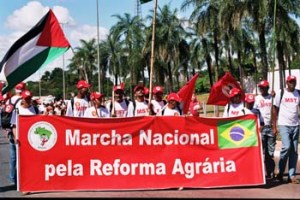
As part of an assignment for the MSc-course Sociology in Development, a group of MSc-students grasped the occasion and interviewed prof. Fabio dal Soglio on the Landless Workers Movement (MST) in Brazil and their struggle for land and land reforms.

mst-21Quoted from the MST-website (English edition):

 The MST is the largest social movement in Latin America with an estimated 1.5 million landless members organized in 23 out 27 states. The MST carries out long-overdue land reform in a country mired by unjust land distribution. In Brazil, 1.6% of the landowners control roughly half (46.8%) of the land on which crops could be grown. Just 3% of the population owns two-thirds of all arable lands.

Since 1985, the MST has peacefully occupied unused land where they have established cooperative farms, constructed houses, schools for children and adults and clinics, promoted indigenous cultures and a healthy and sustainable environment and gender equality. The MST has won land titles for more than 350,000 families in 2,000 settlements as a result of MST actions, and 180,000 encamped families currently await government recognition. Land occupations are rooted in the Brazilian Constitution, which says land that remains unproductive should be used for a larger social function.

 The MST’s success lies in its ability to organize and educate. Members have not only managed to secure land, therefore food security for their families, but also continue to develop a sustainable socio-economic model that offers a concrete alternative to today’s globalization that puts profits before people and humanity.