Benefits and constraints for certification of agro-ecological farmers – MSc-thesis possibility

I am Maria Alice Mendonça, a PhD-student from the Univerity of Rio Grande do Sul (Brazil). I’m interested in the markteting and certification of agroecological food products. I’m staying at the Rural Sociology Group to study the certification of origin and organic food products in the Netherlands.

Certification can play an important role in the transition towards more sustainable food and agriculture. Yet, at the same time, rigid standards may constrain farmer innovation. To many small scale farmers certification is moreover a large financial burden. I want to investigate two or three different major certification schemes in the Netherlands. Interviews will be conducted with agroecological farmers to find the various benefits and constraints faced for different certification schemes.

I’m now looking for a MSc-is student with an interest in the topic that can assist from May 2014 onwards. Seen the interviews, preference is given to a Dutch speaking MSc student studying for example Organic Agriculture, Rural Development and Innovation, International Development Studies or Management, Economics and Consumer Studies.

If you are interested contact me: maria.alice.fcm@gmail.com or Dirk Roep: dirk.roep@wur.nl

Theoretical approaches to the ecologisation of agrifood systems – European Society of Rural Sociology 2014 Summerschool

Transitions towards more sustainable agrifood systems and rural landscapes are at the core of societal demands, technological but also social innovations and renewed public policies at various scales. In rural sociology they are addressed through different theoretical frameworks and the main objective of the ESRS PhD Summer School this year, is to discuss these competing and sometimes articulated frameworks and thereby to help the PhD students to clarify their own theoretical choices and to position them in relation to other theoretical frameworks that are used in rural sociology. For students who are rather at the beginning of their PhD, the aim will be to help them organize their state of the art and clarify their problematisation, while for students who are more advanced, it would rather be a discussion of their results in the light of existing literature and/or possibly the preparation of a future article. All the participants should have an interest in the theoretical frameworks that will be structuring the discussion, i.e. mainly Socio-Ecological Systems/Resilience theories, Food Regime Theory, Transition Theories, Actor Network Theory, and Social Studies of Science and Knowledge. Continue reading

Les Indomptables : An ethnography of niche novelty production in Walloon Agriculture (MSc-thesis)

By Vincent Delobel, MSc Regional Development & Innovation Wageningen University

My ancestors from both sides have been farming for ages. Peasants have continuously held this as ancestral as salutary art of nourishing “débrouillardise” (lit. problem-solving creativity) for ages; they have fed others in the plain as in the mountain, under dictatorship as under “democracy”. However, farmer newspapers today say we may disappear soon; ‘eternal’ peasant population rushes to the bottom.

Are we really going to disappear? How and why did we get to this situation? What is going on in farms today? What are farmers’ plans and projects? What futures do these projects lead to? This is in short the structure of my MSc-thesis ‘Les Indomptables : An ethnography of niche novelty production in Walloon Agriculture’. This alarming observation motivated me to go and see on farms in order to better see, understand phenomena going on in the reality of farms, and to reflect deeper on underlying issues. Thus, I phoned a few cousins and other colleagues and told them I was interested in their “inventivité” (inventiveness), their own way of doing things; I asked them to go and work with them in their own farm, in their daily activities -whatever it would be- to understand why and how they are looking to change their routines, i.e. for novelties.

Continue reading

Imagining Research for Food Sovereignty (video)

This video – ImaginingResearch for Food Sovereignty – highlights the outcomes of the farmer exchanges and the St Ulrich workshop deliberations.

For more information about the St. Ulrich Workshop on Democratising Agricultural Research for Food Sovereignty and Peasant Agrarian Cultures and theDemocratising Food and Agricultural Research initiative go here:http://www.excludedvoices.org/st-ulrich-workshop-democratising-agricultural-research-food-sovereignty-and-peasant-agrarian-culture

Life in the Alpujarra (Spain)

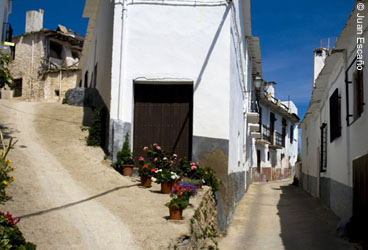
YEGEN-53Since the beginning of February my family and I have been in the Alpujarra; south side of the Sierra Nevada in Spain. We are here to experience the rough side of life: being a farmer in a tough arid land. We are trying to get a glimpse of the other side of the food story and feel what it is like to work the land (mainly by hand labour); and give our brain a bit of a rest. But despite the huge amount of physical work we do each day, the mind doesn’t rest. There is just too much going on here: the shrinking and greying villages, the contrast between coastal and hill-side farmers, the young versus the old, the ‘extranjeros’  vs the locals, fighting bush fires vs keeping a varied landscape, organic farmers selling mainstream to the world market, etc etc… I will start by telling you a bit about the village structure here, in Yegen.

Yegen is a small, typical white Moorish village in the centre of the Alpujarra. It seems just another village, but it is bit more special than all the other white towns. A certain Gerald Brenan (a British self-appointed anthropologist) was already fascinated by the life and customs in this village more than 90 years ago. He experienced Yegen as rather backwards (a way of life that he couldn’t imagine still existed) while at the same time the villagers as being extremely open to new comers. He ended up living in Yegen for about 30 years and produced a very popular book. Unfortunately, I haven’t had the chance to get a hold of a copy but I did discover a 45 minute documentary about Gerald Brenan’s return to the village in 1974 (http://www.youtube.com/watch?v=2JAAYPVsQQ4). Interestingly enough, he talks about the huge progress of the village and the change in customs and traditions, whereas to me – born in the late 1970s – it seems to be a pre-War setting. I couldn’t believe it was actually 1974; the streets were huge irregular stones mixed with sand on which only mules were to be seen, the women washed their clothes in a river, no motorised traffic at all. At the same time, Continue reading