Jan Schakel in China – part one

A group of IMRD-students from different European countries is visiting China this month, doing a case study for their International Master in Rural Development. The first part took place in Nanjing in the Jiangsu Province (200 miles west of Shanghai), where the Nanjing Agriculture University hosted the students for two weeks. Besides lectures by professors from the NAU (who actually knew Wageningen University very well, because most of them did their MSc and/or PhD at the WU!), fieldwork was done in two villages in the rural area south of Nanjing. Together with 25 Chinese undergraduate students from all over China (doing a summer school at the NAU), different households were visited and many farmers (mostly female: so called ‘left-behind-woman’, who’s husbands are migrant workers in the big cities) were interviewed. All information gathered by both European and Chinese students was presented at the university and put together in a final report (soon available on the IMRD-website).

Official group photo

More or less the same program is organized by the Chinese Agriculture University in Beijing (ranked nr. 1’s Agriculture University of China), who is responsible for the second half of the IMRD case study. The COHD (College of Humanities and Development) is hosting us, and also the COHD is a leading centre of excellence on rural development within and outside China. Among others, the COHD is monitoring, analysing and evaluating the new ‘Pro-Farmers-Policies’, as well as the New Countryside Construction Programme (2006). These new policies, programs and measures should tackle the ‘dualism’ between the rural and the urban; a very serious problem threatening China stability as a whole and the future of China’s rural areas more particularly. Part of the New Countryside Construction Program is the Village Development Program (VDP, also from 2006), which will also monitored, steered and evaluated by the COHD.

The IMRD students is given the opportunity to have a closer look at the VDP in an area 2 hours north of Beijing. Fieldwork will be done in 5 days through the use of the PRA-methodology (Participatory Rapid Appraisal) in the Bamudi village in the Yanqing county. With a group of 5 Chinese master students and their professors, farmers, village leaders and others in Bamudi-village will be interviewed and observed by means of several participatory methods.

So far this Case study is really impressive – in all kinds of ways. But: not only me, but also the IMRD-students are getting tired. It’s summertime in China, and in Nanjing (with over 8 million people) and Beijing (almost over 18 million inhabitants) it is 3xH: Hot (over 35 Degrees Celsius), Hazy and Humid, and it’s crowded everywhere. So tomorrow we will leave the city and go to the mountains, where it’s a little bit cooler (although you don’t feel the difference anymore between 38 and 34 degrees). The bad news however is that the mosquito’s are waiting for us, and that there is no internet, no air-conditioning, no shower, no shop, no restaurant nor anything in Bamudi; so it’s going to be a week really ‘doing fielwork’ , and the forthcoming days no more news on our weblog!

By the way: also in Beijing I noticed that Wageningen is rather well-known. Everybody still speaks about professor ‘Jan Douwe’ (they call me ‘prof. Jan’), who visited BAU over a month ago, and who must has done a really great and impressive job, because everyone asks me about him. However, not everyone is really pleased with him; I met a member of the COHD who is (among others) translating Jan Douwe van der Ploeg’s most recently book ‘The New Peasantries’ into Chinese, and it seems to be a ‘hell of a job’. But when it is finished -and that will be within a short period- this book will also be available to at least 1.300.000.000 Chinese people, so well done Jan Douwe!

Jan Schakel, Beijing 2009-08-01
Corn, soybean and hogs; the way we do things here

Iowa agriculture is dominated by corn, soybean, hog and ethanol production. A common feature among this list is that all of these are commodities; bulk products ready for further industrial processing. In a way, Iowa agriculture represents a single ‘farming style’ (Van der Ploeg et al), a choice for:
– a high level of specialization
– high input/high output (a throughput system)
– a high level of mechanization and reliance on technology

So, when the only thing you see growing is corn, you come to believe that Iowa is only suitable for corn, and, maybe, to a lesser extent for soybean. I came across such a conviction many times. For example, at the windmill visitors centre in Pella, I was explained how the wheat which is milled every six weeks comes from North Dakota. “Because in Iowa, you can only grow corn” the lady explained.

The omnipresence of corn, soybean and hog production has a social-coercive character.

“The habit obtains, when established, a more or less self-evident, normative character. Things do not only happen like this, they should happen like this” (Hofstee 1985 in Van der Ploeg 2003: 237).

Highly productive and efficient corn and hog production have become part of people’s identification with what good modern agriculture is all about. Something to be proud of and a status quo to be defended. This identification is not simply about knowledge and power but about beliefs and thus emotion of what is felt morally right.

In the Farm Bureau paper The Spokesman (H29/09) an author felt compelled to defend farming in Iowa, because environmentalists “impose” further unspecified “climate change rules” on farmers which lead oddly enough to environmental damage according to him. How? The logic of reasoning is startling. Basically, other countries would fill the market gap by the increased cost/decreased production is the argument. But – with empathy – the author continues that “in many of those areas, land is fragile and is prone to severe environmental degradation if it is intensively farmed.” Especially because “farming practices in the developing world are not as environmentally advanced as those in the United States.” He concludes therefore that “improving corn and soybean production right here in Iowa” is the best thing to do since Iowa is “the most efficient and most environmentally-friendly place on Earth” for it. Go figure.

Changing the agricultural landscape in Iowa is in essence a cultural change, a change in values and beliefs. The impact of the sheer presence only, of people making alternative choices, of alternative farming styles and practices such as those represented in forms of organic and local food production, cannot be underestimated. Their practice is a ‘nuisance’ because it confronts and therefore uncovers the taken for granted. Of course as the example illustrates, new awareness can be denied, but a return to unawareness is impossible.

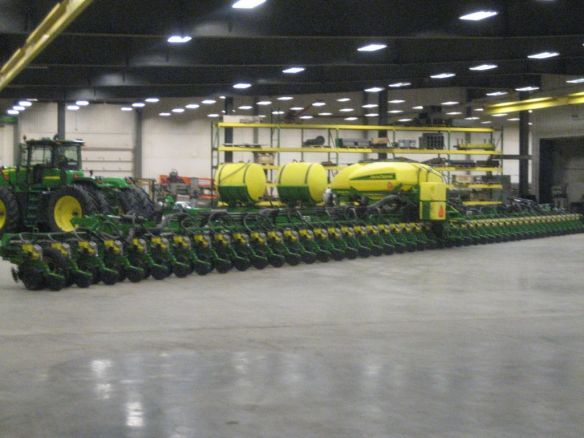
The Technology Treadmill. John Deere's new 48-row planter. From: combineforums.proboards.com

The Technology Treadmill. John Deere's new 48-row planter. From: combineforums.proboards.com

Discussiebijeenkomst multifunctionele landbouw: ervaringen uit het buitenland

Op donderdag 8 oktober 2009 organiseert de vakgroep Rurale Sociologie van Wageningen Universiteit een interessante discussiebijeenkomst over buitenlandse ervaringen van multifunctionele landbouw. Wat gebeurt er in het buitenland en wat kunnen we ervan leren?


Op de bijeenkomst geven een aantal toonaangevende internationale onderzoekers u een indruk van de ontwikkeling rond multifunctionele landbouw in Italië, het Verenigd Koninkrijk en Noorwegen. In de aansluitende forumdiscussie gaan we hierover met elkaar in debat. We verwachten ongeveer 80 tot 100 mensen uit o.a. praktijk, wetenschap, overheid en belangenbehartiging.

De bijeenkomst is interessant voor iedereen actief op het gebied van multifunctionele landbouw en meer wil weten over de betekenis van buitenlandse ervaringen voor Nederland. Als u graag over (uw) grenzen heen kijkt, dan mag u deze bijeenkomst niet missen!


Datum: Donderdag 8 oktober 2009
Tijd: 13.00 – 17.00 uur
Locatie: Landgoed Heerlijkheid Mariënwaerdt, De Hooge Schuur, ‘t Klooster 5 in Beesd


Aan deelname van deze bijeenkomst zijn geen kosten verbonden, de voertaal is Engels.


Programma

12.30 Ontvangst (koffie/thee)

13.00 Opening door dagvoorzitter

Krijn Poppe – Chief Science Officer Agroketens en Visserij, ministerie van LNV

13.05 Welkomstwoord

Frans van Verschuer – eigenaar Landgoed Heerlijkheid Mariënwaerdt, Beesd

13.15 Dynamiek en robuustheid multifunctionele landbouw – introductie onderzoeksproject en presentatie eerste resultaten

Han Wiskerke – projectcoördinator en hoogleraar Rurale Sociologie, Wageningen Universiteit

13.30 Multifunctionele landbouw in Italië – de ‘rural disctrict approach’ in Toscane

Gianluca Brunori – hoogleraar Agrarische Economie, Universiteit van Pisa, Italië

14.00 Multifunctionele landbouw in het Verenigd Koninkrijk – de rol van de staat en de publieke sector

Roberta Sonnino – universitair docent Milieubeleid, Universiteit van Cardiff, Verenigd Koninkrijk

14.30 Multifunctionele landbouw in Noorwegen – een presentatie door:

Katrina Rønningen – senior onderzoeker, Centrum voor Plattelandsonderzoek, Universiteit van Trondheim, Noorwegen (uitgenodigd)

15.00 Pauze

15.30 Dynamiek van plattelandsontwikkeling en landbouw wereldwijd – een vergelijking tussen Europa, China en Brazilië

Jan Douwe van der Ploeg – hoogleraar Transitiestudies, Wageningen Universiteit

16.00 Forumdiscussie – inspirerende lessen voor multifunctionele landbouw in Nederland

16.55 Afsluiting door dagvoorzitter

17.00 Borrel


Aanmelden

Meld u aan met het aanmeldformulier. Wij willen u er op wijzen dat er een beperkt aantal deelnameplaatsen beschikbaar zijn. Voor aanvullende informatie neem contact op met Corine Diepeveen via corine.diepeveen@wur.nl of 0317 – 484507.

De discussiemiddag wordt georganiseerd in het kader van het onlangs gestarte onderzoeksproject ‘Dynamiek en Robuustheid van Multifunctionele Landbouw’. Het onderzoek is ondersteunend aan de Taskforce Multifunctionele Landbouw en wordt gefinancierd door het ministerie van LNV.

Yet another crisis in the hog industry

During my time in Ames I met quite a few current or previous students of the Graduate Program in Sustainable Agriculture (GPSA) in which both Jan and Cornelia Flora teach. The GPSA is a truly interdisciplinary program in which students with diverse (and often international) backgrounds meet. Although each student has a ‘home department’ such as sociology or agronomy, they go through the program together as a group, learning the social, biological and economic aspects of sustainability in agriculture.

I already heard from current students that they really appreciated course ‘509’. This Agroecosystems Analysis course starts with a two week tour around Iowa, in which the students visit a wide variety of farms and related industry. STA72350I was allowed to join the new group of students at start of the excursion tour last Saturday to the hog farm of the Struthers family in Collins, half an hour south west of Ames.

Before departure, Gretchen Zdorkowski, from the Agronomy Department, gave us an introductory lecture on agriculture in Iowa. In some ways, Iowa is quite similar to the Netherlands. Of all states, Iowa probably has been altered the most, with hardly any original landscape left. Like the Netherlands, Iowa has plenty of rainfall and is equally phenomenally drained to serve agricultural needs. Although the dominance of corn and soybean production (20% and 16% of US production respectively) contrast with the Netherlands, another similarity is the large number of pigs and chickens in Iowa. Whereas the Netherlands counted over 12 million pigs in 2008, Iowa had over 16 million pigs in 2005. Also, Iowa has the largest egg production industry in the US.

The US chicken industry is ruled by only 6 companies nowadays. The hog industry is not quite as concentrated as that but, according to farmer Dave Struthers, it is unfortunately moving in the same direction. Dave runs the family hog business, a breed to finish operation based on 750 sows at 8 different locations around Collins. It is one of a diminishing number of independent businesses which do not raise and finish on an integrator contract, but sell to the cash market.

STA72357The hogs are partly housed in individual crates and partly housed in groups in hoop houses. There are also 1000 acres of corn, exclusively used for feeding the hogs and for straw in the hoop houses. A combination of hogs and corn is rare nowadays but it allows Dave a better use of his own resources. The slurry and the partly composted manure from the hoop houses is used as fertilizer, accompanied by a ‘sideshower’ of artificial nitrogen when the corn is a few feet tall.

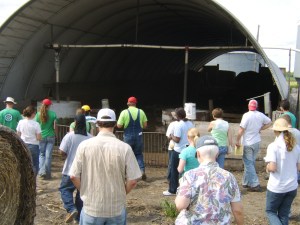
Dave showed us around on two of his locations, and we were even allowed to enter the nursery. “I want the farm to be open to people and I received visitors from all over the world” Dave explained. “I believe that when people know where their food comes from, they have more respect for it”.STA72371

Although a true family business, Dave is currently doing the larger part of the work by himself. He is forced to do so, because the hog industry is in crisis again. “I had a 20 dollar a head loss last week” Dave told us; 20 out of the last 22 months have known red numbers. This crisis is different from the one in the late nineties Dave explained, there seems no end to it now. “They say we need a production cut of 5 to 10 %, but that’s not happening for the moment.” The large integrators hardly cut down, as they can repair losses at one end with profit at the other – retail – end of their production pipeline. Awaiting better times, Dave tries to survive by downsizing production, cutting costs such as labor and intensifying the use of his own resources.

Urban agriculture in Red Hook, Brooklyn NY

STA72194I took opportunity to visit New York City while on my way to my friend Jessica in Ithaca. Fortunately, I had the opportunity to ‘go local’ because Mikey, a friend of her agreed to show me around. We went on bikes exploring Brooklyn, a great experience. I soon learned that you only have to remember one thing; you are on your own, there are no rules in urban jungle traffic.

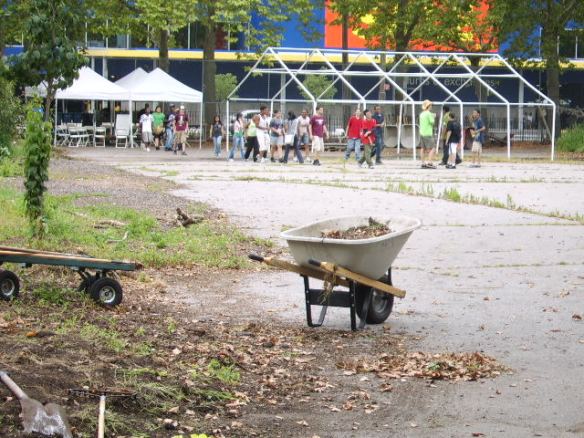
We visited an urban farm in Southern Brooklyn, in the Red Hook neighborhood, a predominantly black and low income community. The Added Value farm is experiencing its third growing season. The farm is located on a run down playground, still visible as a grey spot on Google earth, but now a green oasis, with a small hoop house nursery and a composting section.

STA72196The playground is still there but most of it is covered, underneath 18 inches of rich compost soil. All vegetables you can imagine are growing here, except carrots which go too deep. The produce is sold at the weekly farmers market at the spot and serves a twenty member CSA. The farm now neighbors a gigantic new and heavily opposed IKEA outlet. The outlet symbolizes the start of gentrification of the neighborhood, of which we saw an example at the waterfront, where abandoned industry buildings have been converted into lofty apartments. As more white people move in, rents and living costs increase, which forces the current inhabitants to move to other, cheaper parts of the city.

 The controversy around the outlet is one of the factors influencing the struggle of the farm to reach out to its immediate neighborhood community Donna explained. She is one of the farm workers and kindly showed us around. Showing and explaining the farm to whoever passes by is an important aspect of the openness of the place; the gate is always open while work is going on. Without a programmatic structure such as the youth education program, it has been hard to reach the neighborhood. For many the farm is still a bridge too far in the daily struggle to make a living while on a totally different diet due to the lack of affordable fresh produce and lost cooking skills.  

STA72195Donna is one of 4 farm interns. We met the manager briefly on his way to a meeting. There are also 4 youth workers employed on the farm. One of them was working with a new group of teenagers from the Bronx, who were introducing themselves to each other at the start of their Summer Youth Intensives. Weeding, harvesting, learning about vegetables and composting. But it all starts at a very basic level. Because more than anything else, the farm program is trying to teach these kids a different set of values. Learning the benefit of working as a team. Learning that it is not about the show, wearing appropriate working clothes. Turning compost; doing the dirty jobs. Respect for each other and for every living creature. The value of sharing. The taste of fresh basil.

 The skeptics (see blog Han) or the question alone really, about whether or not urban agriculture can actually provide enough produce to feed an entire city is the narrow economist argument of linear industrial thinking. The remnant of a past modernist era which by default end up in cost efficiency, scale enlargement and mass production solutions. At the cost of soil fertility and hard working people, Marx already taught us in the 19th century. Urban agriculture is about so much more than “only” providing “a bit” of fresh and healthy food.