Multifunctional Agriculture miniconference

On Thursday 8 October 2009 we are organizing a miniconference about multifunctional agriculture (recently also announced in Dutch). This event is part of a two year research project entitled ‘Dynamics and Robustness of Multifunctional Agriculture’ and is funded by the Ministry of Agriculture, Nature & Food Quality. Aim of this conference is to examine what we can learn from experiences in other countries to enhance the development of multifunctional agriculture in the Netherlands. Four speakers will talk about (aspects of) multifunctional agriculture in different countries: Italy, United Kingdom, Norway, Brazil and China.

Mariënwaerdt (source: http://www.marienwaerdt.nl/)

Mariënwaerdt (source: http://www.marienwaerdt.nl/)

The miniconference will be held at Rural Estate Mariënwaerdt and participation is free of charge. All presentations as well as the discussion will be in English. If you are interested to participate, please apply by sending an e-mail to corine.diepeveen@wur.nl. You can also use this e-mail address for any queries about the miniconference.


Dynamics and Robustness of Multifunctional Agriculture – Lessons from Abroad

 Thursday 8 October 2009

 Rural Estate Mariënwaerdt, De Hooge Schuur, ‘t Klooster 5 in Beesd

12.30 – 13.00

Welcome and coffee/tea

13.00 – 13.05 Conference opening by the chairman Krijn Poppe – Chief Science Officer Agro-chains and fisheries, Ministry of Agriculture, Nature & Food Quality
13.05 – 13.15 The multifunctional conference setting – a short introduction to Rural Estate Mariënwaerdt     Frans van Verschuer – Owner of Rural Estate Mariënwaerdt
13.15 – 13.30 Dynamics and robustness of multifunctional agriculture – introducing the project and presentation of the first results Han Wiskerke – project coordinator and Professor of Rural Sociology, Wageningen University
13.30 – 14.00 Multifunctional agriculture in Italy – the rural district approach in Tuscany Gianluca Brunori – Professor of Agricultural Economics, Pisa University, Italy
14.00 – 14.30 Multifunctional agriculture in the UK – the role of the state and the public sector Roberta Sonnino – Lecturer in Environmental Policy & Planning, Cardiff University, United Kingdom
14.30 – 15.00 Multifunctional agriculture in Norway – the relation between multifunctional agriculture and sustainable rural community development Katrina Rønningen – Senior Researcher at the Centre for Rural Research, Trondheim, Norway
15.00 – 15.30

Coffee/tea break

15.30 – 16.00 Agrarian and rural development dynamics across the globe – comparing Europe, China and Brazil Jan Douwe van der Ploeg – Professor of Transition Studies, Wageningen University
16.00 – 16.55 Debate: inspiring lessons for multifunctional agriculture in the Netherlands
16.55 – 17.00 Conference closing by the chairman
17.00

Drinks

A local food movement in central Finland?

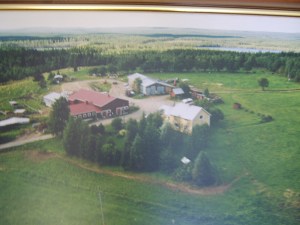
After the ESRS conference in Vaasa, I joined my friend Ella to her place in Sotkamo in the north east of Finland. In Finland Sotkamo is better know as Vuokatti, the ski and outdoor holiday area within the municipality. It makes the center of Sotkamo a rather lively exception in a region suffering from de-population and ageing rural communities. Why would a young generation of farmers take over? A real challenge for Ella’s boyfriend, a dairy farmer in the region Kainuu. Milking 16 cows on 45 hectares party under conservation agreement, he is the only dairy farmer left in his village, delivering his milk to the cooperative a hundred kilometres further. With the decreasing milk price, these are hard times to make a living from this farm.

overview of the farm

overview of the farm

Alternatives are needed, but somehow, the development of alternative food systems seems to take off very slowly in Finland. Jokinen and colleagues (Maaseudun uusi aika 2/2009) give three reasons; 1) the long distances in the sparsely populated areas; 2) the strongly consolidated food supply chain (the three largest retain chains control almost all grocery sales in the Nordic countries) and 3) the declining co-operative culture in abated rural communities. I was struck by the similarity in reasons/conditions to the American Midwest, where, especially in Iowa alternative food systems do take off – against the odds.

Farmer cooperation, consumer awareness and civic action and organisation are among the most needed ingredients for building local food systems and sustainable livelihoods in Finland. Currently, this intermediary level of organisation is lacking in many places. How to start a positive cycle of development depends on many interrelating and partly unpredictable factors. Good examples – from within Finland or from oversees – might inspire people to invest in their communities and in local food.


Herinnering Discussiebijeenkomst Buitenlandse Ervaringen Multifunctionele Landbouw

Op donderdag 8 oktober 2009 organiseert de vakgroep Rurale Sociologie van Wageningen Universiteit een interessante discussiebijeenkomst over buitenlandse ervaringen van multifunctionele landbouw. Wat gebeurt er in het buitenland en wat kunnen we ervan leren?

Op de bijeenkomst geven een aantal toonaangevende internationale onderzoekers u een indruk van de ontwikkeling rond multifunctionele landbouw in Italië, het Verenigd Koninkrijk en Noorwegen. In de aansluitende forumdiscussie gaan we hierover met elkaar in debat. We verwachten ongeveer 80 tot 100 mensen uit o.a. praktijk, wetenschap, overheid en belangenbehartiging.

De bijeenkomst is interessant voor iedereen actief op het gebied van multifunctionele landbouw en meer wil weten over de betekenis van buitenlandse ervaringen voor Nederland. Als u graag over (uw) grenzen heen kijkt, dan mag u deze bijeenkomst niet missen!


Datum: Donderdag 8 oktober 2009
Tijd: 13.00 – 17.00 uur
Locatie: Landgoed Heerlijkheid Mariënwaerdt, De Hooge Schuur, ‘t Klooster 5 in Beesd


Aan deelname van deze bijeenkomst zijn geen kosten verbonden, de voertaal is Engels.


Programma

12.30 Ontvangst (koffie/thee)

13.00 Opening door dagvoorzitter

Krijn Poppe – Chief Science Officer Agroketens en Visserij, ministerie van LNV

13.05 Welkomstwoord

Frans van Verschuer – eigenaar Landgoed Heerlijkheid Mariënwaerdt, Beesd

13.15 Dynamiek en robuustheid multifunctionele landbouw – introductie onderzoeksproject en presentatie eerste resultaten

Han Wiskerke – projectcoördinator en hoogleraar Rurale Sociologie, Wageningen Universiteit

13.30 Multifunctionele landbouw in Italië – de ‘rural disctrict approach’ in Toscane

Gianluca Brunori – hoogleraar Agrarische Economie, Universiteit van Pisa, Italië

14.00 Multifunctionele landbouw in het Verenigd Koninkrijk – de rol van de staat en de publieke sector

Roberta Sonnino – universitair docent Milieubeleid, Universiteit van Cardiff, Verenigd Koninkrijk

14.30 Multifunctionele landbouw in Noorwegen – een presentatie door:

Katrina Rønningen – senior onderzoeker, Centrum voor Plattelandsonderzoek, Universiteit van Trondheim, Noorwegen (uitgenodigd)

15.00 Pauze

15.30 Dynamiek van plattelandsontwikkeling en landbouw wereldwijd – een vergelijking tussen Europa, China en Brazilië

Jan Douwe van der Ploeg – hoogleraar Transitiestudies, Wageningen Universiteit

16.00 Forumdiscussie – inspirerende lessen voor multifunctionele landbouw in Nederland

16.55 Afsluiting door dagvoorzitter

17.00 Borrel


Aanmelden

Meld u aan met het aanmeldformulier. Wij willen u er op wijzen dat er een beperkt aantal deelnameplaatsen beschikbaar zijn. Voor aanvullende informatie neem contact op met Corine Diepeveen via corine.diepeveen@wur.nl of 0317 – 484507.

De discussiemiddag wordt georganiseerd in het kader van het onlangs gestarte onderzoeksproject ‘Dynamiek en Robuustheid van Multifunctionele Landbouw’. Het onderzoek is ondersteunend aan de Taskforce Multifunctionele Landbouw en wordt gefinancierd door het ministerie van LNV.

De-commodification for the sake of soul

New York Times columnist Nicholas D. Kristof figured out the central problem with modern industrial agriculture (global edition 24-9-09).

“It’s not just that it produces unhealthy food, mishandles waste and overuses antibiotics in ways that harm us all”, he writes, “more fundamentally, it has no soul.”

Where the rural is nothing more than an effect of capital the soul that connects people to land and nature disappears.

The soul returns in those practices which are not aimed at abstract quantities but at particular qualities. Following Robert Pirsig, quality, or soul, cannot be defined but can be mutually experienced, in this case, by both producer and consumer.

This means that we have to “de-commodify” as an invited farm couple of Country Natural Beef explained a the Iowa Regional Food Systems Working Group meeting (see earlier blog).

“We were tired of being price takers” they said. “We have learned to seek buyers and work price and quality with them. It is based on transparent costing and a reasonable return. It just is all about relationships.”

The obvious critique is that we cannot feed the world with piecemeal examples of re-connection. But our current global industrial Ag model might just stifle our imagination of what is thinkable as an alternative Larry Busch remarked in his presentation at the ESRS meeting.

What if we left conveyor-belt-linear-thinking behind and instead adopted principles of feed-back or metabolic cycles in our designs, policies and innovations and infrastructure? Rightly so, Thomas L. Friedmann argued in the same edition of New York Times that our solutions to climate change, poverty, food security and biodiversity loss need to be as integrated as nature itself.

Jan Schakel in China – part two

The IMRD-students, who are visiting China to do their case study, just finished their fieldwork in the Bamudi-village in the Yanqing County, North of Beijing. After three weeks of lectures, fieldtrips and surveys, they now will write the final report in the last week of their stay in China. The report will cover the findings from interviews, visits and meeting with farmers, village leaders, shop keepers and other households in the Bamudi-village (Beijing) and Quaoli village (Nanjing).

Part of the methodology of the PRA (Participatory Rapid Appraisal) is to provide a ‘Community Development Program’ and to present and discuss this plan with local inhabitants in the Village Hall to have feedback from the farmers and others involved. It will be a thrilling event, because the situation is rather complex; also in this area, not too far from Beijing.

Industrialization in China started before urbanization (heavy industry in the sixties in the middle and Northeast of China), but in recent decades urbanization is really skyrocketing: from 10% in 1949 and still only 18% in 1979 to almost up to 50% in 2007! Actually, just some month ago, there were –for the first time in their long history- more people living in the cities then in the rural areas! Although the number of ‘the poor’ (which was for a long time synonymous with ‘the rural’) decreased from 250 million in 1978 to less then 15 million in 2007, the rural area still faces tremendous problems. The unique rural-urban migration in China (young labour left to the cities) resulted in disorganization of rural communities and the erosion or even loss of cultural identity, values and the ability of collective action, as well as issues of elites that are leaving, while vulnerable groups are ‘left-behind’.

Box 1: ‘Poor, so rural….’

One of the farmers we visited (see picture) lives in a remote area, just outside Bamudi-village. The farmer is suffering high blood pressure for many years, and his wife (both in their sixties) is illiterate. They own their house (built in 1962) and rent 3,5 mu of land (0,2 ha.), growing mostly corn, fruit and some vegetables. Last year they earned 2000 Yan (200 Euro) by selling apricot to the market, but this year there is hardly any harvest at all, due to the chilly spring. Opposite to other rural families, they don’t have remittances from family members who work in the city (migrant workers), so the family income is only 5000-6000 Yan (or RMB) a year (around 550 Euro), which is really low, even to Chinese standards. As part of  the new pro-farming-policies, the household will have some extra income, like social security and minimum living standard subsidies, compensation for environmental protection schemes, alleviation of agri-tax and subsidies for certain products (mainly grain). The liveability of the community and the households will also be improved by measures of the New Countryside Construction Program; see box 2).

Village farmer

The situation in Bamudi-village is really complex, because a new phenomena – besides the traditional rural-urban-migration processes- is occurring in the region: the urban-rural-migration, which expresses the rediscovery of the rural area by the urban, and a new relation between the city and the countryside. During all the interviews in the village, it became clear that neither the central, nor the provincial government, and neither the county or the village leaders knew how to handle this new phenomena. There are no rules, nor policies and regulations, and the traditional land tenure system doesn’t fit to tackle this new migration process. One of the conclusions, drawn by the students after doing their surveys, is that there is hardly any future in this part of China, if they follow the traditional route or path of development. The growing conditions in this mountainous area very bad, and together with the lack of skilled labour and motivated young people, it rural life is very hard and it will imply the end of agriculture around the municipality of Beijing. Only mostly elderly people will stay in the village, while the rest of the family moves out to the cities. But due to polices (among others) from the NCCP (see box 2), like reafforistication and environmental protection, there might be new sources of income be created. That Bamudi village will be Beijing’s  ‘back garden’ in the near future, implies definitely the final end of a long agricultural tradition, but it will also give the area the opportunity to (re-)develop again in a more modern and more successful way.

We are looking forward to listen and learn what the local villagers will think about the analyses the students have made and the findings that will be presented and discussed tonight; we’re all looking forward to their comments and opinions. And hope that indeed it will be a thrilling night!

Box 2: New Countryside Construction Program (NCCP)

In 2006 the Chinese government launched a new plan to restore the balance and the inequity between the rural and the urban. Part of it will be the NCCP. Background of the NCCP is the rapid industrialization and urbanization, which widened the gap between urban and rural, and forced the state to support farmers and pay more attention to resource and environmental protection. Part of it will be an urbanization strategy: no allowing for most farmers to go to towns, but stay in the villages. To improve the living conditions in these villages, several measures were undertaken, like: promoting agriculture production, e.g. agricultural industrialization infrastructural development like roads, drinking water, street lights employing farmers tot protect non-governmental forests, waters, roads and environment providing public goods: medical, rural education, energy, communication and so on increasing farmers income by subsidies, human resource development, providing help to the poor (among others).

Jan Schakel, Bamudi-Village