
New course: Food Waste!
Image

 Last night I saw this new commercial on Dutch television. It’s in Dutch, but you will get the idea just by watching it (otherwise, I can offer translation). I am curious about your opinion in the light of current discussions about our food system. Please leave your opinion on our Facebook page!
By Marc Wegerif. PhD Candidate, Rural Sociology Group Wageningen University, carrying out research on food provisioning in Dar es Salaam. Contact: marc.wegerif@wur.nl
It’s Saturday morning in Dar es Salaam, no rushing to school and work today. I walk to the duka (shop) a few metres from my house, (you can read more about the duka in http://www.mdpi.com/2071-1050/6/6/3747). After greeting the shop owner and another customer standing at the counter, I buy eggs, chapattis cooked that morning by one of my neighbours and fresh milk in a plastic half litre package for 1,100 Tanzanian Shillings (Euro 0.52). Ready for breakfast and I think it is time to write a few lines about where the milk I just bought comes from.

Man and Women after delivering milk to the collection centre in Pongwe Village
On a morning a few weeks earlier I was standing in Pongwe Village, Tanga Region, watching as buckets and other containers of milk were lined up at the Tanga Fresh milk collection centre. Most of the containers were brought by young men on bicycles and motorbikes, women of all ages came on foot buckets on their head or in their hands and some older men were there as well. Tatu (not her real name), in her twenties, dressed in a clean white coat, hair net and boots – the classic uniform of hygiene – was taking samples from every container to check the quality of the milk and for any impurities. The milk that met the standards (most of it did) was poured into a shiny stainless steel container, weighed, then filtered before being put into one of two large shiny and cooled tanks in the back room of the building. Later in the day a truck would collect the milk and take it to the Tanga Fresh dairy. Continue reading
By Marcell Kustos, Master Food Technology Wageningen University (marcell.kustos@wur.nl)
MSC-thesis: The authority of novel terroir models: Case study on quality characteristics of Traditional Speciality Guaranteed Gouda Farmhouse cheese
 In my MSc-thesis research I tested novel terroir models on Farmhouse cheese (Boerenkaas) originating from the Green Heart area in the Netherlands, also known as the traditional farmhouse cheese area surrounding cities like Gouda and Leiden historically linked to the traditional Gouda type and Leiden type of Famhouse cheese. The latter or Boeren Leidsekaas has been certified a product with a protected designation of origin or PDO by the EU-Quality regulations in geographical indications and traditional specialities in 1997. It has a strict demarcation of the production area or terroir and a strict code of practice. In 2007 the Boeren Goudsekaas was certified as a Traditional Speciality Guaranteed or TSG, that is less strict then a PDO: it guarantees only some traditional product methods. Basically that is made of raw milk and that while processing it should not be heated above 40°C or pasteurized. Unlike PDO the TSG has no regulations with regard to cattle breed, cattle feed or cheese manufacturing, as e.g. the Comte has to some extend. And a TSG has no geographical demarcation and can thus be produced at any farm. Continue reading
Deze zomer zijn een aantal wetenschapswinkelprojecten gestart, waardoor we verschillende studentenopdrachten in de aanbieding hebben. De opdracht waar ik laatst over schreef staat nog uit, maar we zijn nu voor een ander project ook op zoek naar twee studenten.
Dit wetenschapswinkelproject speelt zich ook af in Almere; de opdrachtgever is Almeerse Weelde. Almeerse Weelde (AW) bestaat uit ongeveer vijfentwintig mensen die zich bezighouden met lokaal voedsel. Sommigen van hen doen dat professioneel, anderen meer hobbymatig. Naast de verwerking van lokale producten, houdt AW zich bezig met bewustwording en kennisoverdracht over lokaal voedsel.
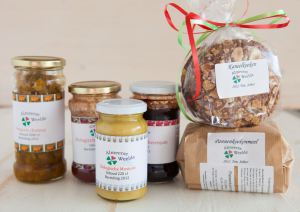
Momenteel denkt AW na over de toekomst; hoe en in welke richting kan ze zich verder ontwikkelen? Deze vraag heeft ze voorgelegd aan de wetenschapswinkel, die AW daarbij gaat ondersteunen. In die zoektocht komen verschillende vragen naar boven, zoals:
View original post 180 more words


