Aankondiging Onderwijsdag Multifunctionele Landbouw

Op donderdag 19 mei a.s. organiseren de Groene Kennis Coöperatie, de Taskforce Multifunctionele Landbouw en KPC Groep de ‘Onderwijsdag Multifunctionele Landbouw’. De dag richt zich op docenten in het (groen)onderwijs die meer willen weten van multifunctionele landbouw, het ondernemen op deze bedrijven en de manier waarop het onderwijs hierop kan inspringen.

Workshop

Naast een bijdrage in de vorm van een inleidende presentatie organiseren wij, n.a.v. van onze recente onderzoekswerkzaamheden, een interessante workshop op deze dag. In de workshop staat de verankering van multifunctionele landbouw in het onderwijs centraal: hoe kunnen we aandacht besteden aan deze vorm van ondernemen en om welke (nieuwe) vormen van leren vraagt het?

Onderwijsdag Multifunctionele Landbouw

Doelgroep: docenten, stagebegeleiders

Datum: 19 mei a.s. van 09.30 – 16.15 uur

Locatie: Fruittuin Verbeek, Oldebroek

Deelname is gratis. Meer informatie over de dag, het programma en aanmelding is te vinden op de volgende website.
DERREG Policy Seminar in Brussels

Last Thursday March 31, a Policy Seminar had place to discuss the relevancy of the results from the EU-funded reserach project DERREG for EU-policies.  Although the project and the work is not yet completed, emerging outcomes and policy recommendations were presented by the project coordinator prof. Michael Woods and the four coordinators of the respective workpackages on Rural business networks, Rural migration patterns, Sustainable development and Rural regional learning. The emerging outcomes and recommendations are also capitalised in the European Policy Brief published at the DERREG website.

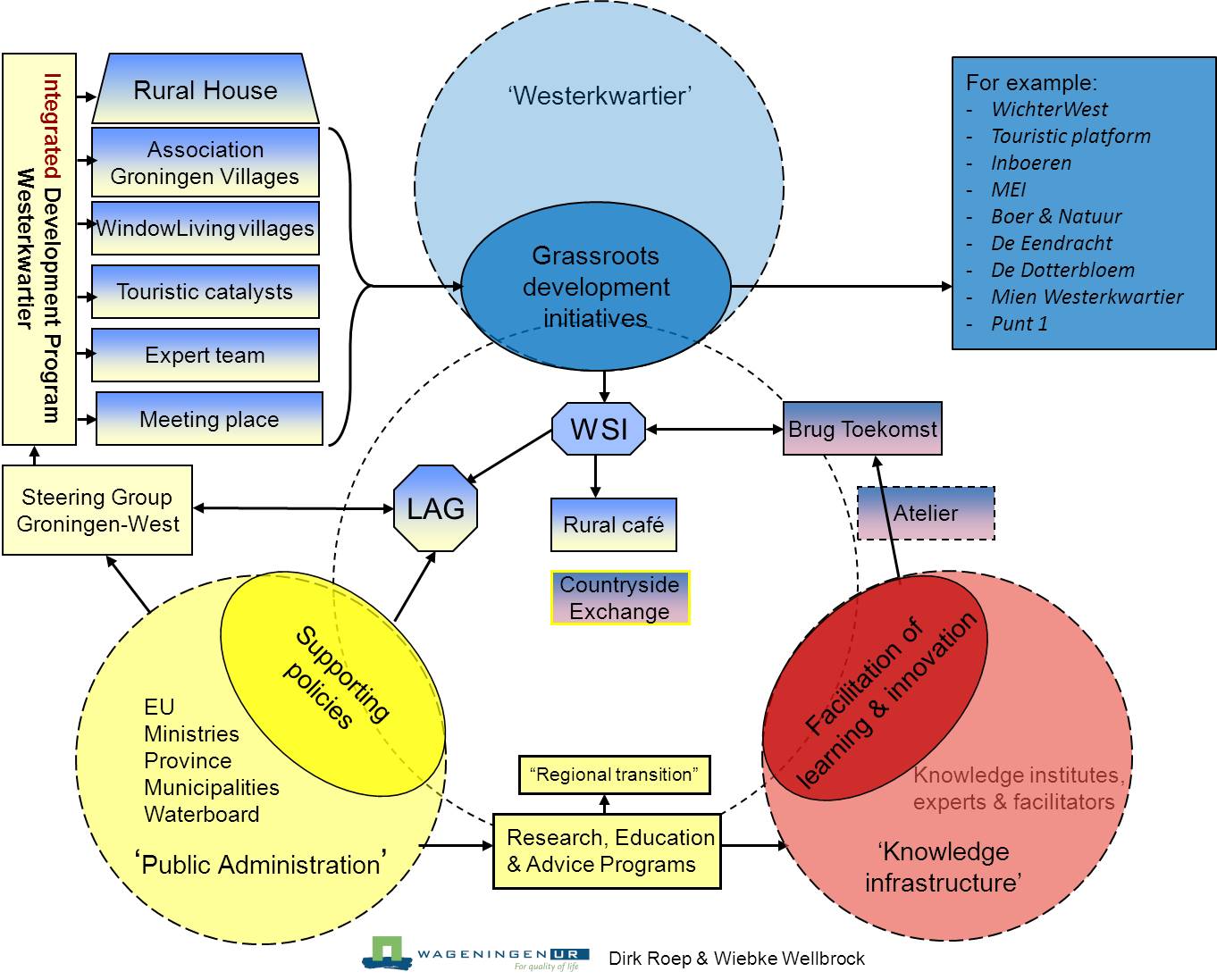
WU is coordinator of Workpackage 4. We focussed on how public support and faciliation of joint learning and innovation in grassroots (place-based) development activities can be best arranged. We have explored, mapped and analysed various such arrangements in six case study areas. See the example of the map of the ‘governance of joint learning and innovation’ in the Westerkwartier below.

Map of the governance of joint learning and innovation in the Westerkwartier (NL)

These arrangements and the support or faciliation given was evaluated by the beneficiaries (see earlier posts on case-study area Westerkwartier, Alytus, Dresden and Comarca de Verin).

Although we will extend our analysis and specifically elaborate more on ‘promising or good practices’ revealed, Wiebke Wellbrock and I presented the main findings and policy recommendations (see our presentation).

Key to our findings is that the effectiveness of support policies depends on well working operational interfaces between public policies, grassroots development initiatives and (knowledge) facilities to support joint learning and innovation. These interfaces get shaped in agreements between various public and private partners but it are operational agents or agencies fulfilling various intermediary task and roles connecting different ‘worlds’ that make them work (well).

Rural regional learning in the Comarca de Verín, Galicia, Spain

Within the European research project DERREG, we are investigating how public policy can best be arranged to stimulate capacity building within development initiatives operating at grassroots level in rural areas across the European Union.

To find out how public policy interventions can best be arranged, we and our research partners have spoken to various stakeholders in different rural regions across the European Union to find out how they intend to support and facilitate learning and innovation and- most importantly- how the support and facilitation agreed upon is actually provided to the grassroots development initiatives. To find out what is working well and what isn’t working well yet, we have spoken to a number of grassroots development initiators in the participating DERREG case study areas and ask them to evaluate the current support and facilitation received.

To be able to compare the results obtained in the different case study areas, I have travelled to Alytus County, Lithuania in October and Oberlausitz, Germany in December of 2010. In January of this year, I was able to visit our colleague Lola Dominguez Garcia of  Universidade de Vigo in the Comarca de Verín in the South-West of Galicia, Spain. In this blog, we intend to share our experiences. Continue reading →

Working group at 24th ESRS congress in Chania, Greece 22-25 August 2011: Call for papers

Imre Kovách ( Institute for Political Science of the Hungarian Academy of Sciences, Budapest), Petra Derkzen and I are organising a working group on “the governance of semi-subsistent food and farming strategies in the countryside and city- a compartive perspective” at the 24th ESRS congress in Chania (Greece) from 22-25 of August 2011. We would like to invite all interested researchers to submit their papers dealing with empirical or theoretical reflections on the driving forces, structure and mechanisms of semisubsistence food and farming strategies in the countryside and-or cities, both within developed and developing countries. Abstracts may be submitted  to Imre Kovach (ikovach@mtapti.hu) AND chania2011@agr.unipi.it until the 30th of April 2011.  For a more detailed description of the workshop please read further…

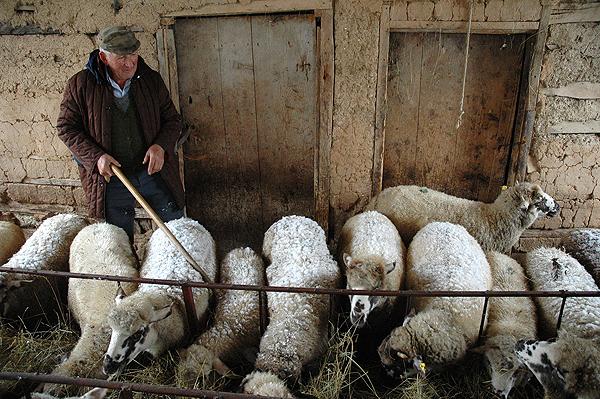
Courtesy of European Forum on Nature Conservation and Pastoralism

Continue reading →

Altijd al eens willen modderworstelen, of toch liever een boeren barbecue?

De Taskforce Multifunctionele Landbouw heeft een studieprijs uitgeschreven voor leerlingen en studenten van het MBO, HBO en Universiteit:

Gaat jouw studieonderwerp over Multifunctionele landbouw? Doe mee met de Studieprijs Multifunctionele Landbouw en win, met vrienden en vriendinnen, een geheel verzorgde VIP-dag bij De Boerinn. Je mag zelf een dag samenstellen, met bijvoorbeeld polderchallenge, klompengolf of kaasmaken en barbecue.

Je moet het studieproject hebben afgerond tussen 1 januari 2010 en 15 april 2011, of ervoor kiezen volgend jaar mee te doen. Kies dan een opdracht-, project-, stage- of scriptie-onderwerp uit de multifunctionele landbouw. Wil je meer weten over de spelregels of je aanmelden? Kijk op http://www.multifunctionelelandbouw.nl/studieprijs

Wat is multifunctionele landbouw? Dit omvat agarische bedrijven die naast hun veehouderij-, akkerbouw- of tuinbouwbedrijf andere activiteiten uitoefenen, gekoppeld aan het primaire landbouwbedrijf. Deze activiteiten zijn zorglandbouw, recreatie, agrarische kinderopvang, boerderijeducatie, agrarisch natuur- en landschapsbeheer en/of de productie en verkoop van streekproducten. Een onderwerp zou dus kunnen zijn: het maken van een ontwerp voor een minicamping of de gevolgen van de bezuinigingen in het zorgstelsel voor zorgboerderijen. Maar (juist) ook andere ideeën zijn welkom!