
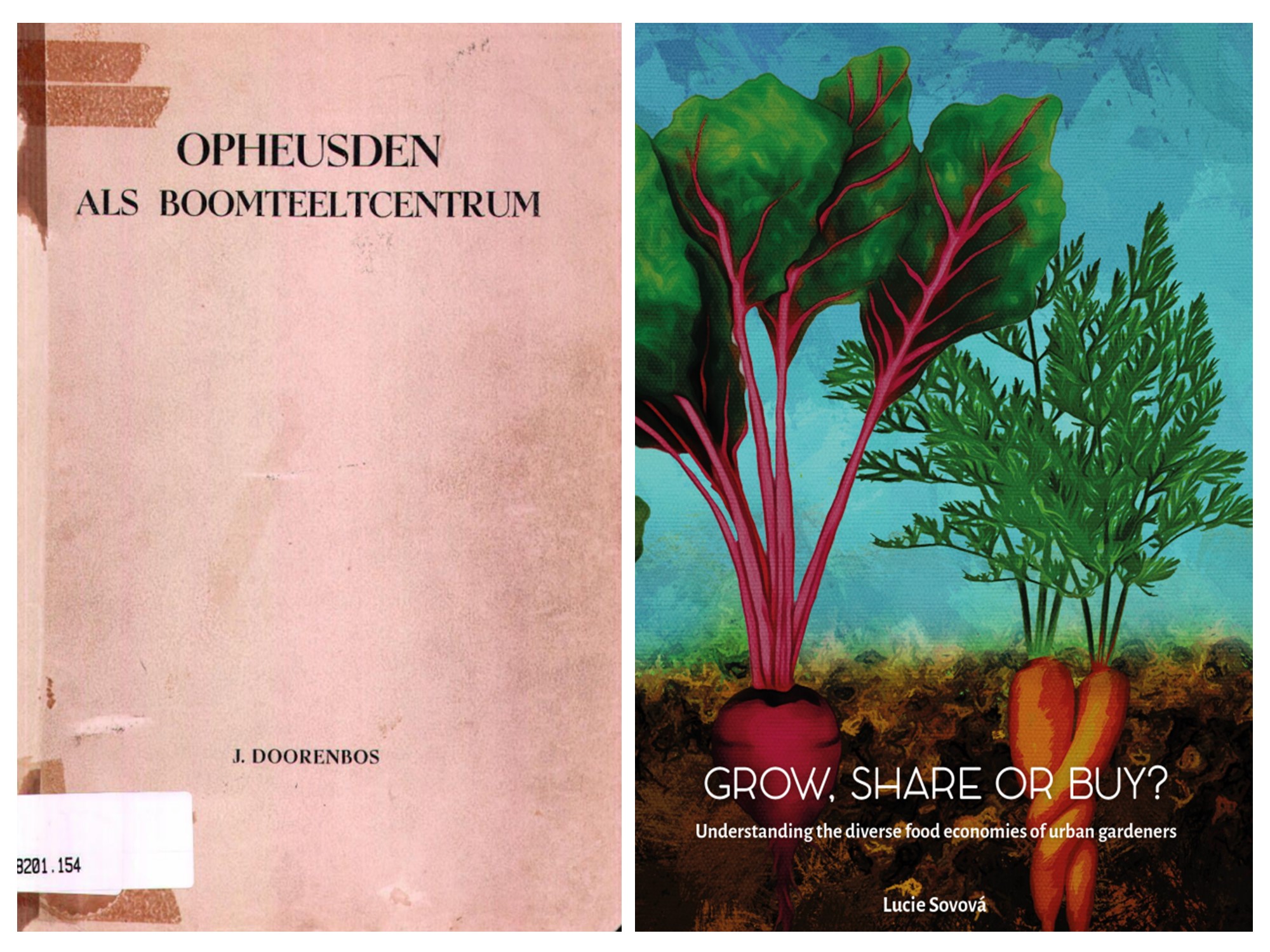
The 75th anniversary of the Rural Sociology Group also marks another milestone: 100 completed and successfully defended PhD theses. The first PhD graduate was Jan Doorenbos, who successfully defended his PhD thesis entitled ‘Opheusden als boomteeltcentrum‘ (Opheusden as tree-growing centre) on 14 June 1950. His PhD study was supervised by Prof. E.W. Hofstee. The 100th PhD graduate was Lucie Sovová, who successfully defended her PhD thesis entitled ‘Grow, share or buy? Understanding the diverse economies of urban gardeners‘ on 13 October 2020. Her PhD study was supervised by Dr. Esther Veen, Dr. Petr Jehlicka and myself. Below the covers of the 1st and 100th PhD thesis.
In this blog about 100 PhD graduates in 75 years Rural Sociology at Wageningen University, I want to present and reflect on some trends related to these 100 PhD graduates. In another forthcoming blog I will present and reflect on some trends related to the content and focus of these 100 PhD theses.
Trend 1: from less than 1 to close to 4 PhD graduates per year
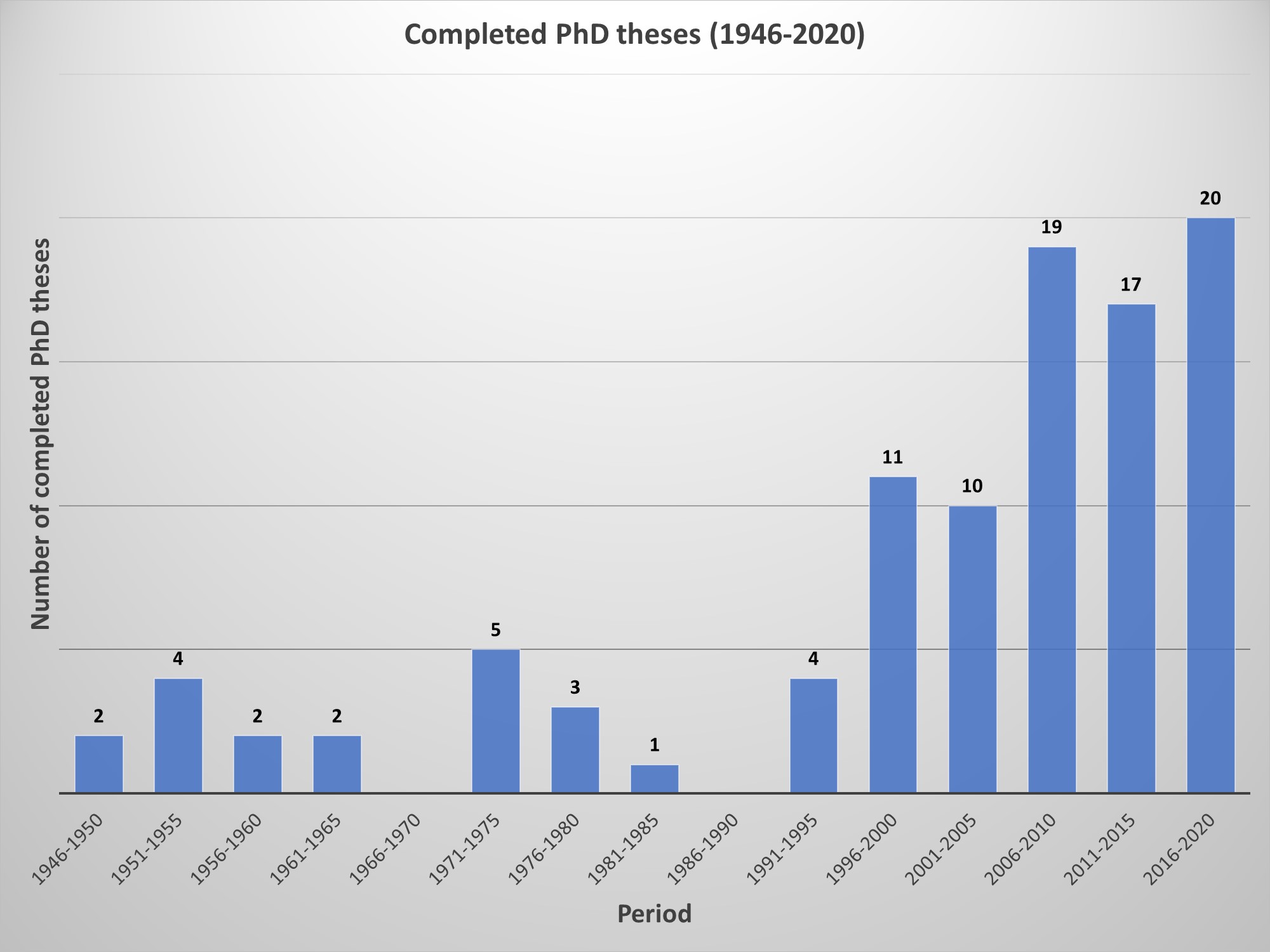
The 100 PhD theses that were completed in the last 75 years are not evenly distributed over the years, as the figure below shows. In the first 50 years 23 PhD theses were completed, meaning that the average number of PhD graduations was below 1 per year (with no PhD graduations at all in the years 1966-1970 and 1986-1990). This increased to approximately 2 per year in the 1996-2005 period and to almost 4 per year in the last 15 years. There are multiple reasons for this. First, until the 1980s having a PhD degree was not that important for an academic career as it is now. When I did my Masters in Wageningen in the late 1980s and early 1990s a large part of the courses I took were taught by assistant, associate and even full professors without a PhD degree. Nowadays, having a PhD degree is a prerequisite for an academic career. Second, in the early 1980s the Dutch government introduced the so-called ‘Two-phase structure’ for university education, with the second phase referring to a 4 year PhD program. The ambition was that 20% of the MSc graduates would continue with a PhD, and as a result universities created more PhD positions (which were then called assistant-in-training or researcher-in-training positions). Alongside, tenured staff without a PhD degree was also encouraged to write a PhD thesis. While these two reasons may explain the increase from the early 1990s onwards, they do not explain the relative high numbers in the last 15 years, with an average of 3 to 4 PhD graduations per year. These figures are a result of: a) the growth of externally funded research projects in which (part of) the research was/is carried out by PhD students; b) the acquisition of specific PhD programs with multiple PhD projects (NWO-WOTRO, INREF, and EU Marie Curie Training Networks); c) the internationalization of our PhD community (more about this below) with a growing number of PhD scholarships funded by NUFFIC and national governments in Asia (mainly China) and Latin-America. In addition, there has been an internal push for more PhD students due to PhD supervision criteria for RSO staff in Tenure Track. And last but not least, the PhD graduation allowance that we get from the national government (currently approximately € 60,000 per PhD graduate) also implies that there is a financial incentive to have a steady and preferable high inflow of PhD students and outflow of PhD graduates.
Trend 2: The average age at which a PhD degree is obtained remains the same (but becomes more diverse)
The average age at which a PhD degree is obtained has remained fairly stable over the past 75 years (just below 40 in 1950 and just above 40 in 2020), but has become more diverse in recent decades (ranging from 27 to 76 years). When making this overview I had actually expected that the average age at PhD graduation would have shown a downward trend as I assumed that the role of the PhD thesis had changed from someone’s life’s work (a middle- to end-career achievement) to a first stepping stone (an early-career achievement) in an academic career. The latter certainly holds true for a large group that obtained their PhD degree at the age of 35 or younger. However, among the PhD graduates of the last 20 years, the PhD degree has also been an important mid-career stepping stone. Many, in particular international, PhD graduates, who got their PhD degree at the age of 40 to 50, have moved up to senior academic or management positions. And throughout the years we’ve had PhD candidates that embarked on their PhD study more towards the end of their career or even after retirement (with two obtaining their PhD degree at the age of 76). For this relatively small group the PhD thesis has remained a life’s work.

Trend 3: From men only to more gender balance
One aspect that has really changed over the past 75 years is the male/female ratio of PhD graduates. In the past 75 years we’ve had twice as many male graduates as female graduates, as the figure below shows.

However, this 2:1 male-female ratio has not been like that over the past 75 years. In the first 55 years the vast majority of PhD graduates were men (32 men versus 2 women), and this changed considerably in the last 20 years (34 men versus 32 women), as the figure below shows. It clearly reflects the changing male-female ratio of BSc and MSc students at Wageningen University (and most likely also at many other universities in and outside the Netherlands). And this also has had an impact on the gender balance within the current academic staff at the Rural Sociology Group.

Trend 4: From mainly Dutch to ‘all over the world’
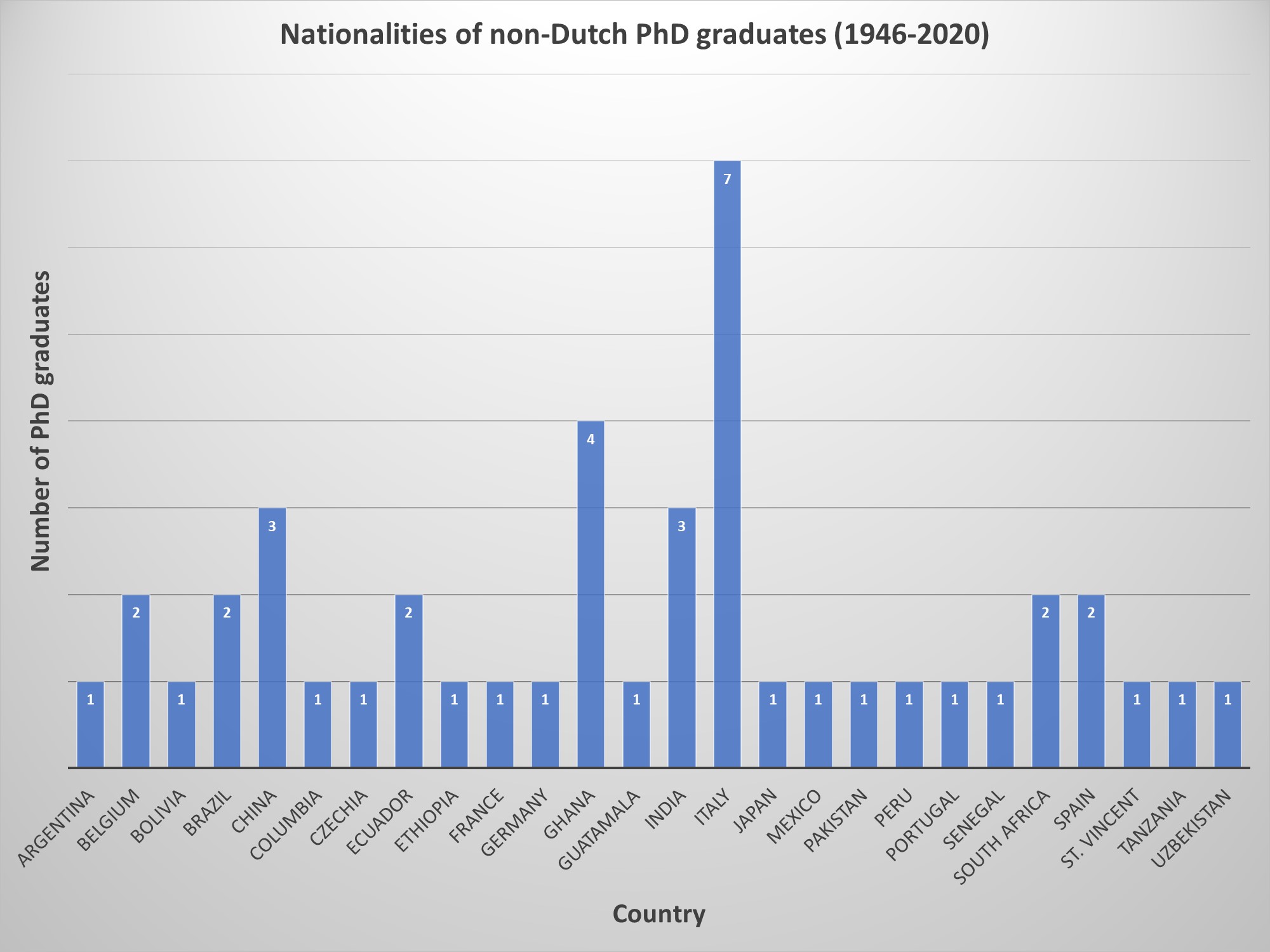
Over the past 75 years the PhD community at the Rural Sociology Group has really become international. Although there were a few non-Dutch PhD graduates in the early years, in recent years PhD students come from all over the world: other European countries, Latin America, Africa and Asia (see figures below: Europe refers to all European countries excluding the Netherlands). A large number of the PhD projects of these international PhD students are projects jointly supervised with staff members of the Sociology of Development and Change group, which traditionally has a strong network in Latin America and Africa. The former chair of Rural Sociology, Jan Douwe van der Ploeg, also has a large international network, in particular in Italy, several Latin American countries and China, and this has clearly contributed to the inflow of PhD students from these parts of the world. The aforementioned growing importance of external research funding and international PhD scholarships has also contributed to the internationalization of our PhD community. I also assumed that the international focus and status of Wageningen University, with all its MSc and part of its BSc programs taught in English, would have contributed to the internationalization of our PhD community. However, hardly any of our international PhD students has an MSc degree from Wageningen University.

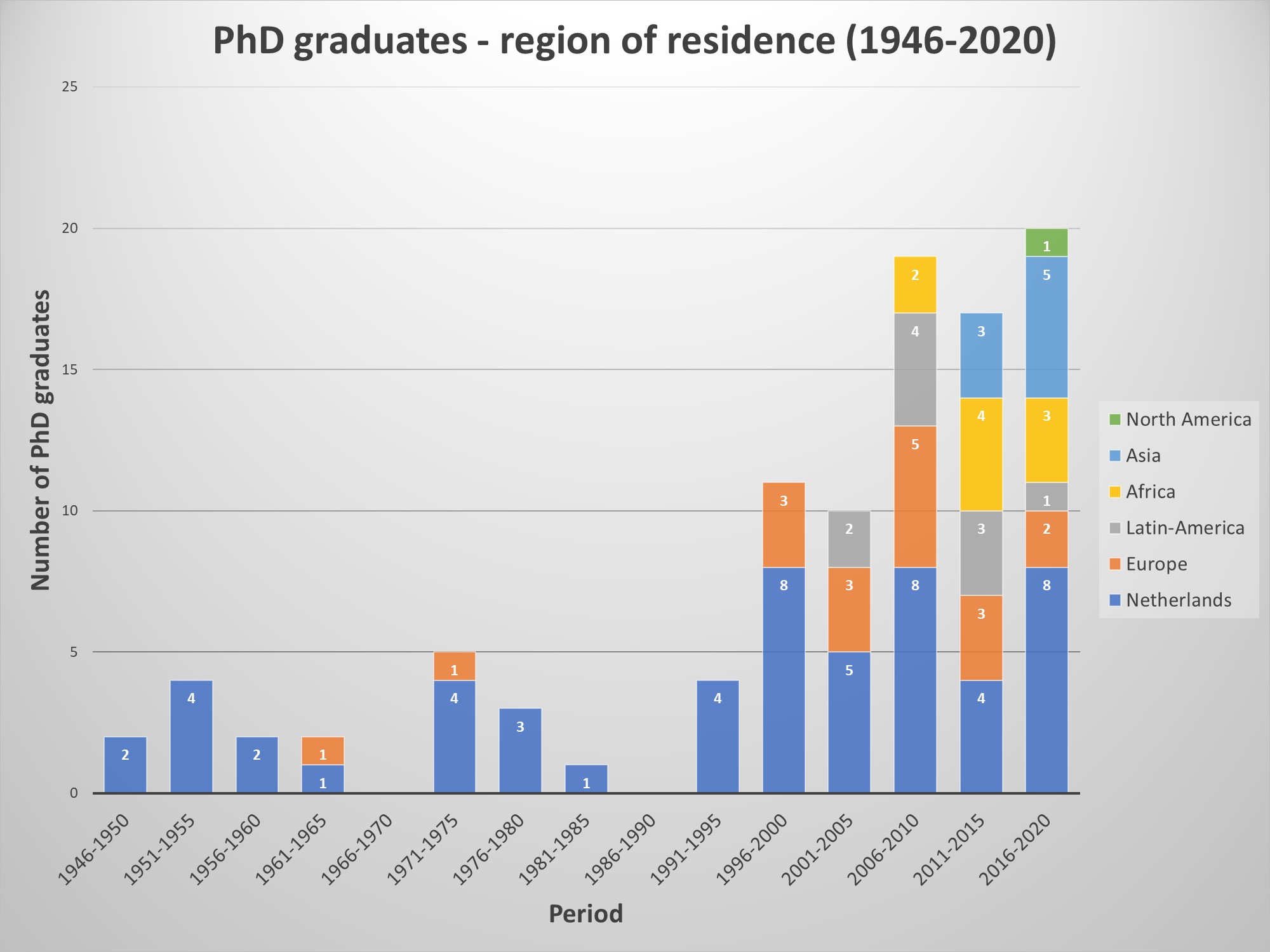
In addition to looking at the countries/regions where our PhD graduates come from, I have also made a figure of where they are currently residing/working or where they were residing when they retired. This basically shows that the vast majority of PhD graduates is residing/working in the country/region where they originate from. Some have moved to other countries and a few of the international PhD graduates have stayed in the Netherlands.
Trend 5: From government official to academic/researcher
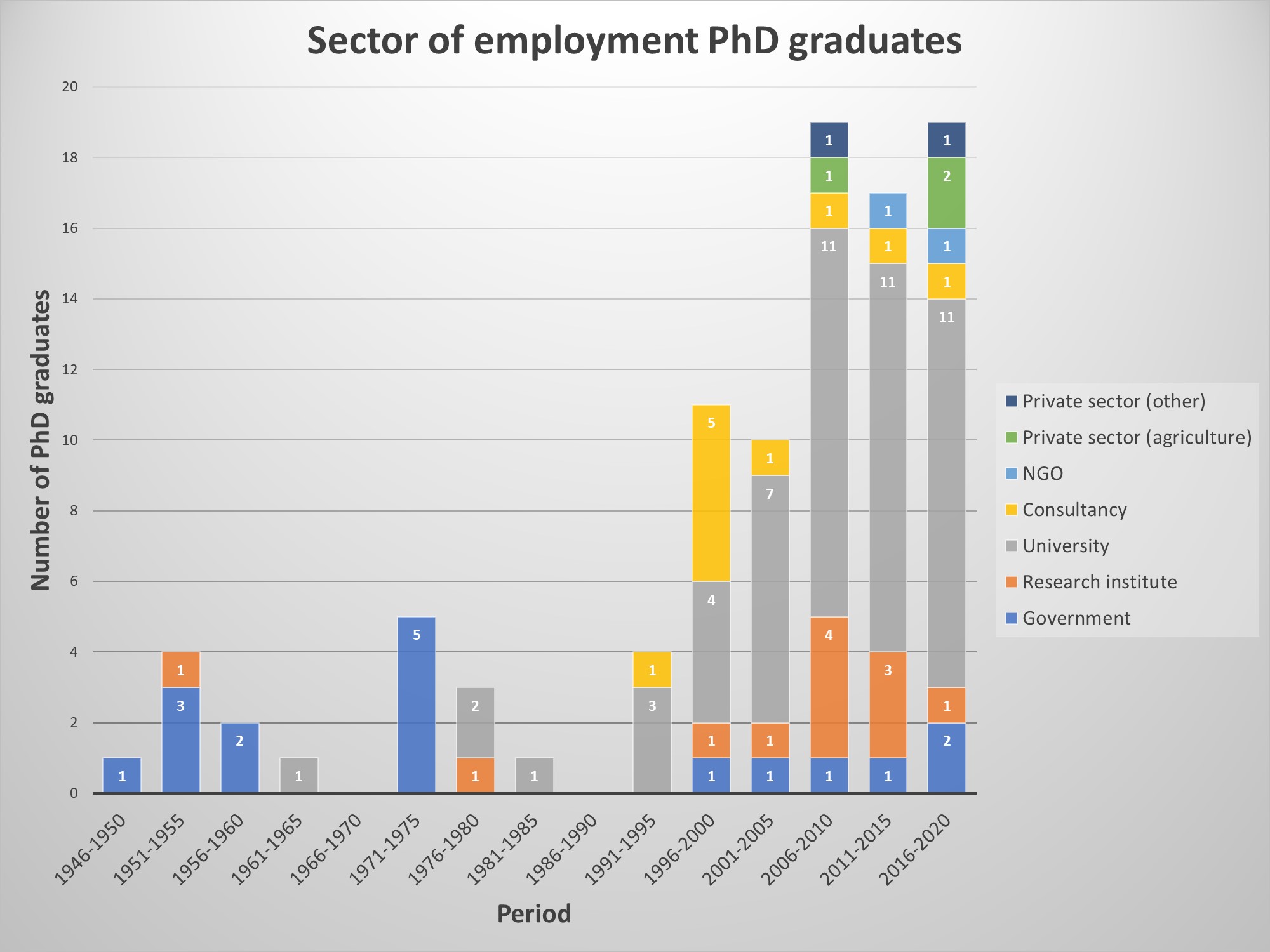
A last topic related to 100 Rural Sociology PhD graduates I want to present is their current or last (in case of retirement) sector of employment. Is a PhD degree really a stepping stone for an academic or research career or does it result in careers in a variety of sectors? This has been summarized in the figure below, which shows that many of the PhD graduates in the early years continued their career in government. To be fair, many of those PhD graduates actually had a government job and were given the time and space to do their PhD research while keeping their job as government official and continued as a government official after obtaining their PhD degree. Since the 1990s the PhD degree seems to have been favorable for a career in academia/higher education or at a research institute. Many of our international PhD graduates now have tenured positions at foreign universities as assistant, associate or full professor or as senior scientist or senior manager at a research institute. Some are self-employed as advisors/consultants and a few ended up working for a NGO or in the private sector (in or related to agriculture or elsewhere). But as the primary aim of our PhD program is to train PhD students to become independent researchers/academics, it is great to see that so many do indeed succeed in building a career in (academic) research (and higher education).


 Rural Sociology Wageningen University