
Do you want to contribute to solving societal issues in the domain of food systems? Do you have a MSc degree in sociology, anthropology, development studies or related field with an interest in food systems? If yes, then we may be looking for you!
The Social Sciences Group (SSG) at Wageningen University is looking for a motivated PhD candidate to study relations between food system transitions and community resilience. The position is based in the Rural Sociology Group (RSO) and will be supervised by Professor Han Wiskerke and Dr Jessica Duncan with active supervision and collaboration with Dr Sietze Vellema from the Knowledge, Technology and Innovation Group (KTI), and Dr Marion Herens from Wageningen Centre for Development Innovation (WCDI).
Tag Archives: food governance
Collaborating towards Berlin Food Policy: Exploring civic-state collaboration in current urban food governance in Berlin – The Case of the Berlin Food Strategy
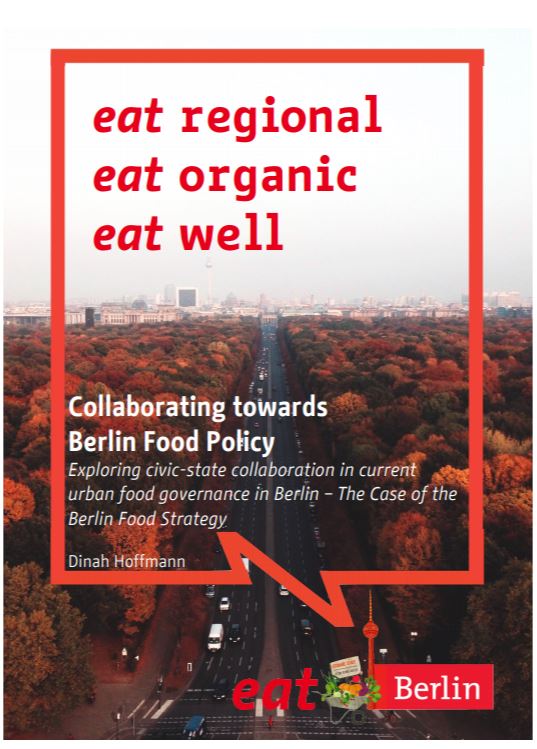 Dinah Hoffman, MSc student Communication, Health and Life Sciences
Specialization: Health and Society, Wageningen University
Below please find the abstract of the MSc thesis Collaborating towards Berlin Food Policy: Exploring civic-state collaboration in current urban food governance in Berlin – The Case of the Berlin Food Strategy
The full thesis can be downloaded from the WUR-Library by clicking on the hyperlink
Urban food policy is an area that joins actors from civil society, academia, the local state and the market. To accomplish sustainable changes of local food systems these actors work together in governance arrangements. Two prominent instruments that are used in urban food governance where these actors collaborate are the food policy council and the urban food strategy. Both can be initiated through top-down or bottom-up processes or a combination of both with the relationship of local government and civil society having an impact on the success of the initiatives. One of the cities where civil society and local government engage in collaborative food governance is the city-state of Berlin, the biggest city in Germany, surrounded by the agricultural region of Brandenburg. Drawing on data from 11 interviews and 40 documents, this thesis describes and examines the nature of the relationship and governance arrangement of the two main actors in current Berlin food governance. The collaborative governance framework, a categorization of civic-state relationships found in urban food governance and the concepts of integrated food policy and institutionalization were used to guide the analysis. The objective of this thesis is to understand how civic-state collaboration in urban food governance looks like in Berlin, what impact the local context has on the development of the governance arrangement and what strengths and challenges involved stakeholders perceive. The two main stakeholders were found to be the civic food policy council Ernährungsrat Berlin and the Berlin Senate Administration for Consumer Protection. It was found that the Ernährungsrat Berlin’s food policy activity brought forward a relationship where they are striving for independence but are linked to the government through a secondary agency, being the aforementioned administrative department. Although not embedded in municipal institutions, which has been identified as crucial for a food policy councils’ success, the Ernährungsrat Berlin proved to be an agile and resilient structure able to successfully be an independent advocate for civil society and a valued advisor to the government. Their collaboration resulted in the development of a Berlin Food Strategy. In this thesis I investigate the process of developing this strategy as a form of collaborative governance. Regarding their governance arrangement around the Berlin Food Strategy, the involvement of the Green Party in the current coalition was found to have had a big impact on the position the Ernährungsrat Berlin but also food policy was able to occupy on the urban agenda. This research identified a number of strengths and challenges of the governance arrangement including a strong interdependence, a strong and long history of civic action, the presence of political food champions in the coalition and the administration, the limiting structure and functioning of the Senate administrations and the limited inclusiveness and representatives of the Ernährungsrat Berlin.
Key words: urban food governance, urban food policy, food policy council, urban food strategy, collaborative governance, Berlin food strategy, Ernährungsrat Berlin, Senate of Berlin
Jessica Duncan awarded Excellent Education prize 2016
Jessica Duncan has been awarded the Excellent Education Prize for the two courses:
- RSO-22306 Food Culture and Customs
- RSO-21306 Policy, People and Resources in Comparative Perspective
Congratulations!
Podcast – civil society participation global governance of food security
As part of the perfect storm seminar series at the University of Edinburgh, Dr Jessica Duncan gave a seminar about civil society participation in the global governance of food security on the 26th of January. ‘The Perfect Storm Scholars‘ interviewed her afterwards and posted a podcast that resulted of this interview on their blog.

As part of the perfect storm seminar series (see poster), Dr Jessica Duncan, Assistant Professor in Rural Sociology at Wageningen University, The Netherlands, gave a seminar about civil society participation in the global governance of food security on the 26th of January at the University of Edinburgh.
She kindly made the time to talk to me about her seminar and research when she was in Edinburgh. You can find the result of this conversation in a podcast. Click HERE to listen to it.
Podcast structure
We talk about her seminar and research until around 24:40 min. From that point onwards we discuss the practical dynamics of undertaking empirical research in general, and specifically on global governance. At 30:00 min Dr. Duncan shares her views on interdisciplinary research.
Podcast notes:
You can find out more about Jessica’s research in her latest book: Global Food Security Governance: Civil society engagement in the reformed Committee…
View original post 229 more words
Eco Intensive Agriculture Conference proceedings
The proceedings of the Eco Intensive Agriculture Conference are available at the website of the Netherlands Institute of Ecology (NIOO-KNAW). Rural Sociology was represented by our chair prof. Han Wiskerke and Jessica Duncan (Food Governance).
Jessica Duncan’s Pecha Kucha (a presentation of 6:20 with a series of 20 slides that change every 20 seconds) was called ‘Governing the Doughnut: the role of scientists in transformations towards sustainable food systems‘, watch the video above.
Han Wiskerke was one of the six key note speakers, presenting ‘Eco-intensive agriculture and the provision of public goods‘. All six key note speakers were asked to make short statements on four questions and this was recorded. These short video are also available at the NIOO website. Below the answer to question 4: What step is needed now?
 Rural Sociology Wageningen University