75th Anniversary: 1) an introduction to a year of celebration events and activities (updated)

In September 1946 Evert Willem Hofstee, the founding father of Rural Sociology at Wageningen University, started as Professor and Chair of Social and Economic Geography and Social Statistics.

In the years that followed, the department was reorganized and renamed (e.g. Agrarian Sociology of Western Areas; Sociology) several times, with Rural Sociology being the official name since the late 1990s. Hofstee was also one of the founders and the first President of the European Society for Rural Sociology.

The Rural Sociology Group of Wageningen University will celebrate its 75th Anniversary on the 13th of May 2022. On that day we will organize an international conference at which we will present, discuss and reflect upon the past, present and future of rural sociology in an interactive setting. And we will, of course, also have a party in the evening of the 13th of May 2022 to celebrate 75 years of rural sociology at Wageningen University with current and former staff members, PhD students and graduates, former and current students and colleagues with whom we collaborated in national and international research projects. So SAVE THE DATE if you want participate in our conference and join our party. More details about the conference program will be published on this website soon!

The conference and party will not be the only activity that we will organize to celebrate our 75th anniversary. Starting today, we will arrange a variety of events, activities and outputs leading up to our main festivity on May 13, 2022.

  • A weekly blog (on this website) about the past, present or future of Rural Sociology. This may be about a specific theory, a research project, an event, or something else;
  • A seminar series (online or blended) with agrarian, rural and food sociologists from other universities;
  • A series of rural field trips in the Netherlands, visiting, for example, rural sociology graduates that have become farmers;
  • A PhD Day with and for PhD graduates and PhD candidates and a PhD Magazine with an overview of all PhD graduates, their PhD thesis and career after completion of their PhD thesis;
  • An anniversary book about the past, present and future of Rural Sociology in Wageningen.

We are looking forward to a year of celebration activities and events and hope many of our (former) colleagues and students will do so too. And we hope to welcome you at our celebratory event on the 13th of May 2022. So stay tuned to this blog and get to know more about the past, present and future of Rural Sociology in Wageningen in the forthcoming 12 months.

Update (July 8, 2021): due to COVID-19, the celebratory event is postponed from October 24, 2021 to May 13, 2022
 

Reminder – Vacancy Assistant Professor in Food Sociology (tenure track)

At the Rural Sociology Group we have a job opening for an Assistant Professor (tenure track position) in Food Sociology. As assistant professor you will undertake independent research and participate in international research projects focusing on the dynamics of food provisioning practices and processes and on the relations between food provisioning and sustainable rural and urban development. You will also teach and coordinate Bachelor and Master courses for the Bachelor and Master program International Development Studies (specialization Sociology of Development), the Master program Food Technology (specialization Gastronomy), and the Master program Organic Agriculture and supervise Master thesis research for these programs. Other aspects of the job include project acquisition, training and supervision of PhD students and participation in various research and/or education committees. About 45% of your time will be spent on education, 45% on research and the remaining 10% on a variety of activities within and outside the university.

For more information about the position (and the Rural Sociology Group) go to the vacancy page of Wageningen University or contact Prof.dr. Han Wiskerke (han.wiskerke@wur.nl). Candidates can apply for this position onlineThe deadline for application is Thursday 14 September 2017.

Pre-announcement Vacancy Associate or Full Professor in Agrarian Sociology

On the 5th of January 2017 we will open a vacancy for an associate or full professor in agrarian sociology. We are looking for someone with demonstrated excellence in research and education in the domain of agrarian and rural sociology. The associate/full professor will undertake independent research and participate in (and coordinate) international research projects, focusing on topics such as agricultural and rural development, rural-urban transformation processes, transitions towards regenerative agriculture, and the role of (multifunctional) agriculture in rural eco-economies. The associate/full professor will also teach courses for the Bachelor and Master programs International Development Studies and the Master program Organic Agriculture, and supervise Bachelor and Master thesis students for these programs. Other aspects of the job include project acquisition, training and supervision of PhD students and participation in various research and/or education committees. At least 40% of the time will be spent on research, a maximum of 40% on education and approximately 20% on other aspects.

Candidates applying for this position are expected to have the following qualifications:

  • A PhD degree in (agrarian or rural) sociology, human geography or related social science discipline;
  • An inspiring vision on agrarian sociology and the future challenges and priorities for agrarian studies;
  • An excellent track record in research in agrarian/rural sociology, proven by publications in key international journals and by the successful acquisition of research grants;
  • A relevant international academic network, combined with good connections with grassroots networks and policymakers (at different levels);
  • Ample empirical research experience, preferably in different geographical settings;
  • Proven experience in supervision of PhD candidates;
  • Excellent didactic qualities and the capacity to motivate and inspire students;
  • Teaching competences that comply with the Learning and Teaching in Higher Education Program (LTHEP, in Dutch referred to as BKO, a system adopted by all Dutch universities) or willingness to follow the LTHEP;
  • Excellent writing skills;
  • Fluency in English and, if appropriate, willingness to learn Dutch.

If you are interested in this position, keep an eye on the vacancies webpage of Wageningen University or create your job alert, so you will be notified when the vacancy opens. Applications can be submitted between 5 January and 8 February 2017. From 9 January 2017 onwards you can contact me (email: han.wiskerke@wur.nl) for more information about the position.

International Master Sciences of Rural Development (IMRD) – Application open till March 15 2015

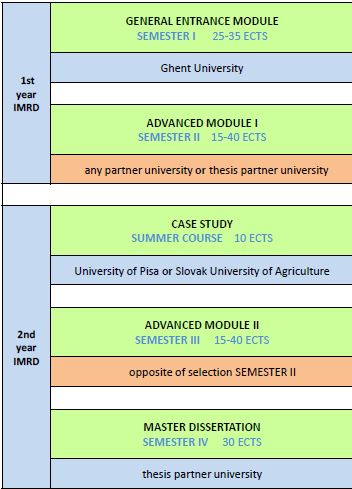
IMRD Programme

IMRD Programme

Wageningen University is partner is the International Master of Science in Rural Development (IMRD) and providing an advanced module in Sociology of Rural Development in the 3rd semester.  Students can subsequently do their MSc-thesis in Wageningen. Till March 15 2015 students can apply for a scholarship. See the IMRD website for more information.

Theoretical approaches to the ecologisation of agrifood systems – European Society of Rural Sociology 2014 Summerschool

Transitions towards more sustainable agrifood systems and rural landscapes are at the core of societal demands, technological but also social innovations and renewed public policies at various scales. In rural sociology they are addressed through different theoretical frameworks and the main objective of the ESRS PhD Summer School this year, is to discuss these competing and sometimes articulated frameworks and thereby to help the PhD students to clarify their own theoretical choices and to position them in relation to other theoretical frameworks that are used in rural sociology. For students who are rather at the beginning of their PhD, the aim will be to help them organize their state of the art and clarify their problematisation, while for students who are more advanced, it would rather be a discussion of their results in the light of existing literature and/or possibly the preparation of a future article. All the participants should have an interest in the theoretical frameworks that will be structuring the discussion, i.e. mainly Socio-Ecological Systems/Resilience theories, Food Regime Theory, Transition Theories, Actor Network Theory, and Social Studies of Science and Knowledge. Continue reading