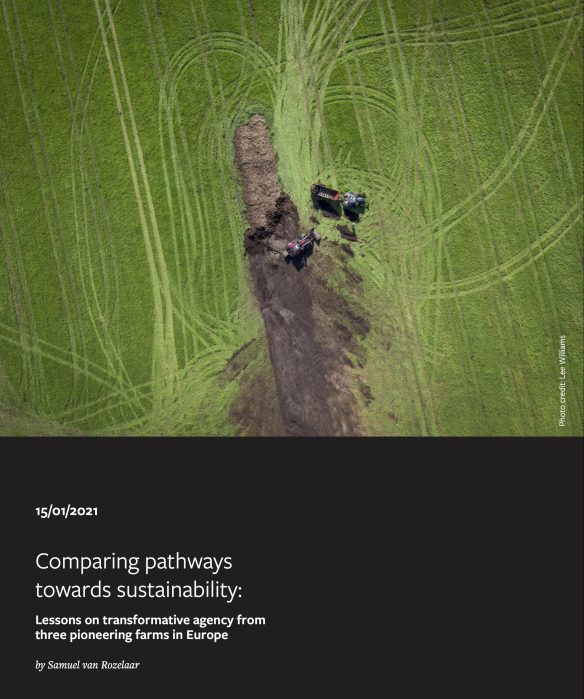
Comparing pathways towards sustainability: Lessons on transformative agency from three pioneering farms in Europe – MSc-thesis by Samuel van Rozelaar

Samuel van Rozelaar is a Master student Organic Agriculture has recently completed an excellent and beautifully illustrated MSc-thesis on the transformative agency of three pioneering farmers, all members of the lighthouse farms network, and meticulously reconstructed their transition pathways towards sustainable farming systems. ‘Comparing pathways towards sustainability: Lessons on transformative agency from three pioneering farms in Europe‘ can be downloaded (click on hyperlink). Below the abstract.

Abstract

This thesis offers lessons on the transformative agency of the farmers behind three pioneering farms. This is done by comparing the transformative strategies they applied in relation to the three-fold embedding of their farms, throughout their pathways towards more sustainable farming systems. To reconstruct these pathways semi-structured interviews and pathway mapping exercises were conducted with the main actors on each farm. This data was then coded, categorized and grouped in dimensions that allowed for a comparison of the interplay between strategies and embedding. The resulting 8 lessons show that these farmers persevered in developing, adapting, and moving towards their dreams and visions, despite many critical moments, by applying a range of transformative strategies. Through these strategies they managed to transform their farms in terms of its practices and relations. Throughout this process of transformation, the farmers continuously moved through a learning process, and as such also personally transformed in terms of thinking and doing, which in turn further enhanced their transformative capacities and strategies. Finally, the lessons show that these farmers have managed to create and navigate complex sustainable farming systems by tapping into the knowledge, skills, and resources of others. This shows the significance of the co-creation of contextual knowledge and the capacities to apply it in the transformation towards sustainable food systems. For future research, it is recommended to test to what extent these lessons resonate with other pioneering farms, but also with conventional farms. In addition, it is worth comparing family farms with non-family farms in their transformations towards sustainable farming systems, with a focus on intergenerational differences. In doing so, the frameworks of resilience of social-ecological systems and the adaptive cycle of transformations could be highly useful. Lastly, future research into transformations should also include the role of the relations to non-humans.

Thesis opportunity: developing a framework for business models that enhance soil quality

The Rural Sociology Group and Business Economics Group jointly offer thesis opportunities on developing business models that enhance soil quality.
Developing a theoretical framework for business models that enhance soil quality in crop and dairy production.

Soil quality is (rapidly) decreasing in The Netherlands, and thereby endangering future income perspectives of farmers. Moreover, reduced soil quality provokes all kind of negative externalities, such as reduced biodiversity, increased climate-change related risks, etc.. Hence, increasing and maintaining soil quality is a prerequisite for sustainable soil use.

This issue affects a multitude of stakeholders, each with different positions and preferences.

Business models, including various stakeholders and aimed at increasing and maintaining soil quality, are essential to enable farmers taking appropriate measures focused on these aims.

Currently, various initiatives have been taken to develop business models, mostly at a smaller scale. However, for mainstream agriculture to getting involved in improved soil management, a thorough theoretical framework, based on scientific analysis and rooted in (at least) economic and sociological theory, is essential. Only then, essentials of balanced business models can be developed which have the pursuit for larger-scale adoption in practice.

Being a pilot study, the aims of this MSc Thesis research are:

  • Qualitative analysis of real costs of soil management (i.e. monetary and non-monetary costs, such as costs for society) through the application of basic economic (cost) concepts;
  • Qualitative analysis of the stakeholder structure;
  • Definition of business cases and performance of a qualitative SWOT-analysis;
  • Evaluation of several existing business cases against the developed framework.

We are looking for a MSc-thesis student with an interest in the topic and a background in (business-)economics and/or rural/agrarian sociology.

Organic Times – first edition of the MOAgazine


Recently students of the Master programme Organic Agriculture (MOA) of Wageningen University launched the first edition of the MOAgazine entitled ‘Organic Times’. The magazine (Organic times online) is written and edited by MOA students and provides some insights into the programme, study and student activities and a variety of issues linked to MOA, including book reviews and organic recipes. As chair of the MOA study programme committee I have enjoyed reading the Organic Times and am proud of the time and energy the students invested in developing this magazine. It reflects the enthusiasm and commitment of this great and dedicated group of international students as well as the interdisciplinary character of the MOA programme.

Sustaining Dairy – PhD thesis by Georgina Villarreal Herrera

On Monday 26 June 2017 at 13.30 hrs Georgina Villarreal Herrera will defend her PhD thesis entitled ‘Sustaining Dairy’ in the Auditorium of Wageningen University. The ceremony will be live streamed by WURTV but can be viewed later as well.

The full thesis will be available online after the defence ceremony.


Summary of the PhD thesis

Dairy in Europe has undergone many changes in the last few years—the abolition of milk production quotas being a fundamental one. This study explores these changes in relation to the sustained social and environmental viability of the sector and how dairy processors’ sustainability programs are a part of that.

This study traces the evolution of the dairy sectors in the Netherlands, Ireland and the United Kingdom since the post-war era, outlining the dominant logic that has guided their development. The analysis shows that the post-war logic based on the increase of scale and intensification of dairying has continued to shape the development of the sector through today. While the visible impacts of intensive dairy have led to adaptations to the dominant rules and practices, these changes have not been fundamental in nature. The analysis of dairy processors and their sustainability programs revealed that these programs can be an additional tool for compliance to legal standards and the alleviation of pressing societal concerns. However, processors address social and environmentally relevant dairy-related challenges when an effective link to profit can be established. These programs have been unable to ensure that the dairy sector operates within established environmental limits and societal expectations, while providing a stable livelihood for farmers.

Agroecology for Food Security and Nutrition – account of symposium hosted by the FAO

Maria Alicia MendoncaBy Maria Alice Mendonça, PhD-student Rural Development at the Federal University of Rio Grande do Sul (UFRGS, Brazil) and guest PhD at the Rural Sociology Group of Wageningen University

During the days 18 and 19th of September, the FAO (Food and Agriculture Organization of United Nations) hosted the International Symposium of Agroecology for Food Security and Nutrition, in Rome, Italy. See the FAO webpage for more information on participants, presentations, poster, videos and so on.

The conference was attended by over 400 people. Amongst them were academics and representatives from government and social movements from all over the world. The aim was to discuss agroecology in the context of global debates and strategies related to: food security, sustainable agriculture and local food systems. The symposium was divided in three parts. The first was a plenary session with presentations by experts at the forefront of scientific research and bystate officials involved in the construction and implementation of innovative policies on Agroecology and Food Security. This was followed by parallel sessions where social movements, such as La Via Campesina and the Articulation in Brazilian Semiarid – ASA, as well as academics and government representatives shared on the ground experiences with Agroecology in diverse countries. At the closing session, State’s ministries of France, Nigeria, Japan, Senegal, Costa Rica, Brazil (video message), the Commissioner of Agriculture and Rural Development of the European Union (video message) and the FAO’s general director, José Graziano da Silva made their statements and commitments to Agroecology and Food Security. Continue reading