Unknown's avatar

About Han Wiskerke

Chair and Professor of Rural Sociology at Wageningen University (The Netherlands) Research domains: rural development, multifunctional agriculture, city-region food systems

Localizing Urban Food Strategies – Farming cities and performing rurality: call for abstracts for the 7th AESOP Sustainable Food Planning Conference

The 7th Aesop Sustainable Food Planning (SFP) Conference entitled “Localizing Urban Food Strategies: Farming cities and performing rurality” will take place in Torino (Italiy) from 7 to 9 October 2015.

Localizing urban food strategies refers to embedding sustainable food planning issues in place and in time within each specific local context. Moreover, by targeting planners, agronomists, designers, geographers, administrators, activists etc. engaged in the urban food debate, Farming cities and performing rurality aims at representing a platform for the development of fruitful perspectives for sustainable food planning policies and practices.

On the one hand, Farming cities refers to the development of innovative roles for agricultural production in and around the city, approaching in a structural manner the way agricultural issues are dealt (or should be dealt) with in contemporary urban policies. On the other hand, Performing rurality considers urban food strategies as a tool to define a cooperating relationship between the urban and the rural, reversing in terms of equality the traditional ideological subordination of the countryside to the city.

The activities of the Conference will be articulated around the following tracks: (i) Spatial planning and urban design, (ii) Governance and private entrepreneurship, (iii) Relevant experiences and practices, (iv) Training and jobs, (v) Flows and networks. There will be a specific activity for PhD students and young scholars.

Abstracts for one of the aforementioned tracks can be submitted until the 31st of May via the submission form on the conference website.
MSc course Sociology of Food Provisioning and Place-based Development

On the 16th of March 2015 the MSc course ‘Sociology of Food Provisioning and Place-based Development’ (RSO-31806) starts. Students that want to participate in this course can contact the course coordinator Han Wiskerke (han.wiskerke@wur.nl) as the deadline for online registration has passed.

IMG_0315

The course aims to provide a theoretical, empirical and methodological understanding of place-based development processes, with an emphasis on food provisioning and rural and territorial dynamics in urbanizing societies. The course is based upon recently completed and ongoing research activities within two of the main research domains of the Rural Sociology Group:

  1. The sociology of food provisioning;
  2. The sociology of place-based development.

Being based on recently completed and ongoing research projects implies that this course provides an up-to-date  insight into current theoretical debates and research findings. These are mainly derived from international collaborative research programmes (see ‘our projects’), carried out by multi-disciplinary research teams in different countries inside and outside Europe. Within and linked to these programmes the Rural Sociology Group has approximately 30 ongoing PhD projects. Some of these projects will also feature during this course.

The course is divided into four main themes: Continue reading

Global dynamics and empowerment of the local street food network: a case study on the Ghana Traditional Caterers Association

By Hilde-Marije Dorresteijn, MSc International Development Studies at Wageningen University

For my MSc thesis within the RSO chair group I did research on street food in Ghana. During the master programme I became more and more interested in food issues and its possibilities for local development. These possibilities are beautifully illustrated by the following quotation with which I started my thesis:

“Food provides an answer. Our landscapes and cities were shaped by food. Our daily routine revolves around it, our politics and economies are driven by it, our identities are inseparable from it, and our survival depends on it. What better tool, then, with which to shape the world.” (Steel, 2012 in Viljoen & Wiskerke, 2012:36).

HM Dorresteijn blog picture 1

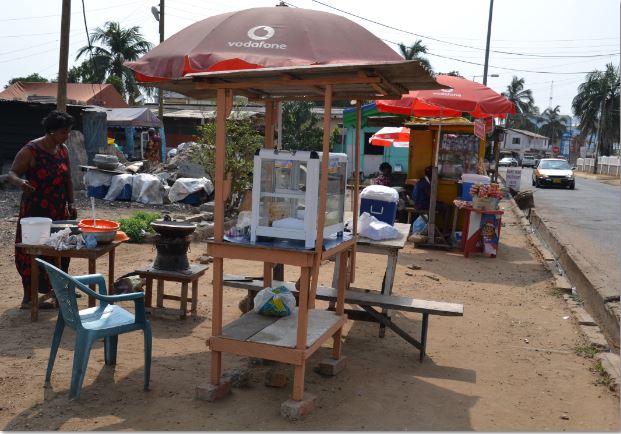
Despite its importance I found little scientific research on street food, a phenomenon that is particularly relevant in developing countries. Street food can be defined as: ‘ready to eat food or beverages prepared and/or sold in the street and other public places for immediate consumption or at a later time without further processing or preparation’ (FAO, 2012). I decided to look into this topic within the context of Ghana’s capital Accra. An estimated 85% of the urban population in Ghana patronize it, cutting across socio-economic boundaries and thus also designating the important cultural role of street food In Accra, from early morning till late at night all sorts of food are being sold on the streets. Also, there is a great variety in the professionalism of microenterprises. There are many hawkers walking around trying to sell their products, well established enterprises that have fixed stands and seating facilities, and the informal eating houses called ‘chop bars’. Street food make an essential contribution to nutrition of the urban population by providing easily accessible and affordable food, as well as they provide a good livelihood strategy by creating employment and increasing incomes for a large number of urban dwellers. Hereby street food thus makes a great contribution to the local economy. This informal sector requires low start-up capital and low levels of education are needed, making it a good business opportunity for especially women.

The cheapest way to make money, is to cook food. You are a secretary, or you have a shop, and the shop collapses. You can buy a pot, buy silver, cooking utensils, buy water, the pepper, yam and you cook and you’ll get people to buy. Very, very cheap. So day in day out people have been coming into the system. That is why they are plenty. And automatically when you cook, you will get people to buy.” (Mr. Ansong, PRO GTCA, 13 Jan. 2014) Continue reading

Call for abstracts Agriculture in an Urbanizing Society Conference

The programme committee of the Agriculture in an Urbanizing Society Conference, which will take place in Rome (Italy) from 14-17 September 2015, has opened the call for abstracts. Abstracts can be submitted through the conference system EasyChair until 31 March 2015 for one of the following 23 working groups (click on the working group for description and convenors or download pdf (500 KB)):

  1. WG1 – Connecting local and global food systems and reducing footprint in food provisioning and use
  2. WG2 – Short food supply chains (regional products; farmers’ markets; collective farmers’ marketing initiatives; alternative food networks; CSA)
  3. WG3 – Economic impact at the farm level
  4. WG4 – New business models for multiple value creation
  5. WG5 – Entrepreneurial skills and competences, knowledge and innovation systems and new learning arrangements
  6. WG6 – Transition approaches
  7. WG7 – Regional branding and local agrifood systems: strategies, governance, and impacts
  8. WG8 – Food systems and spatial planning. Towards a reconnection?
  9. WG9 – Land-use transformations
  10. WG10 – Urban agriculture I. Urban agriculture and Urban Food Strategies: Processes, Planning, Policies and Potential to Reconnect Society and Food
  11. WG11 – Urban agriculture II. Grass-root initiatives and community gardens
  12. WG12 – Urban agriculture III: Effects of UA. Urban agriculture: a potential tool for local and global food security, economic, social and environmental resilience, and community health and wellness
  13. WG13 – Care Farming/Social Farming in more resilient societies
  14. WG14 – Rural tourism (agri-tourism) and changing urban demands
  15. WG15 – Local arrangements for agricultural ecosystem services: connecting urban populations to their peri-urban landscapes through the ecosystem services of agriculture
  16. WG16 – Gender aspects of multifunctional agriculture
  17. WG17 – Civic agriculture for an urbanizing society: production models, consumption practices and forms of governance
  18. WG18 – Society Oriented Farming – working on the balance between market and societal demands
  19. WG19 – Food Security: Meanings, Practices and Policies
  20. WG20 – Revolutionary solutions for local food systems
  21. WG21 – Urban forestry, Green infrastructure
  22. WG22 – Food System Transitions: Cities and the Strategic Management of Food Practices
  23. WG23 – Conceptualising and Assessing City Region Food Systems

After a positive evaluation of the abstract the author will be asked to upload a paper of max 10 pages which will be published online on the website of the conference. There will also be the possibility to submit a short paper of max 2 pages enabling the authors to still publish their results in peer reviewed journals after the conference. Short papers will be published in a book of proceedings. The procedures for the papers will be published on the conference website soon.

Job opportunity – Senior Research Fellow at the Countryside and Community Research Institute (Gloucester, UK)

The Countryside and Community Research Institute (www.ccri.ac.uk), established over 25 years ago, is an internationally-recognised and respected leader in applied rural research in the UK and Europe with a broad portfolio of projects approaching £1m p.a. in value. CCRI staff are drawn from a range of social and political science, economics and applied science backgrounds, and participate in a variety of national and international research collaborations.

The CCRI is seeking to appoint a senior researcher to develop its capacity and reputation in the area of sustainable agriculture and food and nutrition security, with a strong preference to recruit someone with excellent quantitative and statistical analytical skills. Initially, about 60% of the post-holder’s time will be dedicated to a new Horizon 2020 research project entitled ‘Sustainable finance for sustainable agriculture and fisheries’ (SUFISA), which will run from 1st May 2015 to April 2019. A key role for the post holder will be to lead the design and analysis of a large farm survey across European agricultural regions, including econometric and multivariate analysis.

The Post-holder would also be expected to secure, manage and contribute to other UK and EU funded applied rural research, to undertake supervision and teaching, to maintain an active publications portfolio and to be of suitable quality to enter into future assessments of research excellence.

For more information see http://resources.glos.ac.uk/jobs/index.cfm?jobRef=A843