“What is a good life for animals?”

Last week 65 students Animal Science have been dealing with this question during the course ‘Animal Science in Society’ (RSO 11303). We used David Fraser’s book ‘Understanding Animal Welfare. The Science in its Cultural Context’ (2008) as guidance. David Fraser describes three concepts for animal welfare, i.e. what entails  ‘a good life for animals’ : a) a healthy life, b) a natural life, c) a happy life. The three concepts are not mutually exclusive, but overlap. Moreover, they often don’t go together, they are in conflict.

In groups of 6 students per group, the students worked on this question to get familiar with the concepts and to learn to apply these. Each group answered the question for a specific animal in a specific environment. “What is a good life for…?” …a dairy cow at a commercial farm? …a rabbit at home? …a rat at a laboratory? …an elephant in a circus? …fattening pig at a commercial farm? …a rabbit at a farm for meat production? …a fish in a fishbowl? …a laying hen at a commercial farm? …a mink at a farm for fur production? …a cat at home?

The students had to present their answers in a creative way. Well, one can leave that up to Animal Science students! You-tube movies about ‘Youp van ‘t Hek’s ‘Flappie’’, chips-eating cats, home-made movies about the ideal life for laying hens, a performance with students as rabbits and one group even designed a completely new mink production system with mink welfare as departure point!

The presentations as well as the discussions showed that the answer to this question is not as clear-cut as it may seem. Instead, the answers vary according to the animal species and their functionality. The functionality of the animal refers to the function the animal has for humans, for example food production, company, aesthetics, entertainment and testing medication. In some situations, the animal’s function harms its welfare so much, that the function itself is being questioned.  For example, a large majority of the students held the opinion that elephants should not be kept in circuses. In their opinion, the elephants’ welfare is harmed too much – as they are kept in a very unnatural environment – in comparison to the benefit for humans – entertainment. However, students were less unanimous when it comes to use of animals for food production, for example about the welfare of fattening pigs. There was one group of students who held the opinion that the welfare of fattening pigs was fine as long as the pigs were healthy. In their eyes, conventional production systems did not harm pig welfare. On the other hand, there was a group of students who considered conventional production systems too ‘unnatural’. They preferred organic farming systems which give space to more ‘naturalness’ and ‘happy pigs’.

The latter example also illustrates that in addition to the animal’s functionality, personal experiences, values and convictions play a role when defining a good life for animals. Hence, the answer to this question also varies among (groups of) people. Finally, the definition of animal welfare varies according to the social and cultural context in which it is defined and used.

Thanks to the original and enthusiastic input of the students, it was a creative and interesting closure of a week about animal welfare, in which the students could get familiar with present-day social and scientific questions (see former blog) about animal welfare!
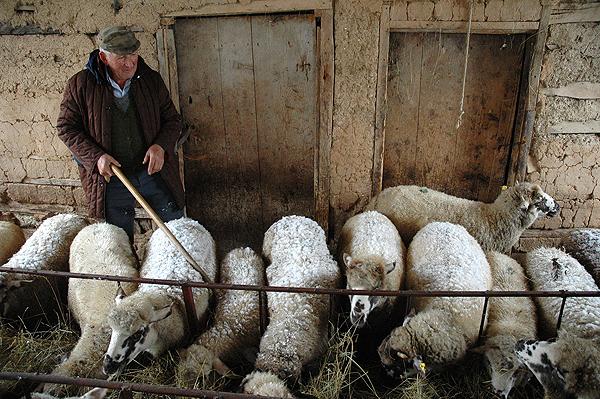
Rural regional learning in the Comarca de Verín, Galicia, Spain

Within the European research project DERREG, we are investigating how public policy can best be arranged to stimulate capacity building within development initiatives operating at grassroots level in rural areas across the European Union.

To find out how public policy interventions can best be arranged, we and our research partners have spoken to various stakeholders in different rural regions across the European Union to find out how they intend to support and facilitate learning and innovation and- most importantly- how the support and facilitation agreed upon is actually provided to the grassroots development initiatives. To find out what is working well and what isn’t working well yet, we have spoken to a number of grassroots development initiators in the participating DERREG case study areas and ask them to evaluate the current support and facilitation received.

To be able to compare the results obtained in the different case study areas, I have travelled to Alytus County, Lithuania in October and Oberlausitz, Germany in December of 2010. In January of this year, I was able to visit our colleague Lola Dominguez Garcia of  Universidade de Vigo in the Comarca de Verín in the South-West of Galicia, Spain. In this blog, we intend to share our experiences. Continue reading

Working group at 24th ESRS congress in Chania, Greece 22-25 August 2011: Call for papers

Imre Kovách ( Institute for Political Science of the Hungarian Academy of Sciences, Budapest), Petra Derkzen and I are organising a working group on “the governance of semi-subsistent food and farming strategies in the countryside and city- a compartive perspective” at the 24th ESRS congress in Chania (Greece) from 22-25 of August 2011. We would like to invite all interested researchers to submit their papers dealing with empirical or theoretical reflections on the driving forces, structure and mechanisms of semisubsistence food and farming strategies in the countryside and-or cities, both within developed and developing countries. Abstracts may be submitted  to Imre Kovach (ikovach@mtapti.hu) AND chania2011@agr.unipi.it until the 30th of April 2011.  For a more detailed description of the workshop please read further…

Courtesy of European Forum on Nature Conservation and Pastoralism

Continue reading

Rural women in Europe: invest in the vitality of rural areas to improve their position

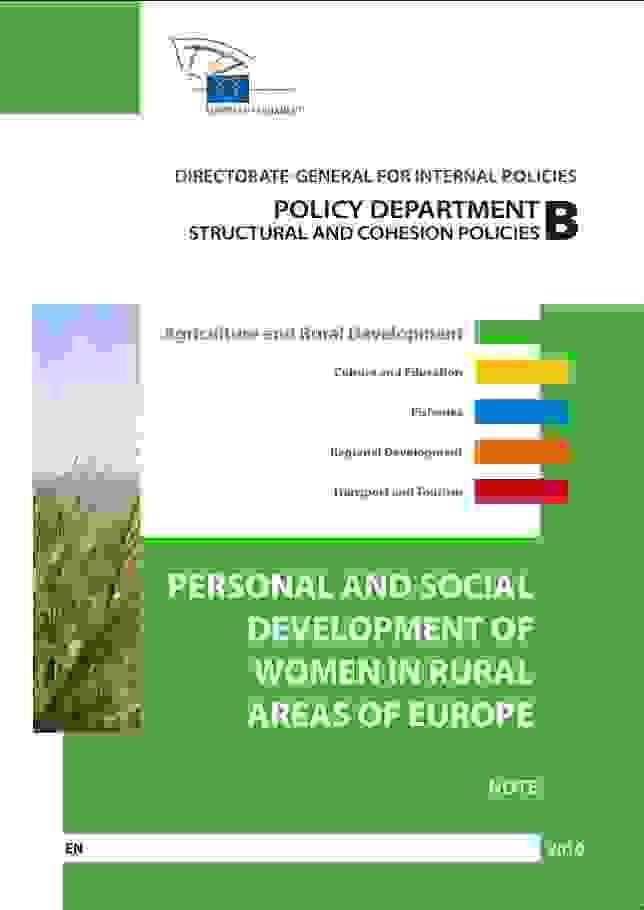
The report ‘Personal and social development of women in rural areas of Europe’, prepared for the European Parliament’s Committee on Agriculture and Rural Development, provides an overview of the social situation of women in the rural areas of Europe. It looks into rural women’s work, political participation and their experience of the quality of life in rural areas. It points at the great diversity between and within Member States but also states that there is no evidence of a general rural disadvantage. Women experience specific problems only in the peripheral rural regions of Europe and in particular the Central-Eastern Member States. These areas are maladapted to women’s needs in terms of employment and services, as well as cultural norms and values. It is also in those areas that young rural women (and men) decide to leave and to search for a better life elsewhere.

Analysis of rural development policies reveals that women seldom participate in the formation of rural development plans or the decision making on the distribution of funds. There are some projects designed for women often focusing on self-employment. There are also some projects aimed at improving the supply of social services. Most projects are fragmented attempts to solve some problems for some women. A coherent plan on how to address gender equality is lacking. 

To improve the situation of rural women it is recommended to focus on the situation in the peripheral rural areas where the low quality of life and lack of work, income and services constraints women’s development and perpetuates unequal gender relations. It is important to invest in the vitality and quality of life of those areas and to improve their accessibility. Upgrading the local quality of life may convince rural women (and men) to stay. It may also help to mobilize individual and collective action for local development.

Multifunctionele landbouw is een sector met toekomst

Ondernemen in de multifunctionele landbouw is niet voor stoppers, maar biedt juist toekomstperspectief. Het vervlechten van nieuwe activiteiten (zoals zorg, recreatie, educatie, huisverkoop etc.) met de agrarische productie zorgt voor een aanzienlijke bijdrage aan het gezinsinkomen en verdere ontwikkeling van de agrarische activiteiten. Dit blijkt uit het onderzoek ‘Dynamiek en Robuustheid van Multifunctionele Landbouw’ dat in opdracht van het ministerie van EL&I werd uitgevoerd door de leerstoelgroep Rurale Sociologie van Wageningen University. Het onderzoek is gebaseerd op diepte-interviews met 120 multifunctionele landbouwondernemers. De ondernemers komen uit het Brabantse Groene Woud, Flevoland, Laag-Holland (Noord-Holland), het Zeeuwse Walcheren/Zuid-Beveland, De Drentse Wolden en de Noordelijke Friese Wouden.

Robuustheid

Uit de interviews blijkt ten eerste dat bij de komst van nieuwe activiteiten vooral positieve drijfveren een rol spelen, meer dan een te laag inkomen. Betrokken boeren en boerinnen hebben vaak behoefte aan meer contact met burgers, consumenten en de maatschappij. Ten tweede blijkt dat op de onderzochte bedrijven gemiddeld bijna drie verschillende activiteiten voorkomen, in verschillende combinaties.

De verschillende combinaties van multifunctionele activiteiten op de onderzochte bedrijven zorgen voor een gemiddelde omzet van 195.000 euro (aanvullend op de agrarische omzet). De activiteiten leveren – met gemiddeld 40 procent – een aanzienlijke bijdrage aan het totale gezinsinkomen. Sinds de start van de nieuwe activiteiten is er bovendien op het overgrote deel van de bedrijven sprake van een positieve wisselwerking met verdere agrarische ontwikkeling. Agrarische omzet, grondgebruik en arbeidsinzet blijft behouden of groeit.

De robuustheid van multifunctionele bedrijvigheid blijkt verder ook uit de positieve beoordeling van het totale bedrijfsinkomen door boeren, groeiende omzetten en inkomensbetekenis en de geleidelijke uitbreiding van het aantal nieuwe bedrijfsactiviteiten in de tijd. Ook de totale arbeidsinzet op betrokken bedrijven neemt geleidelijk aan toe. “Multifunctionele landbouw is dus niet alleen van betekenis voor betrokken bedrijven, maar zeker ook voor de plattelandseconomie als geheel”, aldus projectleider Han Wiskerke.

Verschillen

Het onderzoek laat zien dat er grote verschillen bestaan in dynamiek en robuustheid van onderzochte bedrijven. Dit wordt enerzijds verklaard door regionale verschillen, zoals de aanwezigheid van sterke samenwerkingsverbanden als belangrijke succesfactor. Daarnaast maken ook meer bedrijfsgebonden factoren verschil. Te denken valt aan verschillen in bedrijfsstrategie zoals de mate van investeren, het wel of niet werken met personeel en in hoeverre er wisselwerking plaatsvindt tussen de verschillende bedrijfsactiviteiten.

Taskforce

De Taskforce Multifunctionele Landbouw zet zich namens het ministerie van EL&I in voor de verdere ontwikkeling van zorglandbouw, streekproducten, recreatie, agrarische kinderopvang en educatie en natuurbeheer. Kenniscoördinator Arjan Monteny: ,,Het onderzoek toont aan dat multifunctionele landbouw een stevig fundament heeft: ondernemers durven erin te investeren en behalen rendement uit de nieuwe bedrijfsactiviteiten. Het is mooi dat dit vaak gepaard gaat met verdere ontwikkeling van de agrarische activiteiten. Multifunctionele landbouw is daarmee onlosmakelijk verbonden met de agrarische productie. Het is duidelijk geen exit-strategie.”

Rapport

Het onderzoeksrapport is te downloaden via de website van het onderzoeksproject.

Bron: deze blog is een overname van een gezamenlijk persbericht van de leerstoelgroep Rurale Sociologie en de Taskforce Multifunctionele Landbouw