Thesis Opportunity: The TEDification of Food Activism

Increasingly TED talks are becoming trusted sources for food politics and policy making, and an important medium for food activists to communicate through. Yet, there are also limits to what can be communicated in a TED talk and how. These limitations affect the types of knowledge and activist performances that are deemed suitable. We would like to understand what TED talks are doing to and for food politics, by conducting a comprehensive analysis of recent TED talks on the theme of FOOD. We are interested in the celebrity, bodily, and visual performances that compose these talks. The effects of these talks on public opinion and policy. And the limitations and possibilities of TED talks as a mode of food activism.

Ted-Talk

Qualifications:           

  • You have some training in qualitative methods and critical social theory
  • You are an interested in digital media and food activism
  • You are willing to develop new methodologies and tools for analysing digital media
  • You are registered for one of the following MSc programmes: MID, MCS, MLP, MFT, or MOA
  • You have completed at least 2 RSO courses (or relevant social science courses)

Questions? Please get in touch!

Supervisors: Oona Morrow (RSO) oona.morrow@wur.nl & Prof. Mike Goodman, University of Reading

Thesis opportunity: the gentrifying foodscape part II

The urban foodscape is in constant transition, among others due to gentrification. This has effect on options and choices of both newcomers and people who have been living in the neighborhood for longer.

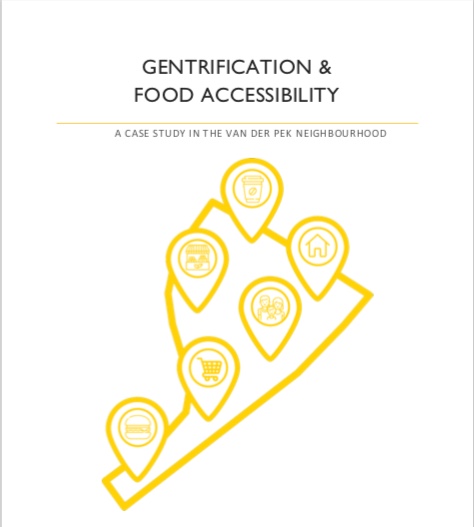
Sophie Visser, MSc student Health and Nutrition, studied the gentrifying Amsterdam neighborhood ‘Van der Pekbuurt’ (see Sophie’s blog on her results) by mapping its food establishments, interviewing both older and newer inhabitants and making observations. She found that due to gentrification the number of establishments in the neighborhood increased immensely. While this has positive aspects – the increased offer leads to an increased choice – not all inhabitants feel comfortable in all these new establishments.

We are looking for a student to continue Sophie’s work on gentrification and foodscapes. Preferably the student would follow up on the previous thesis by updating the mapping of the foodscape, and executing more interviews with a broader group of people. Alternatively, the student chooses another neighborhood (in Amsterdam or elsewhere) in a further state of gentrification, in order to get a broader view on how gentrification can affect foodscapes.

Pre-requisites: completed at least two social sciences courses (preferably with RSO); keen interest in foodscapes; able to conduct qualitative research, preferably but not necessarily in Dutch

Supervisor: Esther Veen (RSO): esther.veen@wur.nl

Questions? Please get in touch!

Thesis opportunity: What are food systems anyway?

Mapping and analysing the diversity of food systems research at WUR

MSc Thesis Project
Rural Sociology & WCDI 

Supervisors: Jessica Duncan (RSO) and Herman Brouwer (WCDI)

The topic: The concept of food systems has emerged recently as a buzzword. Across Wageningen University and Research (WUR) researchers are using the concept and applying it in different ways. This thesis will review the different ways food systems are being defined and applied across WUR.

The research process will involve:

  • Literature review on food systems
  • Data collection (e.g. comprehensive analysis of WUR-based activities around food systems; interviews)
  • Analysis with the aim of: 1) mapping the food systems landscape at WUR; 2) categorizing the diversity of concepts and approaches; 3) analyzing points of coherence and contention across these concepts.
  • Conclusions with possible recommendations

Pre-requisites: completed at least two social sciences courses (preferably with RSO); keen interest in food systems research; interdisciplinary background an asset.

Start date: ASAP

For more information: jessica.duncan@wur.nl

roots

Gentrification and the Van der Pek foodscape

Written by Sophie Visser

‘Gentrification’ transforms cities all over the world. Neighbourhoods are upgraded and there is an influx of new, affluent inhabitants. This often has a negative effect on the longstanding inhabitants of that neighbourhood, as they can no longer afford the housing and no longer feel welcome due to the neighbourhood’s changed cultural and social atmosphere. Gentrification influences the foodscape as well. While there may be an increase in food availability, food accessibility for longstanding inhabitants often decreases due to an increase in price and because longstanding inhabitants do no longer feel welcome in the facilities in their neighbourhood.

With this thesis I aimed to investigate the effects of gentrification on the foodscape, the food choice and food accessibility for the inhabitants of the gentrifying Van der Pek neighbourhood, located in the North of Amsterdam. I used semi-structured interviews, observations, informal conversations and food mapping to collect data.

I conclude that the Van der Pek neighbourhood is at an early stage of gentrification. There is an influx of new inhabitants and a slow decrease in the number of longstanding inhabitants, who are aging and passing away. Over the past years, the number of establishments in the Van der Pek neighbourhood increased immensely. This appears to be positive at first sight because the increased offer leads to an increased choice for the inhabitants. However, not all inhabitants feel comfortable at every establishment. The new establishments are often more expensive, which is unsuitable for longstanding inhabitants: they base their food choice on price and often have lower incomes. Additionally, while some new establishments try to target both new and longstanding inhabitants, mostly new inhabitants are attracted to these establishments. Hence, even though the number of establishments has increased, as the gentrification process furthers, access to food might increase for new inhabitants but decrease for longstanding inhabitants.  

voorblad Sophie

As this thesis provides an in-depth analysis of the foodscape and food choices of inhabitants of the gentrifying neighbourhood, it can provide valuable information to the municipality of Amsterdam – who wants to prevent a division between the two groups of inhabitants in gentrifying neighbourhoods. Besides that it can lead to further research on other gentrifying neighbourhoods to provide a better overview of the influence of gentrification on foodscapes and food choice.


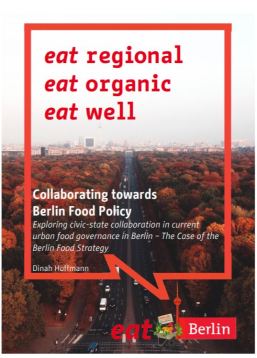
Collaborating towards Berlin Food Policy: Exploring civic-state collaboration in current urban food governance in Berlin – The Case of the Berlin Food Strategy

dinah thesis coverDinah Hoffman, MSc student Communication, Health and Life Sciences
Specialization: Health and Society, Wageningen University

Below please find the abstract of the MSc thesis Collaborating towards Berlin Food Policy: Exploring civic-state collaboration in current urban food governance in Berlin – The Case of the Berlin Food Strategy

The full thesis can be downloaded from the WUR-Library by clicking on the hyperlink


Urban food policy is an area that joins actors from civil society, academia, the local state and the market. To accomplish sustainable changes of local food systems these actors work together in governance arrangements. Two prominent instruments that are used in urban food governance where these actors collaborate are the food policy council and the urban food strategy. Both can be initiated through top-down or bottom-up processes or a combination of both with the relationship of local government and civil society having an impact on the success of the initiatives. One of the cities where civil society and local government engage in collaborative food governance is the city-state of Berlin, the biggest city in Germany, surrounded by the agricultural region of Brandenburg. Drawing on data from 11 interviews and 40 documents, this thesis describes and examines the nature of the relationship and governance arrangement of the two main actors in current Berlin food governance. The collaborative governance framework, a categorization of civic-state relationships found in urban food governance and the concepts of integrated food policy and institutionalization were used to guide the analysis. The objective of this thesis is to understand how civic-state collaboration in urban food governance looks like in Berlin, what impact the local context has on the development of the governance arrangement and what strengths and challenges involved stakeholders perceive. The two main stakeholders were found to be the civic food policy council Ernährungsrat Berlin and the Berlin Senate Administration for Consumer Protection. It was found that the Ernährungsrat Berlin’s food policy activity brought forward a relationship where they are striving for independence but are linked to the government through a secondary agency, being the aforementioned administrative department. Although not embedded in municipal institutions, which has been identified as crucial for a food policy councils’ success, the Ernährungsrat Berlin proved to be an agile and resilient structure able to successfully be an independent advocate for civil society and a valued advisor to the government. Their collaboration resulted in the development of a Berlin Food Strategy. In this thesis I investigate the process of developing this strategy as a form of collaborative governance. Regarding their governance arrangement around the Berlin Food Strategy, the involvement of the Green Party in the current coalition was found to have had a big impact on the position the Ernährungsrat Berlin but also food policy was able to occupy on the urban agenda. This research identified a number of strengths and challenges of the governance arrangement including a strong interdependence, a strong and long history of civic action, the presence of political food champions in the coalition and the administration, the limiting structure and functioning of the Senate administrations and the limited inclusiveness and representatives of the Ernährungsrat Berlin.

Key words: urban food governance, urban food policy, food policy council, urban food strategy, collaborative governance, Berlin food strategy, Ernährungsrat Berlin, Senate of Berlin