
Transitions towards more sustainable agrifood systems and rural landscapes are at the core of societal demands, technological but also social innovations and renewed public policies at various scales. In rural sociology they are addressed through different theoretical frameworks and the main objective of the ESRS PhD Summer School this year, is to discuss these competing and sometimes articulated frameworks and thereby to help the PhD students to clarify their own theoretical choices and to position them in relation to other theoretical frameworks that are used in rural sociology. For students who are rather at the beginning of their PhD, the aim will be to help them organize their state of the art and clarify their problematisation, while for students who are more advanced, it would rather be a discussion of their results in the light of existing literature and/or possibly the preparation of a future article. All the participants should have an interest in the theoretical frameworks that will be structuring the discussion, i.e. mainly Socio-Ecological Systems/Resilience theories, Food Regime Theory, Transition Theories, Actor Network Theory, and Social Studies of Science and Knowledge. Continue reading
Category Archives: Rural Development
Imagining Research for Food Sovereignty (video)
This video – ImaginingResearch for Food Sovereignty – highlights the outcomes of the farmer exchanges and the St Ulrich workshop deliberations.
For more information about the St. Ulrich Workshop on Democratising Agricultural Research for Food Sovereignty and Peasant Agrarian Cultures and theDemocratising Food and Agricultural Research initiative go here:http://www.excludedvoices.org/st-ulrich-workshop-democratising-agricultural-research-food-sovereignty-and-peasant-agrarian-culture
Life in the Alpujarra (Spain)
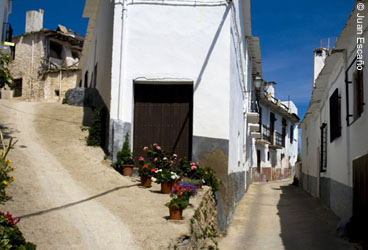 Since the beginning of February my family and I have been in the Alpujarra; south side of the Sierra Nevada in Spain. We are here to experience the rough side of life: being a farmer in a tough arid land. We are trying to get a glimpse of the other side of the food story and feel what it is like to work the land (mainly by hand labour); and give our brain a bit of a rest. But despite the huge amount of physical work we do each day, the mind doesn’t rest. There is just too much going on here: the shrinking and greying villages, the contrast between coastal and hill-side farmers, the young versus the old, the ‘extranjeros’ vs the locals, fighting bush fires vs keeping a varied landscape, organic farmers selling mainstream to the world market, etc etc… I will start by telling you a bit about the village structure here, in Yegen.
Yegen is a small, typical white Moorish village in the centre of the Alpujarra. It seems just another village, but it is bit more special than all the other white towns. A certain Gerald Brenan (a British self-appointed anthropologist) was already fascinated by the life and customs in this village more than 90 years ago. He experienced Yegen as rather backwards (a way of life that he couldn’t imagine still existed) while at the same time the villagers as being extremely open to new comers. He ended up living in Yegen for about 30 years and produced a very popular book. Unfortunately, I haven’t had the chance to get a hold of a copy but I did discover a 45 minute documentary about Gerald Brenan’s return to the village in 1974 (http://www.youtube.com/watch?v=2JAAYPVsQQ4). Interestingly enough, he talks about the huge progress of the village and the change in customs and traditions, whereas to me – born in the late 1970s – it seems to be a pre-War setting. I couldn’t believe it was actually 1974; the streets were huge irregular stones mixed with sand on which only mules were to be seen, the women washed their clothes in a river, no motorised traffic at all. At the same time, Continue reading
Il a plus sur le grand paysage – Film about crisis in Wallonian Dairy farming in Movie W
Monday March 31, 20.00 the film ‘Il a plus sur le grand paysage‘ (with English subtitles) will be shown in Movie-W. The film is directed by Jean-Jacques Andrien. The director and a farmer will be present and open for discussion with the audience.
Autumn 2010. In the region of Herve, in Belgium’s east, the milk crisis of 2009 struck brutally at the dairy farms. In this profoundly estabilised context, the decision of the European Union to completely remove the milk production quota in 2015, and the determination of the World Trade Organisation to further liberalise the markets, directly threatened the existence of the farms. Nine farmers tell us of their struggle, from the heart.
Free entrance thanks to the support by Rural Sociology and Sociology of Development and Change of Wageningen University. The evening is co-organised by Otherwise, Movie-W, ILEIA, RUW and Boerengroep.
Voedselanders / Food otherwise conference very successfull
The Voedselanders or Food Otherwise conference held last Friday and Saturday at the Wageningen Campus has been very successfull and inspiring: more then 800 people participated. Key notes speeches by a.o. Pablo Titonell, Hanny van Geel, Vandana Shiva and Olivier de Schutter were broadcasted live by wurtv.wur.nl and those did missed one or more can still see what they missed. See also the Voedselanders.nl website for links to the recordings.

