“Kuifje in India” (1) – International Master of Rural Development (IMRD)

The University of Agricultural Sciences Bangalore (‘UASB’, in Hindu it is named ‘GVKV’) is ‘associate partner’ of the IMRD consortium. This International Master of Science in Rural Development (‘IMRD’) is an EU funded Erasmus Mundus Program, which originally (it started in 2004) was meant for non EU students to enter an European Master program. Since then, the program became more and more popular; also because it was opened for European students. But more changes took places and put the IMRD into the pictures: since some years, the IMRD not only has full partners (through the Atlantis program) in the US (Florida and Arkansas), but also cooperates with so-called ‘associated partners’ all over the world. These partners are in South Africa (Pretoria University), Beijing (China agricultural University) and Ecuador (Espol).

Students who enter into the IMRD program, have the opportunity to do a ‘specialized module’ in one of those ‘associated partner universities’ (the other 3 semesters has to be chosen out of Ghent, Berlin, Rennes, Nitra, Pisa or Wageningen). In this (‘spring’)semester, 3 IMRD students are in Bangalore: two of them (Basavaraj and Lauren) for their thesis (doing their data collection in India), and one (Tungaa) for the specialized module in agricultural economics.

Continue reading

Thesis assignment commissioned by Foundation Social Workplace Saba (FSWS) on Food Sovereignty in Saba

The assignment is a participatory scenario development on the different possibilities to achieve a local food supply at Saba. Saba is a Caribbean island and the smallest special municipality of the Netherlands. At the moment most food is imported which makes food expensive for the inhabitants of Saba. At the same time agriculture fields aren’t being fully used. The assignment is to develop different scenarios for a local food market. Optional is a thesis assignment including an internship.
Wageningen UR Science Shop accepted the assignment of FSWS. The research will make you familiar with ‘Participatory Scenario Development’ and is a chance to achieve work experience in the field of the Science Shop and Regional Food Supply. The research will start in September.
Are you interested? Please contact project leader Margriet Goris (cocreation@live.nl or 06-28109539).

Traditional foods at IP in Romania (7) Student reflection

Four previous blogs reported on the Intensive Program on Traditional Foods in Romania which took place during the first weeks of February. Students who participated were asked to reflect on their experiences.

Written by Rineke Boonen.

Saturday the 28th of January the time was come. Four students from Wageningen University replaced Wageneningen for two weeks Cluj-Napoca in Romania. We went to the cold Romania (-20C!) to take part at the Intensive Programme (IP) with the subject:”Microbes and traditional Foods: Competitors or allies”. Continue reading

Farmer driven transformation: next grassroots-science seminar

As announced earlier, St. Boerengroep and St. Otherwise organize a serie of seminars called Grassroots science: socially driven alternatives that tackle global problems. Next one will be on Monday May, 14, starting 19.30, in the Forum building. See the announced below and register a seat here:

Farmer driven transformation in the Netherlands: sustainable practices and struggles with the state

Dutch agriculture is one of the most productive in the world. This however seems to have come at a price. Disease outbreaks have led to the killing of more than 40 million animals in the last 14 years, it is the only EU country that does not comply to EU groundwater standards, it is the largest user of antibiotics for meat production in the EU, it ranks in the top 3 of the world’s largest pesticide users and the farming population has shrunk by 36% in 15 years. Policy efforts and huge investments in research seem to have brought little change to this. Farmer-led initiatives have however emerged that promise to tackle some of these problems. Frank Verhoeven (Boerenverstand bv) and Douwe Hoogland (chair Noardlike Fryske Wâlden) will talk about two farmer-led environmental co-operatives in the Frisian Woodlands, who, in cooperation with researchers, have devised system innovation by re-integrating dairy farming with nature conservation and landscape management. To realise this struggles with state policies were inevitable.

Learning about the role of agriculture and natural resources in sustainable rural development

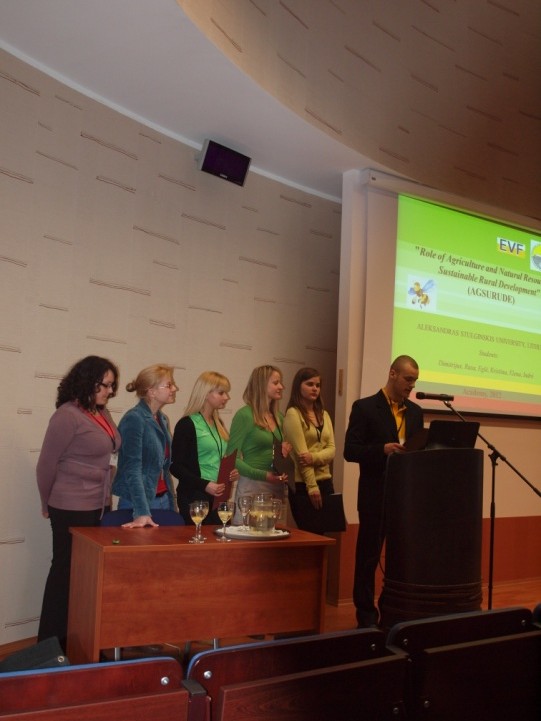
Together with four students of Wageningen University, I spend two weeks in Kaunas, Lithuania to represent Wageningen University, and the Rural Sociology Group, at this years’ ‘Intensive Programme’ on rural development. In this post I would like to reflect on this interesting experience and share some of the activities, impressions and outcomes.


Intensive programme?

An ‘Intensive Programme’ (or IP) is a short study programme bringing together different EU member states’ students and teachers from higher education institutes to study a relevant topic, in this case: rural development. EU’s main motivation to finance these programmes is to encourage multinational learning and teaching in the EU. The Rural Sociology Group has been participating in IP’s on rural development for some years now. Last years’ IP, hosted by colleagues of Padova University, focused on ‘the role of agriculture in territorial identity’ and took place in the Belluno province in the Italian Dolomites. We have also participated in IP’s with other themes. More recent, colleague Petra Derksen participated in an IP on traditional foods and micro-organisms in Romania. In a series of posts on this weblog she, and participating students, reflect on their experiences in this programme.        

The role of agriculture and natural resources in sustainable rural development

This years’ IP, on rural development, focused on ‘the role of agriculture and natural resources in sustainable rural development’. The programme was hosted by colleagues from the Aleksandras Stulginskis University in Kaunas, Lithuania. Twenty tutors and more than forty students came together for two weeks to discuss and learn about (Lithuanian) rural development. Participants represented universities from: Slovenia, Hungary, Slovakia, Italy, Belgium, Lithuania, Estonia, Latvia, Poland, Spain and the Netherlands.

Continue reading