Grow, share or buy? PhD-thesis by Lucie Sovová

October 13 2020, at 13.30 am (CET) Lucie Sovová will defend her PhD-thesis ‘Grow, share of buy? Understanding the diverse food economies of urban gardeners‘. See the abstract below. After the defence the full thesis can be downloaded from WUR Library here. The ceremony will be live-streamed – click here – but is recorded and can be viewed later as well. Lucie Sovová is affiliated as PhD-candidate at the Rural Sociology Group of Wageningen University. 

Abstract
How do urban gardens work as sources of food? That is, in a nutshell, the central question of this thesis. Urban gardening and other food alternatives have received growing attention in relation to issues such as food quality and the environmental impacts of food production. However, we know little about how urban gardens actually provide food. In order to answer this question, I conducted an in-depth study of 27 gardening households in Brno, Czechia, exploring the long and lively tradition of gardening in Central and Eastern Europe. I investigated how much food gardeners produce in their plots, how they think of this practice and how it relates to other ways of obtaining food such as shopping. The results reveal that several practices facilitate food self-provisioning, such as food sharing or preserve making. I conclude that urban gardens play a central role in gardeners’ food supply, influencing eating as well as shopping habits in all four seasons.  

75th Anniversary: 1) an introduction to a year of celebration events and activities (updated)

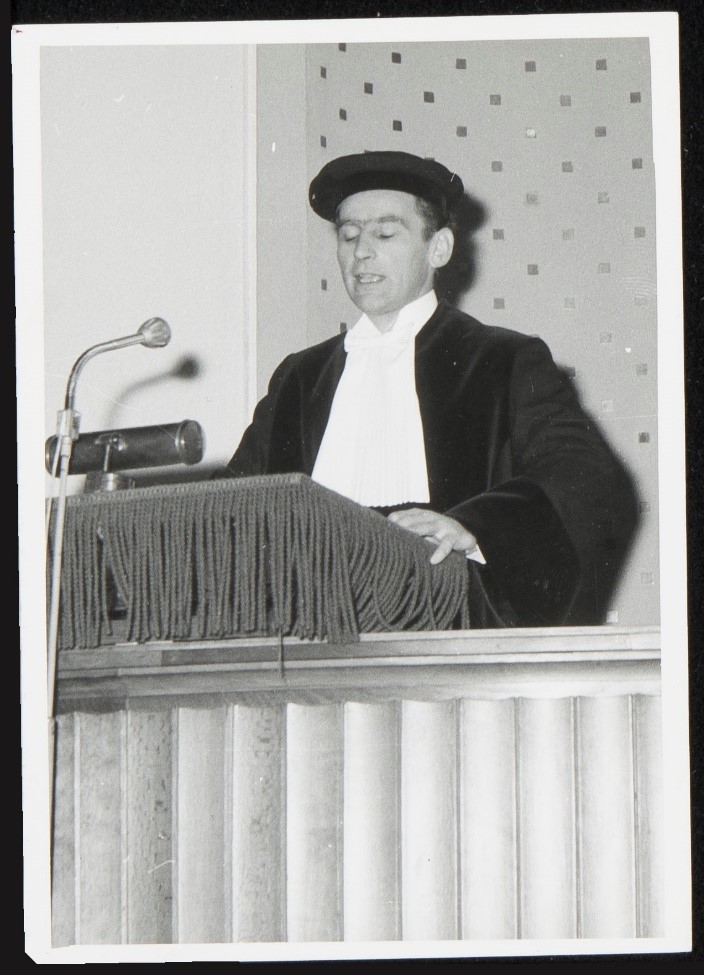
In September 1946 Evert Willem Hofstee, the founding father of Rural Sociology at Wageningen University, started as Professor and Chair of Social and Economic Geography and Social Statistics.

In the years that followed, the department was reorganized and renamed (e.g. Agrarian Sociology of Western Areas; Sociology) several times, with Rural Sociology being the official name since the late 1990s. Hofstee was also one of the founders and the first President of the European Society for Rural Sociology.

The Rural Sociology Group of Wageningen University will celebrate its 75th Anniversary on the 13th of May 2022. On that day we will organize an international conference at which we will present, discuss and reflect upon the past, present and future of rural sociology in an interactive setting. And we will, of course, also have a party in the evening of the 13th of May 2022 to celebrate 75 years of rural sociology at Wageningen University with current and former staff members, PhD students and graduates, former and current students and colleagues with whom we collaborated in national and international research projects. So SAVE THE DATE if you want participate in our conference and join our party. More details about the conference program will be published on this website soon!

The conference and party will not be the only activity that we will organize to celebrate our 75th anniversary. Starting today, we will arrange a variety of events, activities and outputs leading up to our main festivity on May 13, 2022.

  • A weekly blog (on this website) about the past, present or future of Rural Sociology. This may be about a specific theory, a research project, an event, or something else;
  • A seminar series (online or blended) with agrarian, rural and food sociologists from other universities;
  • A series of rural field trips in the Netherlands, visiting, for example, rural sociology graduates that have become farmers;
  • A PhD Day with and for PhD graduates and PhD candidates and a PhD Magazine with an overview of all PhD graduates, their PhD thesis and career after completion of their PhD thesis;
  • An anniversary book about the past, present and future of Rural Sociology in Wageningen.

We are looking forward to a year of celebration activities and events and hope many of our (former) colleagues and students will do so too. And we hope to welcome you at our celebratory event on the 13th of May 2022. So stay tuned to this blog and get to know more about the past, present and future of Rural Sociology in Wageningen in the forthcoming 12 months.

Update (July 8, 2021): due to COVID-19, the celebratory event is postponed from October 24, 2021 to May 13, 2022


Thesis/Stage Transitie naar circulaire bedrijfsvoering Valleivarken

De Wetenschapswinkel is op zoek naar een student(e) die door middel van action research wil bijdragen aan de transitie naar een circulaire bedrijfsvoering van Valleivarken (organisatie van drie varkenshouders): samen met twee geïnteresseerde akkerbouwers en evt andere stakeholders wordt gewerkt aan de transitie naar een circulaire bedrijfsvoering.

Gevraagde expertise: vermogen om het gesprek tussen Valleivarken en de geinteresseerde akkerbouwers te faciliteren (action research). We zijn op zoek naar een student (thesis, internship of projectgroep) die zich uitgedaagd voelt om kennis van verschillende disciplines te overbruggen. Achtergrondkennis op één of meer van de volgende gebieden is gewenst:  akkerbouw, varkenshouderij, circulaire landbouw, bedrijfseconomie, of action research.

Lokatie: Gelderland.

Mogelijke activiteiten: interviews, action research met akkerbouwer(s) en varkenshouder, literatuur onderzoek, evt analyse bedrijfsgegevens, ontwerp bouwplan

Gevraagd: Nederlandstalige masterstudent (thesis of internship), maar ook studenten die extra verdieping willen aanbrengen of een groepsopdracht willen doen, komen in aanmerking.

Achtergrond: ValleiVarken is een samenwerkingsverband tussen drie varkenshouders (1 vermeerderaar en 2 mesters), een slachterij (Gosschalk, Epe) en retail (BONI supermarkten en cateraar/traiteur de Kroes). Momenteel wil Valleivarken een stap maken richting circulaire varkenshouderij door samenwerking te zoeken met o.a. akkerbouwers (voor de productie van varkensvoer in ruil voor varkensmest) en een veevoerfabrikant (Agrifirm). In een eerste ACT studenten project zijn twee geinteresseerde akkerbouwers geidentificeerd. Het unieke van Valleivarken is, dat de varkenshouders met hun afnemers een vaste afzet hebben afgesproken tegen een vaste kwaliteit en prijs. De ketens zijn kort, er zit geen handel tussen en de partijen werken op basis van vertrouwen en goede relaties. Aan de student wordt gevraagd de samenwerking tussen akkerbouwer en varkenshouder gestalte te geven door gesprekken te faciliteren en door het identificeren van geschikte gewassen in het bouwplan van de akkerbouwer.

Voor meer informatie:

Francien de Jonge,

tel 0317 484577;

@ Francien.deJonge@wur.nl;

https://www.wur.nl/nl/project/Valleivarken-in-transitie-naar-circulaire-varkenshouderij.htm

Unpacking legitimacy in regional development

In 2018, Yasmine Willy came as a visiting fellow to the Center of Space, Place and Society at WUR. Two years later, the fruits of this visit have been published in the journal Territory, Politics and Governance. The article focuses on an issue widely discussed in academic literature: the lack of legitimacy of regional development agencies.  Following Hannah Arendt’s distinction between legitimization and justification, the article argues that the main problem regional development agencies struggle with is not procedural rightfulness (legitimization) but means–end coordination (justification). The abstract of the article writes: “In recent years, policy-makers and researchers have identified regional development agencies as the most suitable actors to carry out public tasks. One of these tasks has been the coordination of regional development processes. Both practitioners and researchers argue that legitimacy is a prerequisite for these regional actors to function properly. Although legitimacy is a key issue, little is known about the challenges that arise while producing it. Selecting six regional development agencies in Switzerland and applying an interview-based research method, this explorative study analyses how regional development agencies deal with legitimacy issues. The findings indicate that the main problem with which regional development agencies struggle is not procedural rightfulness but means–end coordination. By proposing a clear distinction between legitimacy and justification, we aim to stimulate the debate on how to operationalize legitimacy and further the discussion of the functioning of regional development agencies. Consequently, we introduce the concept of ‘asymmetric justification’ to the debate on regional development processes in order to shed a light on the functioning of regional development agencies.”

If you are curious, you can access the article under this link
https://rsa.tandfonline.com/eprint/FVR9SKRQMMXG8GMVRZ5S/full?target=10.1080/21622671.2020.1805352


Thesis opportunities | Foodscapes in times of uncertainty

The CSPS Foodscapes cluster is looking for BSc and MSc students interested in researching emerging foodscapes in times of uncertainty.  

Covid-19 has displayed many of the vulnerabilities and externalities of our current corporate food regime, such as unequal access to food, the dependence of our food supply on global supply chains, the exploitation of (migrant) workers in agricultural and food sectors and the fragility of the ‘just-in-time’ supply logistics. While the current crisis displays these vulnerabilities, also food practices and initiatives are arising that might provide seeds for ‘other futures’.

What foodscapes are emerging during Covid-19? What seeds do those emergent foodscapes provide for more sustainable, equitable, inclusive and fair foodscapes? And how can we potentially build on those seeds to make ‘other futures’ more real? 

If you are interested in researching these, or related, questions, please contact Anke de Vrieze (RSO), anke.devrieze@wur.nl or Mustafa Hasanov (BMO), mustafa.hasanov@wur.nl. We welcome multi- and interdisciplinary perspectives and see opportunities for both offline research (e.g. in the Netherlands) and online research.

For more thoughts on the effects of the current pandemic on Foodscapes, see also this series of rapid responses published by Agriculture and Human Values.