Discussing about Diverse Economies with prof. Katherine Gibson

On June 27th 2017, the Rural Sociology Group (in collaboration with SUSPLACE and in conjuction with the CSPS Conference ‘The Value of Life’) organised a masterclass on Performative Practices for Diverse Economies with prof. Katherine Gibson (Western Sydney University).

The masterclass was well attended, with more than 25 PhDs, researchers and professors joining, from a diversity of geographical and disciplinary backgrounds.

Prof. Gibson opened the meeting with a short presentation of her work on Diverse Economies. Next, we engaged in dynamic ‘fishbowl’ conversations in which 3 participants at a time discussed about a topic or question of joint interest, with prof.  Gibson stepping in and helping to advance the thinking.

We thus actively ‘performed thinking’ on diverse economies!

00:1927:06 Family Economies & Gender (with Maria Borras Escayola, Shivani Kaul and Zulfa Utami Adiputri)
27:1042:42 Participation, Activation & Motivation (with Veerle Boekenstijn, Esther Veen and Inez Dekker)
43:0058:28 Food Economies, prosumers and community gardens (with Sungwoong Jung, Lucie Sovova and Alberto Serra)

Thanks to MSc student Veerle Boekestijn, both prof. Gibson’s keynote and all the fishbowl conversation have been captured on video. We are happy to share them here, with all those that weren’t able to attend the masterclass in person.


Sharing food and building community through ICT

Group dinner of surplus food at Thuis Wageningen. Photo by Tzu Yuan Su, Taiwan

By Cheron Constance: drczconstance@gmail.com

June 21 2017 Cheron successfully defended her PhD-thesis What if the trucks stop coming? : exploring the framing of local food by cooperative food retailers in New Mexico

Stone soup an allegorical folktale (with many variations) in which a hungry stranger arrives in a village and persuades the local people to contribute small amounts of ingredients to make a meal collectively. Continue reading

‘A Global Sense of Place’ – register now!

RSO-55306_2017.In period 2, from October 30 till December 22, we’ll be teaching again RSO-55306 A Global  Sense of Place: Place-based approaches to development.  Registration for the course is open until October 1, 2017.

A Global Sense of Place  is an optional interdisciplinary course on sustainable place-based development for students from various master programmes (e.g. MDR, MES, MID, MLP, MUE, MOA, MFN). The course builds on the BSc course RSO-56806 Sociology and Anthropology of Place-shaping providing an introduction to place-based approaches in development. Knowledge of this introductory course is an advantage, but is not assumed. The course aims to make students acquainted with an interdisciplinary and place-based approach to development.

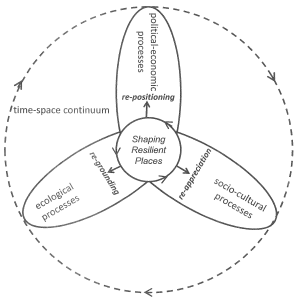
A relational place-based approach is seen as key to the understanding of interrelated rural and urban transformation processes and ergo sustainable development. In a relational approach places are considered as contingent,but in time and space differentiated outcomes of three interrelated interdependent and unbounded transformative processes: political-economic, ecological and social-cultural. Places are time and space specific constructs, like their boundaries and connections.

figureplace

Shaping resilient places. Source: Roep, D., Wellbrock, W, Horlings, I, 2015. Raising Self-Efficacy and Resilience in the Westerkwartier: The Spin-off from Collaborative Leadership, In: J. McDonagh, B. Nienaber, M. Woods (Eds.), Globalization and Europe’s Rural regions. Ashgate, Surrey, pp.41-58

By means of this course students will achieve profound understanding in key-concepts and methods on place-based sustainable development. Work from key thinkers in sustainable place-making will be critically discussed and examined on the basis of various cases. Guest speakers are invited to reflect on place-based approaches to sustainable development and illustrate these through case studies. Ultimately students will acquire a place-based perspective on development.

Language of instruction and examination is English. Classes are taught on Mondays, Tuesdays and Thursdays from 10.30 -12.30.

Key lecturers: Dr. ir. Joost Jongerden (RSO), Dr. Ir. Dirk Roep (RSO) and dr.ir. Martijn Duineveld (GEO).

For more information, please contact Anke de Vrieze, anke.devrieze@wur.nl.

Social Capital and Fisheries participation in Marine Spatial Planning in Orkney – MSc-thesis Yanick Bakker

By Yanick Bakker, MSc International Development Studies.

MSc-thesis Social Capital and Fisheries participation in Marine Spatial Planning in Orkney, Scotland (complete thesis can be downloaded).

In the autumn of 2016, I spent three months on the Orkney Islands in Scotland, where I delved into the worlds of inshore shellfish fisheries and marine spatial planning. Marine spatial planning is a relatively new tool for marine governance designed to manage the use of marine space while minimizing user-user and user-environment conflicts. The marine environment around the Orkney Islands is an important natural asset for the island communities. The waters are used for recreation and transportation, they provide fresh sea foods and are a central part of the islands’ ecosystem, identity and diverse livelihoods. Since 2010, the inshore waters around the Orkney Islands and the North East coast of Scotland have also become sites for marine renewable energy developments. Controversy over the allocation of marine space for these developments, have led to the set-up of a pilot marine spatial plan for the Pentland Firth and Orkney Waters.

Writing this thesis, I was curious to see how fishermen relate to this new way of looking at and giving direction to the development of marine space. As the waters in which they fish and the fish stocks they target are central resources for fisher communities, access to these resources is vital for their survival. Not only do new marine developments create concerns for sustainability, the notion of spatial planning at sea also causes concern for decreased mobility and consumption of space among fishermen. Taking community resilience theory as a starting point, I have focused on the use of community social capital in fisheries’ engagement with marine spatial planning in Orkney.

Social capital refers to practices, values and sets of norms found within different forms of social networks (or communities) which can contribute to the collaboration, functioning and collective action of the network. Social capital can be produced within a community (bonding), between different kinds of communities (bridging) or across scales and hierarchical structures (linking). Community resilience theory assumes that community members can act as agents of change, whereby they use different strategies to ensure the survival of the community in face of change. For example by engaging in social relation within and beyond the boundaries of the community to mobilize resources or gain power.

By conducting qualitative interviews with fishermen, representatives of fisher organizations, researchers and policy makers, I have gained insight in the different ways in which the Orkney inshore shellfish fisher community employs and continues to develop its community social capital in order to collaborate, mobilize resources to generate information to reframe the definition and formal representation of marine space and to gain power in (future) marine spatial planning negotiations.

Although social capital seems to be an enabling factor for participation in policy making, this research has shown that it is not a community asset which can be readily mobilized. Having social capital, does thus not equal having agency to act. Seeing the participatory sphere as one of unequal power, stakeholders’ ability to gain influence in governance processes is influenced by institutional limiting and facilitating factors. Social organization of fishermen in fisher organizations has shown to be an important enabling factor for participation in marine spatial planning, in Orkney.


Reminder – Vacancy Assistant Professor in Food Sociology (tenure track)

At the Rural Sociology Group we have a job opening for an Assistant Professor (tenure track position) in Food Sociology. As assistant professor you will undertake independent research and participate in international research projects focusing on the dynamics of food provisioning practices and processes and on the relations between food provisioning and sustainable rural and urban development. You will also teach and coordinate Bachelor and Master courses for the Bachelor and Master program International Development Studies (specialization Sociology of Development), the Master program Food Technology (specialization Gastronomy), and the Master program Organic Agriculture and supervise Master thesis research for these programs. Other aspects of the job include project acquisition, training and supervision of PhD students and participation in various research and/or education committees. About 45% of your time will be spent on education, 45% on research and the remaining 10% on a variety of activities within and outside the university.

For more information about the position (and the Rural Sociology Group) go to the vacancy page of Wageningen University or contact Prof.dr. Han Wiskerke (han.wiskerke@wur.nl). Candidates can apply for this position onlineThe deadline for application is Thursday 14 September 2017.