Grondhouding en strategie van boeren leidend bij inspelen op vergroening van GLB

MSc-thesis Elisa de Lijster

In mijn onderzoek heb ik gekeken in hoeverre opvattingen en grondhoudingen van melkveehouders aangaande bedrijfsvoering en natuur & het landschap richtinggevend zijn voor de wijze waarop ze zullen inspelen op de aanstaande hervorming van het Gemeenschappelijk Landbouwbeleid (GLB). Door een vergroening van het GLB krijgen boeren de mogelijkheid om publieke diensten leveren op het gebied van klimaat, water, dierenwelzijn, natuur, milieu en landschap. De vraag is dus of en hoe boeren daarop in zullen spelen.

Drie landschapsbeelden die ik in mijn onderzoek heb gebruiktIk heb mijn onderzoek verricht in Noordoost Overijssel, tussen een – door het beleid voorgestelde begrenzing – ‘Maatschappelijk Waardevol Gebied’ (MWG): het  Nationale Landschap Noordoost Twente (NOT) en een gebied daaraan grenzend. In beide gebieden heb ik tien melkveehouders geïnterviewd.  De inkomenssteun per ha vanuit het GLB ligt in dit gebied ver boven het landelijk gemiddelde. Een verlaging of herverdeling van de huidige inkomenssteun kan dus grote gevolgen hebben.

Op basis van mijn onderzoek (klik hier voor mijn complete Msc-thesis) maak ik onderscheid tussen twee uiteenlopende grondhoudingen en daarmee samenhangende ontwikkelingspatronen. Sommige boeren zijn meer productiegericht, andere meer omgevingsgericht. Uit mijn onderzoek blijkt dat zij andere keuzes maken als het gaat om het uit voeren van maatschappelijke waardevolle diensten en de manier waarop ze denken in te spelen op de toekomstige verandering in het GLB.

Productiegerichte boeren richten zich op het behalen van een maximale productie/ha, waarbij de natuur vooral een instrumentele waarde heeft. Deze boeren pakken eerder diensten op die positief interfereren met hun gewenste bedrijfsontwikkeling. Dat zijn veelal diensten op het gebied van klimaat, water en bodem en een verdere verduurzaming van hun landbouwpraktijk via innovatieve technieken. Diensten gericht op natuur of landschap passen hier niet in, wat dus op gespannen voet staat met de beoogde beleidsambitie.

De omgevingsgerichte boeren leggen zich meer toe op het integreren van natuur en landbouwbeoefening en beogen een balans met de omgeving. De intrinsieke waarde van natuur wordt meer gewaardeerd. De voorgestelde maatschappelijk waardevolle diensten worden sneller door deze boeren opgepakt aangezien deze overeenkomen met hun ontwikkelingsvisie en grondhouding.

Beide ontwikkelingspatronen kunnen zowel binnen en buiten het MWG NOT gevonden worden, wat een relevante observatie is voor de beoogde doelstellingen vanuit het beleid. Uit dit onderzoek komt naar voren dat sommige beleidsambities overeen komen met die van de boeren in Noordoost Overijssel en andere minder. In het kader van de aanstaande GLB hervorming, valt op dat alle boeren hun bedrijf wensen voort te zetten in lijn met hun gewenste ontwikkelingsrichting en dat het beoogde beleidsplan hierdoor een polariserende werking in de landbouwstructuur zal hebben.
PUREFOOD Research Vacancy ‘Comparative analysis of urban food strategies’

The vacancy for a position as Early Stage Researcher (ESR) for the project  ‘Comparative analysis of urban food strategies in European cities’ within the PUREFOOD research and training network has been re-opened. More information about PUREFOOD can be found below and on the PUREFOOD website (which is still under construction).

Job description

For this PUREFOOD project ‘Comparative analysis of urban food strategies in European cities’ we are looking for an Early Stage Researcher who is interested in the topics of urban food provisioning and the relations between food and policy domains as public health, education, environment, et cetera from a sociological, political science and/or planning perspective. The research will focus on how food policies are articulated and motivated in different European cities and what  the consequences are for their implementation. This focus is inspired by the fact that more and more city governments are taking up food as a key policy area to enhance human and environmental urban health. The challenges of policy articulation and implementation are big. The articulation of food policy has so far been reliant on individual politicians and on a political level vulnerable to electoral shifts. Institutionalization of food policy in city governments has just started and different patterns of institutionalization are emerging with particular pitfalls and successes. This study will explore the preconditions, political processes, strategy articulation and implementations of urban food strategies in different European cities in comparative perspective to enhance the understanding of the conditions for successful urban food policy implementation. Continue reading

DERREG Policy Seminar in Brussels

Last Thursday March 31, a Policy Seminar had place to discuss the relevancy of the results from the EU-funded reserach project DERREG for EU-policies.  Although the project and the work is not yet completed, emerging outcomes and policy recommendations were presented by the project coordinator prof. Michael Woods and the four coordinators of the respective workpackages on Rural business networks, Rural migration patterns, Sustainable development and Rural regional learning. The emerging outcomes and recommendations are also capitalised in the European Policy Brief published at the DERREG website.

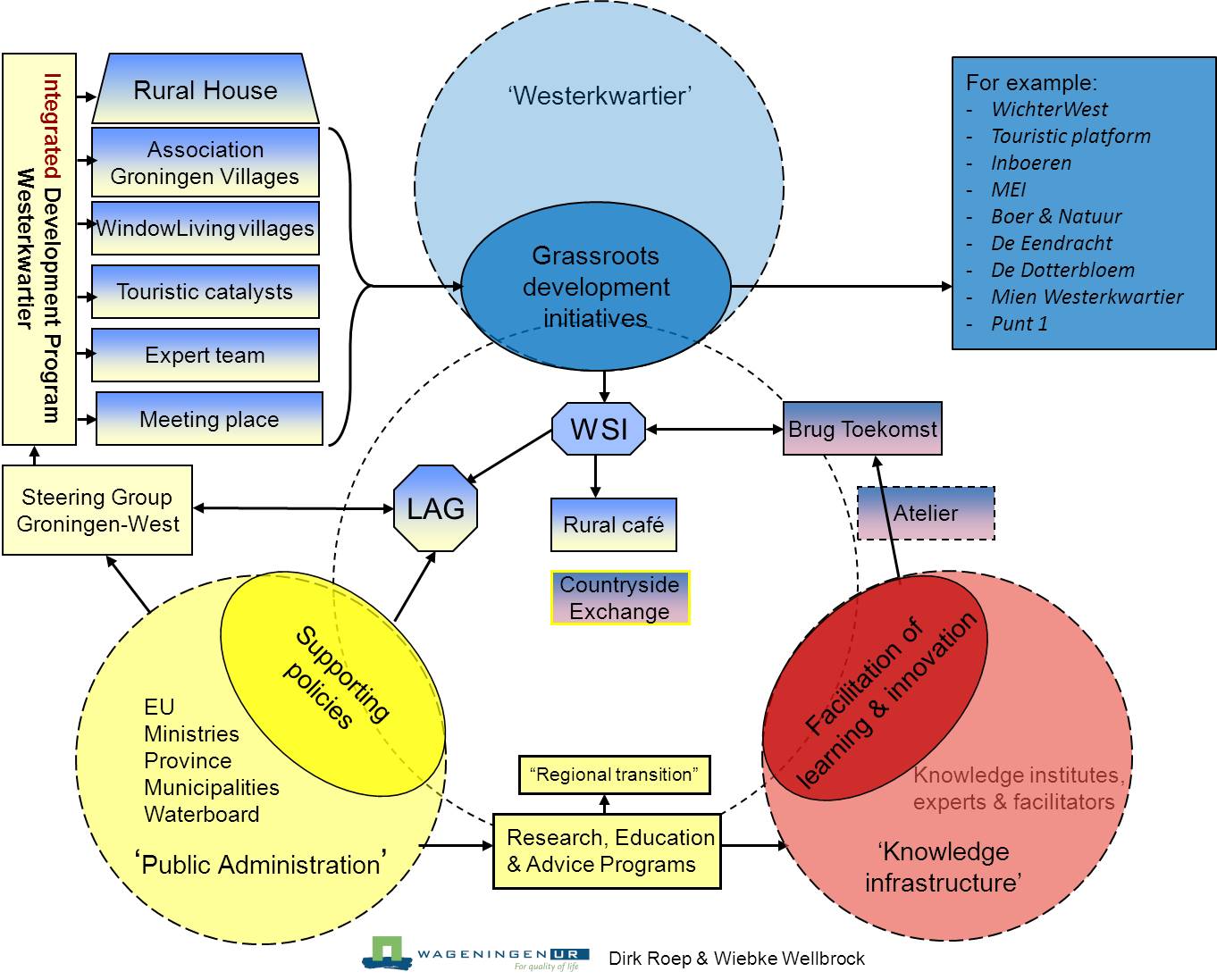
WU is coordinator of Workpackage 4. We focussed on how public support and faciliation of joint learning and innovation in grassroots (place-based) development activities can be best arranged. We have explored, mapped and analysed various such arrangements in six case study areas. See the example of the map of the ‘governance of joint learning and innovation’ in the Westerkwartier below.

Map of the governance of joint learning and innovation in the Westerkwartier (NL)

These arrangements and the support or faciliation given was evaluated by the beneficiaries (see earlier posts on case-study area Westerkwartier, AlytusDresden and Comarca de Verin).

Although we will extend our analysis and specifically elaborate more on ‘promising or good practices’ revealed, Wiebke Wellbrock and I presented the main findings and policy recommendations (see our presentation).

Key to our findings is that the effectiveness of support policies depends on well working operational interfaces between public policies, grassroots development initiatives and (knowledge) facilities to support joint learning and innovation. These interfaces get shaped in agreements between various public and private partners but it are operational agents or agencies fulfilling various intermediary task and roles connecting different ‘worlds’ that make them work (well).

Rural regional learning in the Comarca de Verín, Galicia, Spain

Within the European research project DERREG, we are investigating how public policy can best be arranged to stimulate capacity building within development initiatives operating at grassroots level in rural areas across the European Union.

To find out how public policy interventions can best be arranged, we and our research partners have spoken to various stakeholders in different rural regions across the European Union to find out how they intend to support and facilitate learning and innovation and- most importantly- how the support and facilitation agreed upon is actually provided to the grassroots development initiatives. To find out what is working well and what isn’t working well yet, we have spoken to a number of grassroots development initiators in the participating DERREG case study areas and ask them to evaluate the current support and facilitation received.

To be able to compare the results obtained in the different case study areas, I have travelled to Alytus County, Lithuania in October and Oberlausitz, Germany in December of 2010. In January of this year, I was able to visit our colleague Lola Dominguez Garcia of  Universidade de Vigo in the Comarca de Verín in the South-West of Galicia, Spain. In this blog, we intend to share our experiences. Continue reading

Working group at 24th ESRS congress in Chania, Greece 22-25 August 2011: Call for papers

Imre Kovách ( Institute for Political Science of the Hungarian Academy of Sciences, Budapest), Petra Derkzen and I are organising a working group on “the governance of semi-subsistent food and farming strategies in the countryside and city- a compartive perspective” at the 24th ESRS congress in Chania (Greece) from 22-25 of August 2011. We would like to invite all interested researchers to submit their papers dealing with empirical or theoretical reflections on the driving forces, structure and mechanisms of semisubsistence food and farming strategies in the countryside and-or cities, both within developed and developing countries. Abstracts may be submitted  to Imre Kovach (ikovach@mtapti.hu) AND chania2011@agr.unipi.it until the 30th of April 2011.  For a more detailed description of the workshop please read further…

Courtesy of European Forum on Nature Conservation and Pastoralism

Continue reading