Landbouwbedrijven hebben steeds meer bronnen van inkomsten

Steeds meer agrarische bedrijven halen hun inkomen uit andere dan pure landbouwactiviteiten. Slechts een derde van de Nederlandse agrarische bedrijven legt zich toe op de primaire productie van bijvoorbeeld melk of varkensvlees en richt zich op de wereldmarkt. Zij proberen tegen zo laag mogelijke kosten te produceren. De overige bedrijven hanteren een veelzijdiger strategie om inkomsten te genereren.

Dat blijkt uit een enquête-onderzoek naar bedrijfsstrategie en toekomstperspectief van uitgeverij Agrio en de leerstoelgroep Rurale Sociologie van Wageningen University & Research. De enquête die deze zomer werd gehouden onder ruim 1200 agrarische bedrijven laat een aanzienlijke verbreding van inkomstenbronnen zien ten opzichte van het laatste grootschalig onderzoek midden jaren negentig naar bedrijfsstrategieën in de landbouw. In 1995 combineerde 22% van de bedrijven landbouw met andere bedrijfsactiviteiten, nu is dat 50%.

Agrarische bedrijven hanteren diverse strategieën om inkomen uit hun activiteiten te genereren. De meest oorspronkelijke route is die van de primaire productie van akkerbouwgewassen, zoals tarwe, en veeteelt, met melk, vlees of eieren als producten. In de afgelopen decennia hebben agrariërs naast akkerbouw en veehouderij ook andere inkomstenbronnen gegenereerd. Tegenwoordig is er een heel scala aan activiteiten zoals agro-toerisme, agrarisch natuurbeheer, een zorgboerderij en activiteiten die geen specifieke agrarische link hebben, zoals energieproductie met zonnepanelen of windmolens. Puur en alleen landbouwproductie komt nog maar bij de helft van de bedrijven voor, terwijl dat in 1995 nog op 78% van de bedrijven het geval was.

Han Wiskerke, hoogleraar Rurale sociologie aan Wageningen University & Research, die het onderzoek begeleidde, noemt de toegenomen diversiteit van strategieën binnen de landbouw onderbelicht. „Het beeld in de media werd het afgelopen jaar vooral gedomineerd door de stroming die zich richt op specialisatie en schaalvergroting. Uit ons onderzoek blijkt dit slechts één van de vele stromingen te zijn.”

Arbeidsmarkt gunstig voor extra activiteiten

De bedrijven die zich richten op verbreding en toegevoegde waarde (zoals eigen productverwerking), genereren opmerkelijk meer arbeid. Daarmee leveren ze een bijdrage aan de werkgelegenheid en de leefbaarheid van het platteland. Volgens Wiskerke zou het goed zijn als overheden zich bewust zijn van het feit dat bepaalde vormen van landbouwontwikkeling ook veel werkgelegenheid creëren. „Ik heb de indruk dat beleid gericht op het behouden en creëren van werkgelegenheid op het platteland zich niet op landbouw maar op andere economische sectoren richt.” Wiskerke plaatst daarbij wel een kanttekening. “De activiteiten die potentieel veel werkgelegenheid creëren doen zich vooral voor nabij steden en in toeristische gebieden (met name langs de kust), omdat daar nu eenmaal de meeste mensen wonen of recreëren en daar dus de meeste consumenten en afnemers van die boerendiensten te vinden zijn.”

Ontevreden over inkomen uit landbouw

Uit het onderzoek blijkt dat boeren die zich richten op specialisatie en productie voor de wereldmarkt op veel fronten afwijken ten opzichte van boeren met een andere strategie. Dat neemt niet weg dat voor alle boeren geldt dat ze ontevreden zijn over de inkomsten uit agrarische activiteiten. Bijna de helft is erg ontevreden of behoorlijk ontevreden. Het minst tevreden over het inkomen uit de landbouw zijn boeren met een bedrijfsstrategie waarbij zij zgn. groenblauwe diensten leveren, zoals beheer van sloten, en verbreding, zoals zorglandbouw of agrotoerisme. Daarentegen zijn deze boeren wel het meest tevreden over hun bedrijfsinkomen. Maar ook voor de boeren die zich richten op specialisatie en productie voor de wereldmarkt is het moeilijk om met alleen landbouw rond te komen, constateert prof. Wiskerke. “Puur van landbouw rondkomen is moeilijk.”

Veranderende regelgeving als belemmering

Als grootste belemmering voor bedrijfsontwikkeling staat bij alle bedrijfsstrategieën met stip op één: steeds veranderende regelgeving. 63 procent van de deelnemers kruiste dit aan. Agrariërs hebben behoefte aan een duidelijke langjarige overheidsvisie. “Daarop kunnen zij hun bedrijfsstrategie, waarbij vaak investeringen gemoeid zijn, inrichten,” licht prof. Wiskerke toe.

Kwart van gezinsinkomen afhankelijk van landbouw

Uit het onderzoek blijkt dat van alle bedrijven in de enquête slechts een kwart voor het gezinsinkomen volledig afhankelijk is van de landbouw. Bij de overige 75 procent bestaat het gezinsinkomen uit landbouw plus andere bedrijfsactiviteiten, een baan buiten het bedrijf of een combinatie daarvan. “Dat kan een teken van bittere noodzaak zijn, omdat ondernemers het met alleen landbouw financieel niet redden”, zegt prof. Wiskerke. “Maar het kan ook een uiting zijn van veranderende opvattingen over wat goed of toekomstbestendig agrarisch ondernemerschap is.” Tien jaar geleden gaf 72 procent van de ondernemers van multifunctionele bedrijven aan dat direct contact met burgers en consumenten de belangrijkste drijfveer was voor verbreding. Ook financiële risicospreiding werd toen door de helft genoemd. “En het kan ook een teken zijn van een verdere emancipatie van de boerin / vrouw van de boer, waarbij de nadruk ligt op een eigen carrière en inkomen buiten het bedrijf of een eigen bedrijfsactiviteit voortkomend uit eigen expertise en interesse. Het zijn toch overwegend vrouwen, veelal met werkervaring buiten de landbouw, die de drijvende kracht zijn achter verbredingsactiviteiten.”

Verantwoording onderzoek

Het onderzoek naar agrarische bedrijfsontwikkeling is een initiatief van uitgeverij Agrio en is in samenwerking met de leerstoelgroep Rurale Sociologie van Wageningen University & Research opgezet. Eind juli en begin augustus voerde marktonderzoeksbureau Geelen Consultancy het onderzoek digitaal uit. Aan het onderzoek namen ruim 1200 boeren deel. Het aandeel biologische boeren (6 procent) en veebedrijven is licht oververtegenwoordigd en tuinbouwbedrijven zijn juist ondervertegenwoordigd.

Bron

Persbericht Wageningen University & Research, nr 101, 30 oktober 2020

Zie ook: Veehouders willen stikstofruimte inleveren

Onderzoek naar kansen en belemmeringen voor agrarische bedrijfsontwikkeling

Vandaag zijn we samen met Agrio een onderzoek gestart naar de factoren die van invloed zijn op de bedrijfsvoering en -ontwikkeling in de landbouw. Tevens proberen we zicht te krijgen op welke uiteenlopende bedrijfsstrategieën en bedrijfstypen er zijn en waar boeren en boerinnen belemmeringen en kansen zien voor een toekomstbestendig bedrijf. De eerste stap in dit onderzoek bestaat uit een korte enquête, die vandaag is verspreid onder ruim 15000 boeren en boerinnen. Dit deel van het onderzoek wordt uitgevoerd in samenwerking met Geelen Consultancy. De uitkomsten van de enquête zullen in het najaar worden gepubliceerd in de vakbladen van Agrio. Later dit jaar willen we, mede op basis van de uitkomsten van deze enquête, een verdiepend onderzoek doen naar de huidige diversiteit in de Nederlandse landbouw, de kansen en belemmeringen voor bedrijfsontwikkeling en perspectieven voor verduurzaming.

New Book: Achieving Sustainable Urban Agriculture

Book cover Achieving Sustainable Urban Agriculture

This collection reviews key recent research on developing urban and peri-urban agriculture. The first part of the book discusses ways of supporting urban agriculture, from policy and planning to building social networks for local food supply chains. The chapters in the second part of the book survey developments in key technologies for urban agriculture, including rooftop systems and vertical farming. The book also assesses challenges and improvements in irrigation, waste management, composting/soil nutrition and pest management. The final group of chapters are case studies on urban farming of particular commodities, including horticultural produce, livestock, and forestry.

The book targets a varied audience: academic researchers in agricultural science, urban planning and environmental science specialising in urban agriculture; urban planners and policy makers in local government; national government and other bodies promoting urban agriculture.

More information about the book can be found at https://shop.bdspublishing.com/store/bds/detail/workgroup/3-190-83836


Internship or Thesis Opportunity: Allotment and Community Gardens in Warsaw and Berlin


person wearing black lace up sneakers standing on green grass with fallen leaves

Photo by Artem Beliaikin on Pexels.com

Are you interested in the politics and governance of community and allotment gardening ? How these gardens can become more inclusive? And what lessons gardeners in Berlin and Warsaw can exchange?

The research project “Integration von Kleingärten und Gemeinschaftsgärten in Warschau und Berlin” seeks a German speaking research assistant.

We are looking for a person with:

– German language (spoken and written).

– Research interest in the topic of urban gardening;

– Training and experience with qualitative research methods

– Knowledge about Berlin allotment and community gardens’ and/or administrative situation and structure;

 
Project duration December 2019 – March 2021
  • November/December 2019 – Kick off. Interviewing gardeners, the city administration, city dwellers and other persons related to the topic – in Berlin (December and January)
  • May 2020 – Focus Groups in Warsaw and Berlin, a visit of Berliners to Warsaw
  • September 2020 – VISIS workshops on challenges and opportunities of this integration.
  • March 2021 – final meeting in Warsaw

The rest of the time is for research, reading, meeting with the project team, writing and meetings in gardens (action research).

The project is a cooperation with Humboldt University and Łódź University in Poland. With funding from the Deutsch Polnische Wissenschaft Stiftung.

Deadline: Please send expressions of interest to oona.morrow@wur.nl  by October 14

RSO supervisor: Oona Morrow oona.morrow@wur.nl

Field Research supervisors: Agnieszka Dragon and Anna Dańkowska

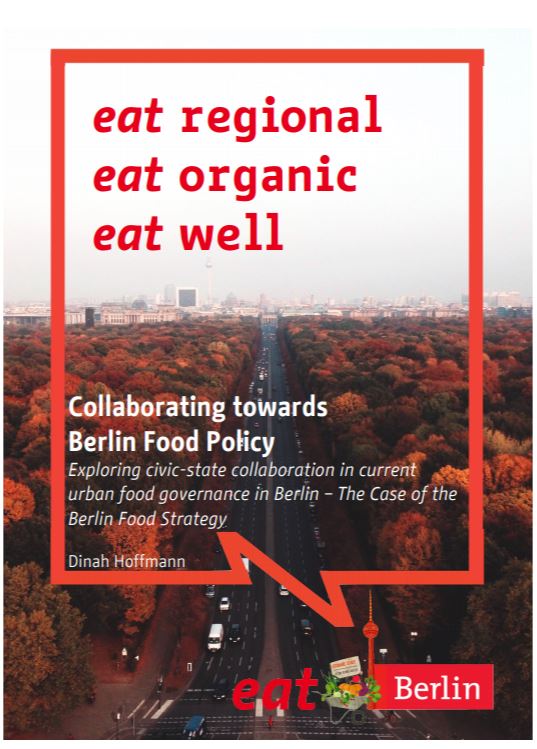
Collaborating towards Berlin Food Policy: Exploring civic-state collaboration in current urban food governance in Berlin – The Case of the Berlin Food Strategy

dinah thesis coverDinah Hoffman, MSc student Communication, Health and Life Sciences
Specialization: Health and Society, Wageningen University

Below please find the abstract of the MSc thesis Collaborating towards Berlin Food Policy: Exploring civic-state collaboration in current urban food governance in Berlin – The Case of the Berlin Food Strategy

The full thesis can be downloaded from the WUR-Library by clicking on the hyperlink


Urban food policy is an area that joins actors from civil society, academia, the local state and the market. To accomplish sustainable changes of local food systems these actors work together in governance arrangements. Two prominent instruments that are used in urban food governance where these actors collaborate are the food policy council and the urban food strategy. Both can be initiated through top-down or bottom-up processes or a combination of both with the relationship of local government and civil society having an impact on the success of the initiatives. One of the cities where civil society and local government engage in collaborative food governance is the city-state of Berlin, the biggest city in Germany, surrounded by the agricultural region of Brandenburg. Drawing on data from 11 interviews and 40 documents, this thesis describes and examines the nature of the relationship and governance arrangement of the two main actors in current Berlin food governance. The collaborative governance framework, a categorization of civic-state relationships found in urban food governance and the concepts of integrated food policy and institutionalization were used to guide the analysis. The objective of this thesis is to understand how civic-state collaboration in urban food governance looks like in Berlin, what impact the local context has on the development of the governance arrangement and what strengths and challenges involved stakeholders perceive. The two main stakeholders were found to be the civic food policy council Ernährungsrat Berlin and the Berlin Senate Administration for Consumer Protection. It was found that the Ernährungsrat Berlin’s food policy activity brought forward a relationship where they are striving for independence but are linked to the government through a secondary agency, being the aforementioned administrative department. Although not embedded in municipal institutions, which has been identified as crucial for a food policy councils’ success, the Ernährungsrat Berlin proved to be an agile and resilient structure able to successfully be an independent advocate for civil society and a valued advisor to the government. Their collaboration resulted in the development of a Berlin Food Strategy. In this thesis I investigate the process of developing this strategy as a form of collaborative governance. Regarding their governance arrangement around the Berlin Food Strategy, the involvement of the Green Party in the current coalition was found to have had a big impact on the position the Ernährungsrat Berlin but also food policy was able to occupy on the urban agenda. This research identified a number of strengths and challenges of the governance arrangement including a strong interdependence, a strong and long history of civic action, the presence of political food champions in the coalition and the administration, the limiting structure and functioning of the Senate administrations and the limited inclusiveness and representatives of the Ernährungsrat Berlin.

Key words: urban food governance, urban food policy, food policy council, urban food strategy, collaborative governance, Berlin food strategy, Ernährungsrat Berlin, Senate of Berlin