Onderzoek naar kansen en belemmeringen voor agrarische bedrijfsontwikkeling

Vandaag zijn we samen met Agrio een onderzoek gestart naar de factoren die van invloed zijn op de bedrijfsvoering en -ontwikkeling in de landbouw. Tevens proberen we zicht te krijgen op welke uiteenlopende bedrijfsstrategieën en bedrijfstypen er zijn en waar boeren en boerinnen belemmeringen en kansen zien voor een toekomstbestendig bedrijf. De eerste stap in dit onderzoek bestaat uit een korte enquête, die vandaag is verspreid onder ruim 15000 boeren en boerinnen. Dit deel van het onderzoek wordt uitgevoerd in samenwerking met Geelen Consultancy. De uitkomsten van de enquête zullen in het najaar worden gepubliceerd in de vakbladen van Agrio. Later dit jaar willen we, mede op basis van de uitkomsten van deze enquête, een verdiepend onderzoek doen naar de huidige diversiteit in de Nederlandse landbouw, de kansen en belemmeringen voor bedrijfsontwikkeling en perspectieven voor verduurzaming.

Register now for RSO55306 – A Global Sense of Place: Place-based approaches to development | Period 5

soap-bubble-406944

In the face of urgent environmental and societal challenges, how do we move towards inclusive futures? What is the role of people in places? And what can be our role as (social) scientists?

In this course, we explore inclusive place-based approaches to development. We analyse how change happens from below and how people take matters in their own hands, shaping the places they live in according to their own needs and values. A relational perspective allows us to see the interdependence between the local and the global, the urban and the rural and the individual and the collective.

Besides engaging with key theories and analysing topical cases, we reflect upon our own role as (social) scientists and explore the tools and methodologies we need in place-based research, specifically focusing on participatory and creative methods.

This advanced MSc course is relevant for all students (including PhD candidates) with an interest in inclusive development, that seek theoretical as well as methodological guidance. The course can help students prepare an MSc thesis proposal and is supported by lecturers from all chair groups involved in the Centre for Space, Place and Society (RSO, SDC, HSO and GEO)

For more information, contact anke.devrieze@wur.nl.


Postdoc vacancy – Developing An Integrative Approach to Regenerative Agriculture, Circular Agri-Food Systems, and Convivial Conservation

We are recruiting a postdoc for the three-year research project ‘Tackling Crises in the Countryside: An Integrative Approach to Regenerative Agriculture, Circular Agri-Food Systems, and Convivial Conservation‘. Apply before January 20, 2020.

Food, farming, and conservation face major, interrelated challenges in the countryside, yet are treated as largely independent in research and policy. This postdoc will explore regenerative agriculture and convivial conservation as two paradigms that aim to address these challenges. The key questions are (1) how can the two paradigms be integrated into a holistic approach, and (2) how can this integrative approach help sustain biodiversity, livelihoods, social equity? Next to developing an integrated approach and assessing the impacts of its application at different integrative levels, the postdoc is expected to disseminate findings and develop an acquisition portfolio.

The postdoc will be positioned at the chair groups of Rural Sociology and Sociology of Development and Change under supervision by Dr Dirk Roep (Rural Sociology) dirk.roep@wur.nl and Mindi Schneider (Sociology of Development and Change): mindi.schneider@wur.nl

This is one of the 15 vacant postdoc positions at the Social Sciences Department of Wageningen University. For more information on requirements and selection procedure see: We-are-looking-for-15-Postdocs-in-social-sciences

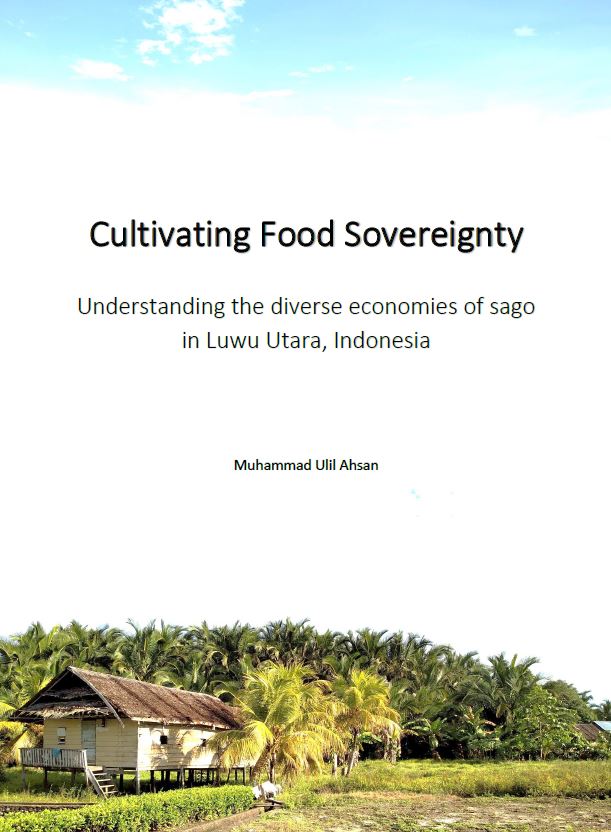
Cultivating Food Sovereignty: Understanding the diverse economies of sago in Luwu Utara, Indonesia

title pg ulilMuhammad Ulil Ahsan, MSc Student Development and Rural Innovation, Wageningen University


Below the abstract of the MSc-thesis “Cultivating Food Sovereignty: Understanding the diverse economies of sago in Luwu Utara, Indonesia“.


The full thesis can be downloaded from the WUR-Library by clicking on the hyperlink


Indonesia has taken up food sovereignty in the constitutional document Food Act number 18/2018 that animates the food policy and program implementation in Indonesia. However, it remains largely rhetorical since the food program implementation has undermined the local food system in many places. This study explores the implementation of food sovereignty in Luwu Utara that is predicated with productionist paradigm, where self-sufficiency is the main goal and transnational corporation are involved in the process of enactment. The implementation put pressure on the local food system in Luwu Utara, particularly in relation to sago. The sago food system encompasses complex issues ranging from the relationship between people in the system to their relation with sago. The diverse economy framework is applied to unravel the diverse forms of economies that lie within the sago food system, and to legitimate the value of food sovereignty existing in Luwu Utara. Diverse economies of sago in Luwu Utara are dominated by non-capitalist practices that can challenge the dominant discourse of capitalist economy as food sovereignty against for. The different forms of food sovereignty at different scales necessitates reflection on food sovereignty implementation. Cultivating food sovereignty requires reflexivity, creating the basis of food sovereignty and building recognition are the strategies to develop a multi-scalar sovereignty. Administering multi-scalar sovereignty is a challenge that must be overcome in the development of a democratic food system in Indonesia.

Keywords: Food sovereignty, diverse economies, sago, Luwu Utara

Thesis Opportunities: Diverse economies of food, agriculture, and nature in Galicia, Spain

In the field of diverse economies, researchers have paid particular attention to diverse forms of economic organisation and exchange that make up our food system, disrupting dominant development narratives that privilege capital, markets, wages, private property and mainstream financing (Gibson-Graham, 2006). Examples in the literature are multifunctional agriculture (Renting et al., 2009), communal land use (Soto, 2014; Caballero, 2015), ecosystem service provisioning (Bolund and Hunhammar, 1999; Braat and De Groot, 2012), and sharing food or skills to reduce waste, or foster greater food security (Davies et al., 2017). These manifestations of diverse economies are often captured and explained through the theoretical lens of the social economy, an umbrella term used to describe a variety of third sector, cooperative, voluntary, non-profit, and social enterprise initiatives that put social and environmental well-being before profit.

Problem definition / hypothesis 

In Galicia, a ‘green’ region in the northwest corner of Spain, industrialisation and urbanisation mainly takes part in the coastal area. The mountainous interior consists of forests and pastures for beef and dairy cattle, creating a strong divide between the urban and the rural, and their development pathways. Primary production, with relatively low added value, remains important to Galicia’s economic production. The daily fabric of life, in rural but also in industrial-urban environments, is anchored in what can be termed the social economy. Whilst formal collaborative and/or cooperative approaches to market access or income generation are often lacking, the question pops up – whether and how these everyday practices (can) build upon existing social economy dynamics. This research seeks to understand, how communities in these places negotiate social, economic, and environmental concerns by practicing diverse economies in urban and rural areas, and how these practices can contribute to realizing social economies

Communal forestry and mountain farming

Empirical studies in Galicia on the diverse economies of food, agriculture, and nature (i.e. the local resource base, e.g. ecosystems services, green infrastructure, or more theoretically: ecological capital) will contribute to the (yet often) unrecognised role of the social economy in bringing about economic development in relation to provisioning of ecosystem services and/or green infrastructure.

Depending on the preferences of individual students for empirical research subjects, and a possibly simultaneous implementation of MSc thesis projects,  research subjects can consist of communal (agro) forestry (in urban and/or rural contexts), mountain farming (in more remote rural areas), or a combination of these.

Research topics include but are not limited to:

  • Mapping diverse economies of food, agriculture, and nature: initiatives and projects (focus: forestry and farm activities), community and/or household configurations, collaboration (different aggregation levels), payments and income strategies (private and public goods), availability of regional policy support schemes, support structures for similar initiatives elsewhere
  • Developing strategies to enhance local business opportunities (forestry and farming activities, food and other ecosystem service provisioning in relation to e.g. gastronomy and tourism), identify and describe heterogeneity in best practices, report bottlenecks in relation to place-based development (taking into account spatial relationships)

Planning of an MSc thesis research project

The overall goal of these MSc thesis projects are to a) advance our understanding of the diverse and social economies in rural, peri-urban and urban areas, and b) identify and promote policies, governance models and practices that foster this type of social innovation, with the aim to also enhance more mainstream economic production: contribute to creating value added, market access, and additional farm income for primary producers.

An assignment will be drawn up together with the student: an initial research plan in advance to leaving to Galicia for the field research, and a more definitive plan at arrival, in collaboration with local stakeholders.

Research requires a stay of 3 months or longer at the University of Vigo / in Galicia.

Start date: Spring or Summer 2019

Qualifications:

  • You have training in qualitative methods and are able to conduct qualitative research in Spanish or Galician (Thesis is written in English)
  • You have an interest in engaging diverse stakeholders in participatory and collaborative research
  • You have one or more of the following skills and/or interests: able to use basic excel and mapping tools; interest in diverse economies and social innovation and/or spatial relationships; experience with assessment and evaluation
  • You are registered for one of the following MSc programmes: MID, MCS, MLP, MFT, or MOA
  • You have completed at least 2 RSO courses (or other relevant social science courses)
  • Questions? Please get in touch!

Supervisors: RSO Oona Morrow oona.morrow@wur.nl & GEN Paul Swagemakers paul.swagemakers@uvigo.es (University of Vigo, Galicia, Spain)

Works cited & further reading:

Bolund, P., Hunhammar, S., 1999. Ecosystem services in urban areas. Ecological Economics 29, 293–301

Braat, L.C., De Groot, R., 2012. The ecosystem services agenda: bridging the worlds of natural science and economics, conservation and development, and public and private policy. Ecosystem Services, 1, 4–15.

Caballero, G.,2015. Community-based forest management institutions in the Galician communal forests: a new institutional approach. Forest Policy and Economics 50, 347–356

Davies, A.R., Edwards, F., Marovelli, B., Morrow, O., Rut, M., Weymes, M., 2017. Making visible: Interrogating the performance of food sharing across 100 urban areas. Geoforum 86, 136-149

Gibson-Graham, J.K., 2006. A Postcapitalist Politics. University of Minnesota Press, Minneapolis

Gibson-Graham, J. K., 2008. Diverse economies: performative practices for other worlds’. Progress in Human Geography, 32(5), 613-632

Jongerden, J.P., 2018. Living Structures : Methodological Considerations on People and Place. In: Methodological Approaches in Kurdish Studies. Baser, B., Toivanen, M., Zorlu, B., Duman, Y. (Eds.), Lexington Books (Rowman & Littlefield Publisher), Lanham, 21 – 33

Morrow, O., Dombroski, K., 2015. Enacting a Postcapitalist Politics through the Sites and Practices of Life’s Work. In: Precarious Worlds: Contested Geographies of Social Reproduction. Meehan, K., Stauss, K. (Eds.), University of Georgia Press, Georgia

Öztürk, M., Topaloğlu, B., Hilton, A., Jongerden, J., 2017. Rural‒Urban Mobilities in

Turkey: Socio-spatial Perspectives on Migration and Return Movements, Journal of Balkan and Near Eastern Studies 20(5), 513 – 530

Renting, H., Rossing, W.A.H., Groot, J.C.J., van der Ploeg, J.D., Laurent, C., Perraud, D., Stobbelaar, D.J., van Ittersum, M.K., 2009. Exploring multifunctional agriculture: a review of conceptual approaches and prospects for an integrative transitional framework. Journal of Environmental Management 90, 112–123

Soto, D., 2014. Community, institutions and environment in conflicts over commons in Galicia, northwest Spain (18th–20th centuries). International Journal on Strikes  and Social Conflicts 5, 58–76

Swagemakers, P., Domínguez García, M.D., Milone, P., Ventura, F., Wiskerke, J.S.C., in press. Exploring cooperative place-based approaches to restorative agriculture. Journal of Rural Studies. Online first, doi.org/10.1016/j.jrurstud.2018.12.003

Swagemakers, P., Dominguez Garcia, M.D., Wiskerke, J.S.C., 2018.  Socially-innovative development and value creation: how a composting project in Galicia (Spain) ‘hit the rocks’. Sustainability 10(6), 2040

Swagemakers, P., Dominguez Garcia, M.D., Onofa Torres, A., Oostindie, H., Groot, J.C.J., 2017. A values-based approach to exploring synergies between livestock farming and landscape conservation in Galicia (Spain). Sustainability 9(11), 1987

Wiskerke, J.S.C., Verhoeven, S., 2018. Flourishing foodscapes: designing city-region food systems. Valiz, Amsterdam

Wiskerke, J.S.C., 2009. On places lost and places regained: reflections on the alternative food geography and sustainable regional development. International Planning Studies 14(4), 369-387