
 Last year’s Food Farmer Fork series organised by Boerengroep and Otherwise was a big success. Some 750 people came to one or more of the 9 evening lectures and activities. The series could also be followed as a Capita Selecta course with the Rural Sociology group. Initially, 40 students enrolled and 20 students finalised the course successfully with the writing of an essay. All in all, it inspired both participants and us as organisers. So, the new series until the summer is again available for students to follow as a capita selecta course. Please look at the websites of Boerengroep and Otherwise where you can subscribe to the course and download the course outline. The current topic; grassroots science. Why? Continue reading
Category Archives: Agriculture
Living the peasant way of life in Santa Cruz de la Colina
After a longer posting-pause in which I finalized my first research phase, identifying supporters of rural grassroots development initiatives in the Province of Soto, here a new update of my activities in Colombia:
Time is flying and I am finalizing my second research phase, asking grassroots development initiatives to evaluate the support they are receiving to build joint capacities. To be able to speak with rural development initiatives, I was invited to spend a week with a peasant family in the vereda St. Ana of Santa Cruz de la Colina.
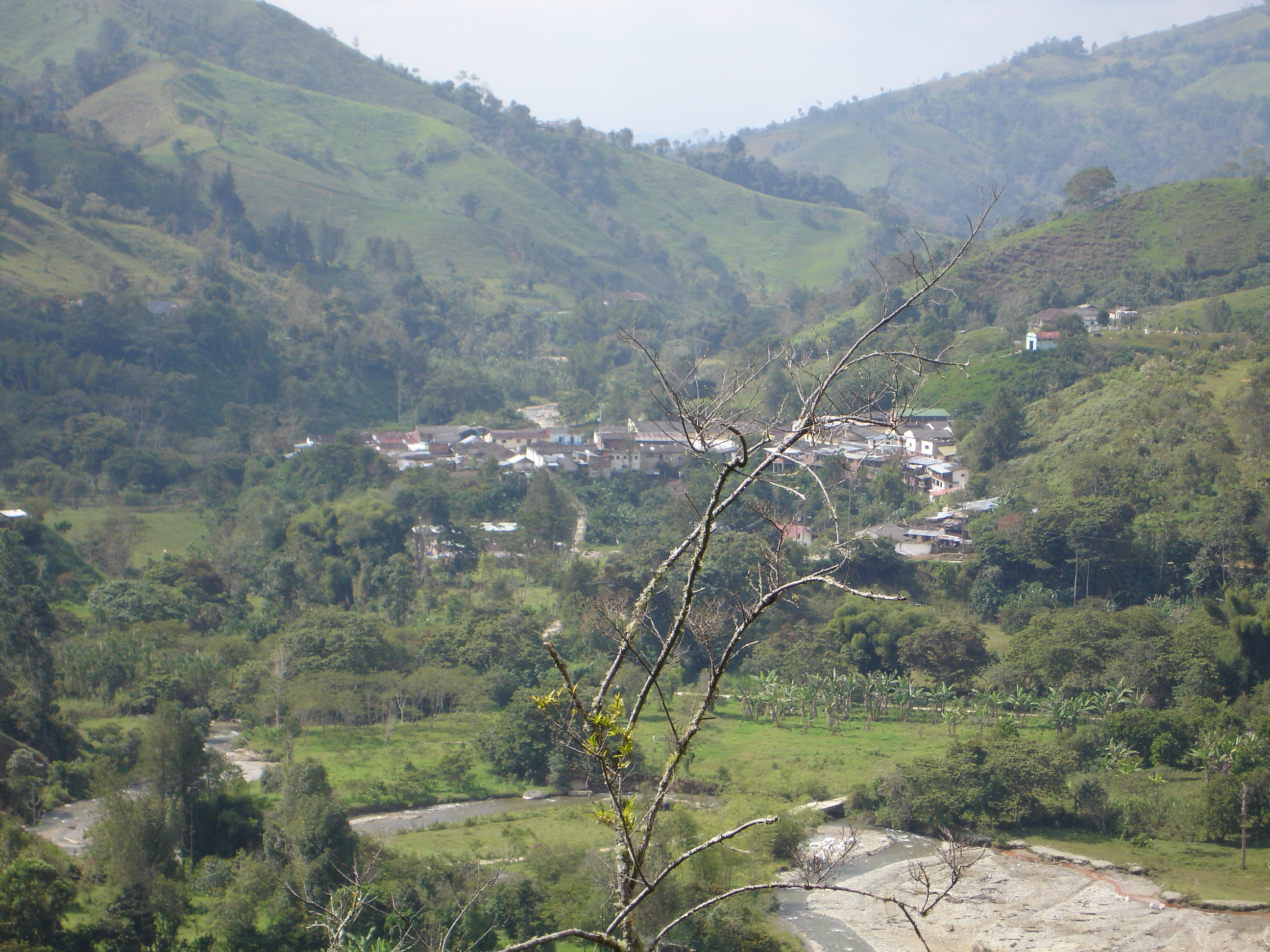
Santa Cruz de la Colina, Matanza, Colombia
Request for a master student interested in product development and marketing for an organic farm and macro-distillery in Wales



Glynhynod is an organic farm where artisan cheeses are produced, situated in west-Wales and managed by a Dutch family. The firm is highly innovative, applying sustainability guidelines to all their activities and producing food of high quality; several cheeses have received prices on national and international level. The family is now developing the first organic Welsh whisky and an orange liqueur at their newly established organic micro-distillery. They are looking for a master student- preferably one in food technology- who will be able to do an internship and/or thesis inWales. The student should be interested in organic, artisan food production. The student will be during his/her intership:.
- actively involved in developing, testing and trying out new liqueur and spirit recipes using organic ingredients and trial batches of different orange liqueurs using different ingredients and different amounts of ingredients. The student will be required to accurately measure the amounts of ingredients e.g. total weight, of oranges, orange peel amounts of sugar etc; ‘age’ the different liqueurs for 3 different periods e.g. 40, day, 50 day and 60 day infusions. The same method will be used to develop various recipes for spirits e.g. sloe gin and seaweed gin.
- Doing research on marketing aspects to try out the new recipes such as implementing a sensory evaluation in a real life situation where the public will be asked to judge the product. The student will be expected to develop a statistical sensory evaluation method that will determine which liqueur the public prefers and this liqueur will then proceed to bulk production.
His/her master thesis can be focused on of the following themes:
- Marketing and/or gastronomy: how to enhance the supply of local artisan products in this rural area;
- Consumer demands towards locally produced speciality products in west-Wales;
- Develop guidelines for food quality and taste of new alcoholic local products
- Research on food safety of organic artisan products
The student will start around the beginning of April 2012 and stay on the farm for 3-4 months in the beautiful setting of the Teifi Valley in Llandysul near Carmarthen, not far from the sea in west-Wales. The research will be supervised by a staff member of the relevant chair group and co-supervised by Ina Horlings (Rural Sociology Group). If you are interested please apply or ask for more information by sending a mail to (lummina.horlings@wur.nl) before the end of February, 2012.
Politics of place making in urban farming – an essay
By Anke de Vrieze
Last trimester, I had the opportunity to join the Capita Selecta course `A Global Sense of Place´, taught by Joost Jongerden and Dirk Roep. From my current working experience in the field of urban agriculture, the subject of the course – place-based approaches for sustainable development- interested me and proved valuable. In the course, different approaches to ‘place’ were discussed and related to culture, politics, economics and leadership. As we were a small group of students, we met in a weekly reading group, to discuss the literature and our written assignments.
Personally, I was most inspired by the work of Doreen Massey. Her perspective on place and space is a relational one, as she describes places as ‘temporary constellations’ or ‘bundles of space-time trajectories’. In one of her articles, she connects this relational perspective to ‘geographies of responsibility’ and shows how the ‘global’ is embedded locally as well. Taking the example of the City of London, i.e. it’s financial district, she argues against generalised understandings of the local as a product of the global, and demonstrates that indeed much of what we call ‘the global’ stems from local areas, such as the City of London. This leads her to plea for alternative globalisations, based on ‘a challenge of place’. I think, Massey’s perspective can prove meaningful for anyone studying ‘place’, whether it be in urban or rural settings.
For the final essay, ‘Growing community? Urban agriculture in the context of place-based urban development’ of the course, I discussed the ‘politics of place-making’ in a case of urban farming. By drawing on the example of an neighbourhood-based urban agriculture project, I showed how the different perspectives on place, as employed by various actors involved, creates a dynamic fields of interests regarding the ability of UA to address urban issues, and to achieve sustainable community development. Based on this short analysis, I argued for the need of a relational perspective on place, taking into account place-frames and positionality of actors, in (future) cases of neighbourhood-based urban farming.
Anke de Vrieze, anthropologist and project coordinator of FARMING THE CITY (www.farmingthecity.net), contact: ftc@citiesthemagazine.com
‘Agriculture in an Urbanizing Society’ Conference – new deadline for submission of abstracts
As mentioned in previous posts, an international conference entitled ‘Agriculture in an Urbanizing Society’ will be held from 1 to 4 April 2012 in Wageningen. A whole range of different topics and research findings will be presented and discussed in 20 different working groups. The deadline for submitting abstracts was originally 20 December 2011 but the conference committees, in consultation with the working group convenors, have decided to postpone this deadline by one month. So if you are interested to present and discuss your research activities (or plans) in one of the working groups, please send your abstract to the convenor of the working group before 20 January 2012. You are kindly requested to use the abstract submission form.

