Book Launch: Yearbook of Women’s History 36 (2016)

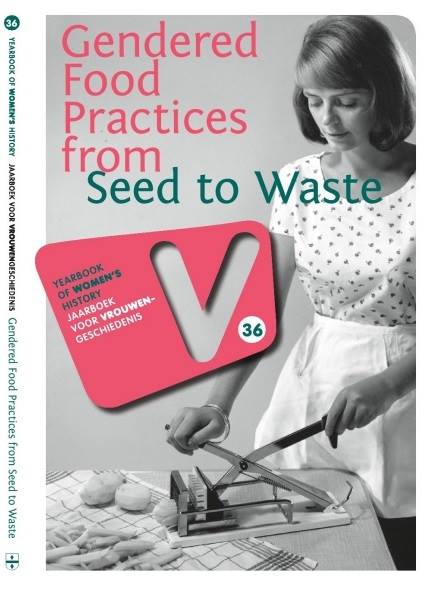
yearbook-cover

You are all welcome to the launch of Gendered Food Practices from Food to Waste

  •  Wednesday 22 February 2017 / 15.00-17.00 
  • Impulse / Wageningen Campus, Building 115,Wageningen University
  • Address: Stippeneng 2, Wageningen

Program

There will be coffee and tea upon arrival. Guest-editors Bettina Bock and Jessica Duncan (from RSO) will give a short presentation and hand over the first copy to professor J.M. van Winter, professor emerita of medieval history, expert in food history, and main benefactor of the Yearbook of Women’s History.

Curator of the National Museum of Education Jacques Dane will give a presentation of his contribution to the volume on Domestic Science in and outside the Dutch Classroom in the period 1880-1930.

Registration:  Please RSVP before 19 February to e.c.walhout ( a ) hum.leidenuniv.nl (Evelien Walhout).

About the volume

In nearly all societies gender has been, and continues to be, central in defining roles and responsibilities related to the production, manufacturing, provisioning, eating, and disposal of food. The 2016 Yearbook of Women’s History presents a collection of new contributions that look into the diversity of these gendered food-related practices to uncover new insights into the shifting relations of gender across food systems. Authors explore changing understandings and boundaries of food-related activities at the intersection of food and gender, across time and space. Look out for intriguing contributions that range from insights into the lives of market women in late medieval food trades in the Low Countries, the practices of activist women in the garbage movement of prewar Tokyo, the way grain storage technologies affect women in Zimbabwe, through to the impact of healthy eating blogs in the digital age.

Editors: Bettina Bock and Jessica Duncan (guest-editors), Eveline Buchheim, Saskia Bultman, Marjan Groot, Evelien Walhout and Ingrid de Zwarte


Food forests as an upcoming phenomenon in the Netherlands

Eva de Groot wrote an essay about food forests and how this phenomenon is gaining momentum in the Dutch agriculture. In this blog she shares some of her findings. Continue reading →

Boekpresentatie ‘Boeren in de Food Valley’

Voor het boek Boeren in de Food Valley sprak Janneke Blijdorp met vijftien agrariërs uit de Gelderse Vallei. Door schaalvergroting verdween de afgelopen decennia tachtig procent van de boerenbedrijven in dit gebied. De overgebleven boeren zetten in op de internationale voedselindustrie of juist op ambachtelijkheid en de lokale markt. De boeren vertellen in het boek over hun motivatie en toekomstverwachting. Vaak zijn zij al generaties lang met het gebied verbonden. Samen leveren de verhalen een verrassend divers beeld op van veerkrachtige ondernemers. Eric Veltink maakte fotoportretten van de boeren en hun bedrijf. U bent van harte welkom bij de presentatie van Boeren in de Food Valley op donderdagmiddag 24 November van 15.00 – 16.30 uur in De Schaapskooi op het erf van melkveehouder Cor den Hartog, Grote Veenderweg 10, 6741 MC Lunteren. Continue reading →

An impact assessment of potentially radical niche developments in the Dutch dairy sector – MSc-thesis Anne Verschoor

October 11 2016, Anne Verschoor successfully defended her MSc-thesis ‘An impact assessment of potentially radical niche developments in the Dutch dairy sector‘. She thus completed the Specialization Gastronomy of the Master Food Technology of Wageningen University. Applying a Social Science perspective in her thesis research was extra challenging but she managed very well to do so. Below an abstract of the thesis. Continue reading →

A light shining on Cluj – Nyeleni Europe Forum for Food Sovereignty

file2-1

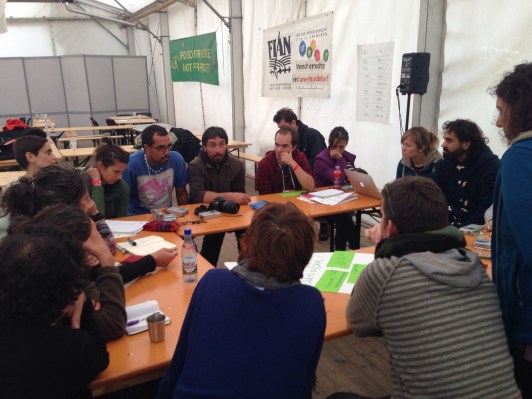
Participants discuss strategies to advance food sovereignty in Europe

Last week the second Nyeleni Europe forum for Food Sovereignty was held in Cluj-Napoca, Romania. The Forum brought together different delegations from European countries and beyond representing producers, consumers, NGOs and researchers involved in the Food Sovereignty movement. The Forum set out create new initiatives and ties among people in opposition to the dominant food paradigm. Continue reading →