Food and urban planning

MorgenTomorrowLast week the municipality of Amsterdam, together with the Netherlands Institute for Planning & Housing and the Ministry of  Housing, Spatial Planning & the Environment, organized and hosted the International Urban Planning Conference entitled MorgenTomorrow. The two-day conference was a combination of plenary sessions in the morning and parallel workshops in the afternoon. I had the honour and pleasure of convening a workshop entitled ‘Food and the City’. Although the food system is, as Pothukuchi and Kaufman (2000) rightfully state in their article in the Journal of the American Planning Association, a stranger to the field of urban planning it was good to see that the conference organizers had put food very prominently on the conference agenda. Not only by means of the workshop I convened but also by means of keynote lectures in the plenary sessions by LaDonna Redmond and Tim Lang. Both are extremely critical about the prevailing food system.

LaDonna is a community activist as well as founder and CEO the Institute for Community Resource Development (ICRD) in Chicago (Illinois). The ICRD’s mission is to rebuild the local food system by building grocery stores that bring access to sustainable products to urban communities of color, organizing farmers markets, converting vacant lots to urban farm sites and distributing local grown produce to restaurants. I was unable to attend LaDonna Redmond’s keynote, but she participated in my workshop and reflected on the different presentations.

Tim is Professor of Food Policy at the Centre for Food Policy of City University London. He has authored and co-authored many articles and books about food policy, especially focussing on the relation between food, health, social justice and the environment. His current work is about ‘omni-standards for sustainable diets’. I attended his keynote lecture and what I very much appreciated about his vision is that, despite the food system being a major contributor to climate change, devising sustainable food systems is not simply a matter of creating ‘climate neutral’ food systems. It will only be truely sustainable if it is able to meet a whole range of sustainability standards (a set of omni-standards as he calls them) in which social and health aspects are as important as economic and environmental ones. What struck me most in his presentation, and which will undoubtedly become the new issue in food debates, is the water footprint of the conventional food system.
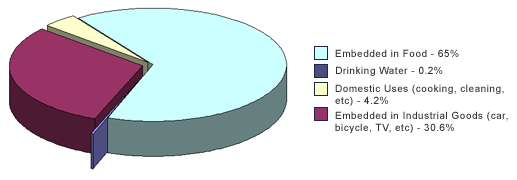
Around 65% of all fresh water is used for food production and with growing water scarcity and an increase in water-stressed countries, water use is likely to become the main threat for food production. The table below, of which Tim displayed a part in his presentation, is rather shocking. It shows how much water is needed to produce one portion of a whole range of mainly food products and drinks. It surely makes one (at least is does make me) aware of the urgent need for change.

Portion Litres Portion Litres Portion Litres
Pint of beer, 568ml 170 Cup of coffee, 125ml 140 Glass of orange juice, 200ml 170
Glass of milk, 200ml 200 Cup of instant coffee, 125ml 80 Glass of apple juice, 200ml 190
Cup of tea, 250ml 35 Glass of wine, 125ml 120 Orange, 100g 50
Slice of bread, 30g 135 Bread with cheese, 30g + 10g 90 Bag of potato crisps, 200g 185
Egg, 40g 135 Tomato, 70g 13 Hamburger, 150g 2400
Potato, 100g 25 Apple, 100g 70 Bovine leather shoes 8000
Sheet of A4, 80 g/m² 10 Cotton tee-shirt, medium 500g 4100 Microchip, 2g 32
Source: http://www.igd.com/index.asp?id=1&fid=1&sid=5&tid=48&cid=326

Sustainable food planning conference

AESOP logoOn 9 and 10 October 2009 the first Sustainable Food Planning Conference will be held. This conference is an initiative of the AESOP (Association of European Schools of Planning), the ISOMUL (International Studygroup On Multiple Use of Land) and the Rural Sociology Group of Wageningen University.

The sustainable food planning conference is organized to examine the role of food in urban and regional planning. Although political, societal and academic interests in food and the city are rapidly increasing, food largely remains a stranger to the field of urban and regional planning, spatial planning policies and planning studies. Recently the American Planning Association launched its Policy Guide on Community and Regional Food Planning. Inspired by this policy guide, this conference seeks to explore ways in which food can and should be incorporated in planning practices, policies and research and develop strategies for enhancing sustainable food planning in Europe. The character of the conference is primarily agenda-setting by establishing a network of planning practitioners, policymakers and agrifood and planning scholars in Europe and beyond.

.

Restaurant and meeting centre De Kemphaan (source: http://www.restaurantdekemphaan.nl/content/ons_bedrijf)

Restaurant and meeting centre De Kemphaan (source: http://www.restaurantdekemphaan.nl/content/ons_bedrijf)

The conference will take place at De Kemphaan in the city of Almere in the Netherlands. If you are interested to participate in this conference, please apply by e-mail to corine.diepeveen@wur.nl. Costs for participation are € 100,- (incl. drinks, lunches and diner). The number of participants is limited to 50 persons. For more information have a look at the conference programme below:


Day 1 – Generating ideas, exchanging experiences and comparing perspectives

09.00 – 09.30

Welcome and coffee/tea

09.30 – 09.45 Food and planning: an introduction to the conference Prof. Kevin Morgan (Professor of Governance & Development, Cardiff University, UK)
09.45 – 10.00 Including food and agriculture in urban planning: the Almere approach Mr. Henk Mulder (Almere municipality – director urban development and planning) 
10.00 – 10.30 An integrated and territorial perspective on food studies, policy and planning Prof. Han Wiskerke (Chair of Rural Sociology – Wageningen University, NL)
10.30 – 11.00

Coffee/tea break

11.00 – 12.00

Session 1: Agri-food policy issues

11.00 – 11.30 Food and agriculture in Europe’s peri-urban regions Mrs. Dwarshuis (President of Peri-Urban Regions Platform Europe – PURPLE)
11.30 – 12.00 Feeding the city: practices, challenges and lessons from developing countries Mr. Henk de Zeeuw (director RUAF foundation)
12.00 – 13.00

Session 2: Urban food planning practices

12.00 – 12.20 The practice of food planning in New York City Dr. Nevin Cohen (Associate Professor in Urban Studies at the New School for Liberal Arts, New York
12.20 – 12.40 The practice of food planning in New York State Mr. Bob Lewis (Senior Planner New York State)
12.40 – 13.00 Amsterdam’s food strategy (“Proeftuin Amsterdam) Mr. Bart Pijnenburg(Programme manager Proeftuin Amsterdam)
13.00 – 14.00

Lunch break

14.00 – 15.30

Session 3: Theoretical perspectives and academic issues

14.00 – 14.30 Reconnecting consumers and producers:  dynamics, diversity and potentials of alternative food networks Prof. Gianluca Brunori (Professor of Agriculture Economics – Pisa University, Italy)
14.30 – 15.00 Urban Food and Public Spaces: Planning for Security and Sustainability Dr. Roberta Sonnino (Lecturer in Environmental Planning – Cardiff University, UK)
15.00 – 15.30 Food and the city: the links between food, public health and sustainable urban development Dr. Martin Caraher (Reader in Food & Health Policies, City University London, UK)
15.30 – 16.00

Coffee/tea break

16.00 – 18.00 Excursion to City Farm Almere Tineke van den Berg (urban farmer)
19.30 – 22.30

Drinks & Diner

Day 2 – Towards an agenda for sustainable food planning

09.00 – 09.30

Welcome and coffee/tea

09.30 – 10.00 Including food in planning studies and planning practices: experiences from the USA Prof. Jerry Kaufman (Professor Emeritus of Urban and Regional Planning – University of Wisconsin-Madison, USA)
10.00 – 10.45 Issues, topics, themes for a sustainable food planning agenda (plenary inventory) Moderated by Prof. Arnold van der Valk (Professor of Land Use Planning – Wageningen University, The Netherlands)
10.45 – 11.15

Coffee/tea break

11.15 – 12.45 Developing the building blocks for a sustainable food planning agenda (parallel working sessions)
12.45 – 14.00

Lunch break

14.00 – 14.45 Plenary presentation of and discussion about results of parallel working sessions Moderated by Prof. Terry Marsden (Professor of Environmental Policy – Cardiff University, UK)
14.45 – 15.00 Sustainable food planning in Europe: concluding reflection and look ahead Prof. Kevin Morgan (Professor of Governance & Development, Cardiff University, UK)
15.00

Coffee & tea / end of conference

Herinnering Discussiebijeenkomst Buitenlandse Ervaringen Multifunctionele Landbouw

Op donderdag 8 oktober 2009 organiseert de vakgroep Rurale Sociologie van Wageningen Universiteit een interessante discussiebijeenkomst over buitenlandse ervaringen van multifunctionele landbouw. Wat gebeurt er in het buitenland en wat kunnen we ervan leren?

Op de bijeenkomst geven een aantal toonaangevende internationale onderzoekers u een indruk van de ontwikkeling rond multifunctionele landbouw in Italië, het Verenigd Koninkrijk en Noorwegen. In de aansluitende forumdiscussie gaan we hierover met elkaar in debat. We verwachten ongeveer 80 tot 100 mensen uit o.a. praktijk, wetenschap, overheid en belangenbehartiging.

De bijeenkomst is interessant voor iedereen actief op het gebied van multifunctionele landbouw en meer wil weten over de betekenis van buitenlandse ervaringen voor Nederland. Als u graag over (uw) grenzen heen kijkt, dan mag u deze bijeenkomst niet missen!


Datum: Donderdag 8 oktober 2009
Tijd: 13.00 – 17.00 uur
Locatie: Landgoed Heerlijkheid Mariënwaerdt, De Hooge Schuur, ‘t Klooster 5 in Beesd


Aan deelname van deze bijeenkomst zijn geen kosten verbonden, de voertaal is Engels.


Programma

12.30 Ontvangst (koffie/thee)

13.00 Opening door dagvoorzitter

Krijn Poppe – Chief Science Officer Agroketens en Visserij, ministerie van LNV

13.05 Welkomstwoord

Frans van Verschuer – eigenaar Landgoed Heerlijkheid Mariënwaerdt, Beesd

13.15 Dynamiek en robuustheid multifunctionele landbouw – introductie onderzoeksproject en presentatie eerste resultaten

Han Wiskerke – projectcoördinator en hoogleraar Rurale Sociologie, Wageningen Universiteit

13.30 Multifunctionele landbouw in Italië – de ‘rural disctrict approach’ in Toscane

Gianluca Brunori – hoogleraar Agrarische Economie, Universiteit van Pisa, Italië

14.00 Multifunctionele landbouw in het Verenigd Koninkrijk – de rol van de staat en de publieke sector

Roberta Sonnino – universitair docent Milieubeleid, Universiteit van Cardiff, Verenigd Koninkrijk

14.30 Multifunctionele landbouw in Noorwegen – een presentatie door:

Katrina Rønningen – senior onderzoeker, Centrum voor Plattelandsonderzoek, Universiteit van Trondheim, Noorwegen (uitgenodigd)

15.00 Pauze

15.30 Dynamiek van plattelandsontwikkeling en landbouw wereldwijd – een vergelijking tussen Europa, China en Brazilië

Jan Douwe van der Ploeg – hoogleraar Transitiestudies, Wageningen Universiteit

16.00 Forumdiscussie – inspirerende lessen voor multifunctionele landbouw in Nederland

16.55 Afsluiting door dagvoorzitter

17.00 Borrel


Aanmelden

Meld u aan met het aanmeldformulier. Wij willen u er op wijzen dat er een beperkt aantal deelnameplaatsen beschikbaar zijn. Voor aanvullende informatie neem contact op met Corine Diepeveen via corine.diepeveen@wur.nl of 0317 – 484507.

De discussiemiddag wordt georganiseerd in het kader van het onlangs gestarte onderzoeksproject ‘Dynamiek en Robuustheid van Multifunctionele Landbouw’. Het onderzoek is ondersteunend aan de Taskforce Multifunctionele Landbouw en wordt gefinancierd door het ministerie van LNV.

Jan Schakel in China – part two

The IMRD-students, who are visiting China to do their case study, just finished their fieldwork in the Bamudi-village in the Yanqing County, North of Beijing. After three weeks of lectures, fieldtrips and surveys, they now will write the final report in the last week of their stay in China. The report will cover the findings from interviews, visits and meeting with farmers, village leaders, shop keepers and other households in the Bamudi-village (Beijing) and Quaoli village (Nanjing).

Part of the methodology of the PRA (Participatory Rapid Appraisal) is to provide a ‘Community Development Program’ and to present and discuss this plan with local inhabitants in the Village Hall to have feedback from the farmers and others involved. It will be a thrilling event, because the situation is rather complex; also in this area, not too far from Beijing.

Industrialization in China started before urbanization (heavy industry in the sixties in the middle and Northeast of China), but in recent decades urbanization is really skyrocketing: from 10% in 1949 and still only 18% in 1979 to almost up to 50% in 2007! Actually, just some month ago, there were –for the first time in their long history- more people living in the cities then in the rural areas! Although the number of ‘the poor’ (which was for a long time synonymous with ‘the rural’) decreased from 250 million in 1978 to less then 15 million in 2007, the rural area still faces tremendous problems. The unique rural-urban migration in China (young labour left to the cities) resulted in disorganization of rural communities and the erosion or even loss of cultural identity, values and the ability of collective action, as well as issues of elites that are leaving, while vulnerable groups are ‘left-behind’.

Box 1: ‘Poor, so rural….’

One of the farmers we visited (see picture) lives in a remote area, just outside Bamudi-village. The farmer is suffering high blood pressure for many years, and his wife (both in their sixties) is illiterate. They own their house (built in 1962) and rent 3,5 mu of land (0,2 ha.), growing mostly corn, fruit and some vegetables. Last year they earned 2000 Yan (200 Euro) by selling apricot to the market, but this year there is hardly any harvest at all, due to the chilly spring. Opposite to other rural families, they don’t have remittances from family members who work in the city (migrant workers), so the family income is only 5000-6000 Yan (or RMB) a year (around 550 Euro), which is really low, even to Chinese standards. As part of  the new pro-farming-policies, the household will have some extra income, like social security and minimum living standard subsidies, compensation for environmental protection schemes, alleviation of agri-tax and subsidies for certain products (mainly grain). The liveability of the community and the households will also be improved by measures of the New Countryside Construction Program; see box 2).

Village farmer

The situation in Bamudi-village is really complex, because a new phenomena – besides the traditional rural-urban-migration processes- is occurring in the region: the urban-rural-migration, which expresses the rediscovery of the rural area by the urban, and a new relation between the city and the countryside. During all the interviews in the village, it became clear that neither the central, nor the provincial government, and neither the county or the village leaders knew how to handle this new phenomena. There are no rules, nor policies and regulations, and the traditional land tenure system doesn’t fit to tackle this new migration process. One of the conclusions, drawn by the students after doing their surveys, is that there is hardly any future in this part of China, if they follow the traditional route or path of development. The growing conditions in this mountainous area very bad, and together with the lack of skilled labour and motivated young people, it rural life is very hard and it will imply the end of agriculture around the municipality of Beijing. Only mostly elderly people will stay in the village, while the rest of the family moves out to the cities. But due to polices (among others) from the NCCP (see box 2), like reafforistication and environmental protection, there might be new sources of income be created. That Bamudi village will be Beijing’s  ‘back garden’ in the near future, implies definitely the final end of a long agricultural tradition, but it will also give the area the opportunity to (re-)develop again in a more modern and more successful way.

We are looking forward to listen and learn what the local villagers will think about the analyses the students have made and the findings that will be presented and discussed tonight; we’re all looking forward to their comments and opinions. And hope that indeed it will be a thrilling night!

Box 2: New Countryside Construction Program (NCCP)

In 2006 the Chinese government launched a new plan to restore the balance and the inequity between the rural and the urban. Part of it will be the NCCP. Background of the NCCP is the rapid industrialization and urbanization, which widened the gap between urban and rural, and forced the state to support farmers and pay more attention to resource and environmental protection. Part of it will be an urbanization strategy: no allowing for most farmers to go to towns, but stay in the villages. To improve the living conditions in these villages, several measures were undertaken, like: promoting agriculture production, e.g. agricultural industrialization infrastructural development like roads, drinking water, street lights employing farmers tot protect non-governmental forests, waters, roads and environment providing public goods: medical, rural education, energy, communication and so on increasing farmers income by subsidies, human resource development, providing help to the poor (among others).

Jan Schakel, Bamudi-Village

Suburban Ag

Land use planning and housing development can bring farming and food production closer to (sub)urban citizens. Similar to trends in the Netherlands, suburban agriculture is taking form in new developments projects. There are two pathways. First, development organised by citizens in co-housing projects such as the Ecovillage in Ithaca. Co-housing projects often involve the creation of an ‘intentional community’ of people who have chosen to live and work together in a lifestyle that reflects their shared core values. Projects often include a community owned and operated farm.

Intentional communities rebel against two dominant American features; individualism and property rights/ownership. Both features are reflected in the overall perspective on land use planning and housing development here. In order to understand it, Dutch assumptions on land use planning need to be left behind.  In most places, state and county legislators refrain from ‘interfering’ with land ownership. Without zoning or specific designations, any land, no matter how far from an urban centre, represents a bundle of rights. For example water rights (see blog), and more importantly ‘development rights’. Development takes place where developer and landowner agree. Around cities, this causes a large ring of ‘urban sprawl’; fragmentation of land and a random patchwork of malls, offices, agricultural land, housing and roads without any visible coherence. Although farmers, who farm in the middle of this, oppose to the developments, they oppose to land use planning at the same time; nobody wants to give up their right to sell their rights.

A second type of suburban agriculture, therefore, is often led by private or public land trusts.  This means that land use planning is applied on the coherent whole of land owned by the trust on a certain location. Some parts are developed for housing, other parts for farming and other parts for nature conservation. A good example of this is Prairie Crossings, set up in 1987 by a group of citizens. This can only take place if development rights are taken off the land even though it is not used for building (‘easement’) to prevent future unwanted development. Rights are taken off by conservation easements in two ways; by being sold or being donated to the trust (the latter for receiving advantagous tax breaks). Whereas until 10 years ago, easements were only for nature conservation, nowadays there are agricultural easements possible too now environmentally sustainable farming is becoming a practice.

It is remarkable how absent the state is in land use planning. Planning in the Netherlands, such as Reconstruction Law land use planning, including the movement of entire farms for preserving natural habitats, equals to an unthinkable intrusion of property rights here.