
Acknowledgement of the enormity of the many socio-environmental, agricultural, food, health and related ‘planetary emergencies’ confronting us today has provoked a growing chorus of calls for urgent action. In the face of such urgency, it seems that there is less and less (obvious) time for pause and reflection. Moreover, both from within and directed at the social sciences, there are many who argue that it is time to dispense with or move beyond critique. From Latour’s 2004 question ‘has critique run out of steam?’ to more recent commentary, it may seem that the value of critique and critical thinking is no longer obvious, even in many social sciences. Instead, we are told, we must focus our attention on identifying and formulating constructive alternatives and/or solutions to the planetary emergencies currently haunting us.
Author Archives: Han Wiskerke

Call for papers for special issue on ‘City region foodscapes’
This is a call for papers for a special issue about ‘City region foodscapes’ of the open access journal Sustainability – Section Sustainable Urban and Rural Development.
There is increasing broad recognition that food is an integral part of the urban agenda. Cities in different parts of the world are developing policy and programme initiatives related to urban food provisioning. The 2007-2008 food price hikes, and climate-induced disruptions to food supply, have triggered a call for more resilient urban food systems. In addition, alarming increases in diet-related ill-health require cities to ensure access to sufficient, affordable, healthy and safe food to their population. Continue reading
Vacancy for a Lecturer and Education Coordinator Sociology and Anthropology of Development
The section Sociology and Anthropology of Development (SADE) – composed of the Sociology of Development and Change (SDC) and Rural Sociology (RSO) Groups – is looking for a highly motivated person to teach (and coordinate) courses, to supervise BSc and MSc and internships and to plan and coordinate educational activities within SADE, with a view to promote high-quality educational processes. In terms of time allocation it will be a 50/50 division between lecturer and education coordinator.
As lecturer you will co-develop and teach courses in the Bachelor and Master programme in International Development Studies. These courses focus on the sociology of agrarian and rural development, food sociology and sociology of development . The lecturer will give lectures to smaller as well as bigger audiences, lead discussion lectures, and tutor group work. The lecturer should be able to teach in both English and Dutch. Furthermore the lecturer will supervise BSc and MSc thesis students and internship students, which may also include students from other programmes than International Development Studies.
The role of coordinator is a diverse one, in between operational and strategic levels. The preferred candidate will be able to quickly switch between working with the secretariat on executing a range of practical tasks and with the education managers and chairs of SADE as well as broader Wageningen University bodies such as the Educational Institute (OWI) and the programme committees to provide input on strategic and policy levels. A sense of the importance of the smooth functioning of educational processes is expected as well as the ability to set up communication activities (information, public relations, marketing) around educational and other SADE activities. More specifically, the role of education coordinator includes the following main tasks: Continue reading
Dealing with private property for public purposes. An interdisciplinary study of land transactions from a micro-scale perspective – PhD thesis by Sanne Holtslag-Broekhof
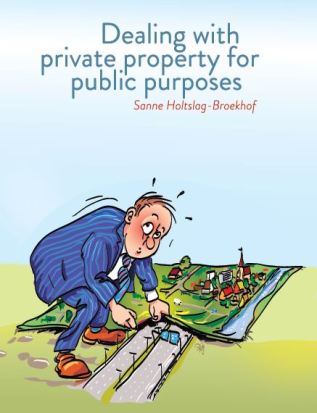 On Monday 6 June 2016 Sanne Holtslag-Broekhof will defend her PhD thesis entitled “Dealing with private property for public purposes. An interdisciplinary study of land transactions from a micro-scale perspective” at 13.30 hrs in the Auditorium of Wageningen University.
The defence ceremony will be streamed live by WURTV but can be viewed later as well. The thesis will be available at WUR-Library after the ceremony has been concluded.
Sanne’s PhD thesis focusses on land transactions between governments and private landowners. During these publicly initiated land transactions, central aspects for landowners are ‘a good solution’ and ‘a feeling of justice’. Ideas on just land acquisition are diverse amongst owners and acquirers, but were related to lawfullness, decentness and equality. During land transactions landowners experience many uncertianties. Landowners deal with these uncertainties by creating expectations and act based on these expectations. The risk to end without replacing land, stops many owners from going to court for expropriation. Yet, a comparison between the last compensation offer during the voluntary negotiations and the final compensation in court shows that the final compensation ends on average 52% higher than the last compensation offer.
Since the economic crisis public parties aim for more facilitative land policy, but have often little experience to cooperate with private landowners. The insights of this research can help public parties to deal more effective and lawful with private property during spatial developments.
Participants needed for online survey about sustainable urban and peri-urban food provision!
SUPURBFOOD is an international research project carried out by a consortium of ten research and ten SME (small and medium-sized enterprises) partners, in which novel solutions to urban and peri-urban food provision have been examined in three thematic areas. These thematic areas are: (i) nutrient, water and waste cycles, (ii) short food supply chains, and (iii) multi-functional land use. While positive developments are found in all of these, additional steps are needed to make full use of the potential of these innovations. Hence, the project team formulated a set of recommendations and would like to ask relevant stakeholders (e.g. policymakers, entrepreneurs, civil society organisations) for their opinion about their effectiveness. For that purpose an online survey has been launched, which takes 10-15 minutes to complete. If you considers yourself to be a relevant stakeholder, you are kindly requested to complete the online questionnaire, which is available in seven languages: English, Dutch, German, Italian, Latvian, French and Galician.
 Rural Sociology Wageningen University